At a time when many analysts and experts are advising clients and investors to increase ‘market exposure’ and take more risks I advise you to do the exact opposite.
Now is the time to step out of risky investments and look to minimize portfolio volatility.
.
Here’s how you can sum up the true state of the world economy
= Uncertain & Unstable & Volatile.
.
Here’s my 2010 check list
.
Hope springs eternal: Now that equities have staged massive rallies off their panic lows in March 2009, the performance chasing analysts continue to push more ‘buy’ recommendations to investors, even when the current risk reward ratio is clearly not in their favour.
.
Government Support: has enabled the world economy to survive a deflationary spiral that would have triggered another great depression…….or so they tell us. What we now have instead, is a global economy that is addicted to government stimulus packages, bailout packages and ever increasing government debt levels and deficits.
How costly will continuing stimulus packages be for emerging markets in 2010, as export driven Asian economies struggle with slowing consumption in the developed world?
.
Stimulus Packages: continue to strain government finances. The fragile global economic recovery is now becoming dependent on these stimulus packages that are artificially preponing demand and artificially propping up consumption. This is leading to a misallocation of resources and resulting in rising commodity prices and a buildup of excess manufacturing capacity.
.
Fed exit strategy: I do not think that the FED will be increasing rates anytime soon.
Firstly, the appetite for US Treasury Bonds remains strong. Why raise rates if the market doesn’t force you to!
Secondly, given the large amount of debt issuance lined up for 2010, why would the Fed raise rates now?
Lastly, can the Fed and the Treasury stop supporting the US mortgage market now?
As a student of the Great Depression, Bernanke knows that any further fall in home prices would deal a lethal blow to the 'nascent recovery'. So expect Freddie Mac and Fannie Mae to get unlimited amounts of support.
Stemming foreclosures and reducing the inventory of unsold homes is key to building confidence levels of the US consumer.
.
Banking: The only sector that is growing profitably again! But wait…......weren’t these guys the largest beneficiaries of the bailouts in 2008-09!
Then they rushed to reapy TARP money, so that they could start issuing bonuses again!
As for sound lending or sound accounting practices or sound banking practices, don’t expect anything to change anytime soon.
.
Employment and Capital Investment: These are two factors that have failed to recover and support this ongoing recovery and bullish sentiment. Continuing uncertainty and a total lack of confidence has resulted in businesses postponing fresh hiring and many capex plans have been shelved for now.
As for government statistics; well you must take them with a pinch of salt. Unemployment statistics, conveniently exclude individuals from the labour force, because they ‘may not be actively searching for a job’. These are people who are actually struggling to find a job in a terrible job market……..and yes they are UNEMPLOYED!
.
Expert Views:
David Rosenberg – says we are witnessing a secular shift in consumer behaviour and spending patterns in the US. According to him, ‘frugality’ is here to stay. This will ensure that the deleveraging of US consumer debt will continue unabated, despite the reflation efforts of the FED & US Treasury!
Continued inflows to fixed income investments and continued outflows by retail investors from US equity funds are also signs of a changing investor mentality.
He also labels the government’s efforts to pre pone consumption via the cash for clunkers plan and housing tax credits as ‘’bribes’’ to force consumers to start spending again.
He advises investors to take a more cautious view and favours a conservative income generation investment policy to minimize portfolio volatility and risk.
Government stimulus and inventory restocking have been key drivers of growth in the US economy and David Rosenberg believes that earnings estimates for FY 2010-11 are far too optimistic!
.
Ruchir Sharma (head of emerging markets at Morgan Stanley Investment Management) – says that ‘we are all entitled to our own opinions, but not to our own facts’, and advises investors to be wary of the herd. The world economy suffers from excess leverage in the financial system, excess manufacturing capacity and excess leverage on consumer balance sheets. ‘A growth relapse is the true contrarian view to engage in 2010.’ Risks include disappointing announcements from China or a double dip in the US! He says the most money is indeed made or saved by staying away from the herd.
.
Chris Laird: the editor of The Prudent Squirrel Newsletter is also cautious. He advises everyone to avoid being swept away by the information overload in the financial media, and avoid fresh risk taking. His track record over the past few years has been impressive!
.
US Recovery: The current rebound will go down as the weakest recovery on record going by the Recovery to loss ratio = Gain in the first year or recovery in real GDP / peak to trough loss during the recession. Q4 GDP will be boosted by inventory restocking and a low year on year base effect. How will the economy cope when government support is withdrawn…..if it can be withdrawn?
.
US domestic finances and the November 2010 elections – A number of US states continue to struggle with falling government revenues and ever increasing expenses. California is a prime example.
The world’s 8th largest economy has suffered a massive real estate collapse, record debt levels and is in need of a bailout from Washington.
Thing is, they are not the only guys queuing up! And with elections coming up later this year, can these states resort to cutting government spending?
Politicians are the same everywhere – expect election politics to kick in soon enough.
.
Government Debt: A friend of mine recently asked me if there is actually some limit on the amount of debt that a government can issue before it becomes excessive, bringing the whole system down?
Here are two quotes that answer the question:
“There is no means of avoiding the final collapse of a boom brought about by credit expansion. The alternative is only whether the crisis should come sooner as the result of voluntary abandonment of further credit expansion, or later as the final and total catastrophe of the currency system involved.”
- Ludwig von Mises, Human Action (1949).
“You have only to find a way to multiply your creditors by the cube and pay them by the square, out of their own money. The fatal weakness of the scheme is that you cannot stop. When new creditors fail to present themselves faster than the old creditors demand to be paid off, the bubble bursts.”
--Garet Garrett
Dubai, Greece, Ireland and Spain are already under severe strain as they struggle to get back on their feet. The ‘world reserve currency’ country -the U.S.A. continues to add on to its debt, as investors continue to lap up US Treasury bond issues.
No one knows what the limit is or when we will get to it – but all these governments are pushing their luck!
.
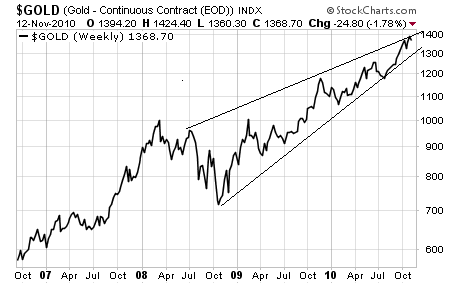
GOLD: An environment of uncertainty, instability & volatility created a perfect storm for Gold in 2009. These are bigger drivers for gold than the ‘inflation’ argument as of now.
While I think that the massive wealth destruction of the last few years will delay an eventual return of inflation, massive government intervention has created a ‘feel good…back to normal’ environment once again.
.
Question is – what normal are we talking about?
Expanding consumer leverage & consumption, permanently rising house prices and exploding mortgage derivative markets were never ‘normal’
Falling personal income, increased working hours with less pay, and continued weakness in the US real estate market are the new reality.
Gold prices have now stabilized in the $1080 - $1150 range. The year end USD rally has stalled for now. I will wait for a buying opportunity in gold, which appears likely in the event of a stock market crash, which would trigger a flight back to the USD!
.
Strategy for 2010
A genuine recovery vs. a recovery on life support – Understanding this difference is key!
Continue to book profits in equities as the current margin of safety is just not adequate.
Beware of sectors that have been the biggest beneficiaries of stimulus packages, example the auto sector.
Hold on to positions in Gold, and wait for a buying opportunity. Don’t forget that Gold was the top performing asset class of the last decade!
.
The US Dollar: I’m a long term dollar bear. In 2010, I expect to see a pullback in the USD when the equity markets correct. There are far too many USD bears out there and one can expect the usual flight to USD safety when markets correct. A rebound in the USD would also enable US Treasury Bond issues to sail through smoothly.
.
Complacency and overconfidence will be key factors that punish the unprepared investor this year. The VIX (Volatility index) is at record lows. Expect volatility to make a comeback soon, once investors realise that we aren’t out of the woods as yet!
.
The Eurozone – will face quite an eventful 2010. Weaker economies like Greece, Ireland, Spain, and yes even the UK are struggling to reduce deficits and support their local economies. Stronger economies like Germany will be forced to lead bailouts or support packages for their weaker neighbours if things take a turn for the worse.
The EURO could have a volatile time in 2010 if sparring members refuse or delay support packages for weaker members.
.
Commercial Real Estate: will continue to haunt banks that are overexposed to the sector. Office Rents continue to decline, and rising vacancies will continue to stress out balance sheets of companies in the sector.
US Home Prices: I still believe that we will see lower prices next year. The resetting of Adjustable Rate Mortgages ( more on this in subsequent posts) and more foreclosures in 2010 will delay any recovery in this sector.
.
Emerging Markets (including Indian Equities): The ‘decoupling’ theory is resurrected again, after the correlations were crushed in the crash of 2008 -09.
Export driven economies in Asia are still dependent on customers in the western world. Their stock markets are still dependent on foreign institutional investors (FIIs). These are the same guys who stormed out in panic during the crash in the first quarter of 2009.
Conclusion: It’s time to book profits or at least take some chips off the table.
.
Indian Equities have risen along with other emerging markets. Valuations leave no room for error. Capital Investment has started to increase gradually, but companies are still cautious on the sustainability of the current recovery. Sectors like FMCG and Autos are at lifetime highs. Lock in some profits now!
.
On the buy side, one sector that I’m looking into is the Telecom Industry. Valuations have been slashed after the price war of 2009. Uncertainty over the upcoming 3G rollout, continuing capital expenditure and shrinking margins has frightened investors. As a disclosure, I must say that I have recently become a shareholder of Bharti Airtel. Of the listed telecom companies, Bharti Airtel has the best balance sheet and the first mover advantage! For anyone thinking of buying in right now, I must warn you that the stock is a high risk high return proposition. We will undoubtedly see at least a year of very poor profitability until the price war stabilizes. We are heading towards a forced consolidation so it’s going to get tough.
All in all, I think Bharti Airtel is the best company if an investor must take any exposure to the Telecom space in India.
.
To conclude, I think that investors should look for sustainability over returns in 2010.
Gold bugs should be patient and wait for a pull back before buying in agin.
Don’t get caught unawares by a massive equity market selloff when it comes along!
Know your investment risk profile, and the volatility that you are able to cope with.
As David Rosenberg says, look to minimize portfolio volatility.
No one knows when the market will finally turn. Just like 2007-08 it will do so without any warning. The global economy faces strong headwinds in 2010, so be prepared for volatile times, even though the VIX is currently sinking to new lows.
It’s not a time to be buying now. It is a time to sell and book profits.




+Emerging+Markets+Index+CHART.PNG)

