Showing posts with label INDIAN BUDGET. Show all posts

Monday, August 27, 2012

INDIA'S NET FINANCIAL SAVINGS RATE CONTINUES TO TREND DOWNWARDS

As the Indian consumer consumption boom continues, a combination of moderating growth rates, high inflation and low real rates on investments is taking a toll on India's Net Financial Savings rate. 


""According to preliminary estimates released by the Reserve Bank of India (RBI), net financial savings moderated to 7.8% of GDP in F2012 from 9.3% of GDP in F2011 and 12.2% of GDP in F2010.
Net Financial savings comprises cash investments, deposits with banks and non bank companies, investments in shares, debentures, mutual funds, small savings and also life insurance, provident and pension fund


RBI attributed the decline in net financial savings to persistently high inflation, leading to low real rates on bank deposits and small savings funds, coupled with uncertain global environment adversely impacting equity market returns, leading households to favour investments in valuables such as gold. In addition to these factors, we believe slower urban job creation and income growth would also have affected the rate of household savings."""

LINKS:

Friday, August 17, 2012

INDIA: OIL MARKETING COMPANIES IN DIRE STRAITS

A weak Indian Rupee, unyielding Crude Oil prices and an unsustainable petroleum subsidy policy by the Indian Government have resulted in Indian Oil Corporation ( IOC) reporting a massive loss of Rs. 22,451 crore for the quarter ended 30th June 2012.


India will have to urgently address its petroleum subsidy policy. The Oil Marketing Companies (HPCL, BPCL, IOCL), Upstream Oil Companies (ONGC, GAIL) and the Indian Government cannot continue to subsidise petroleum products consumed by the Indian public at this rate.

Despite the Oil Sector being a major source of revenue for the government via numerous duties levied at the state and central govenment level; massive subsidies have resulted in heavy borrowings for Oil marketing companies.

The article below highlights the ongoing crisis in the case of IOC, that has now pushed up its debt levels to almost Rs.90,000 Crores as of June 2012, and is incurring interest costs as it awaits reimbursement by the Government.

LINK:
IOC: Marred by uncertainties

INDEPENDENCE DAY -15.08.2012 - INDIA @65


Well, after a year of policy inaction, high inflation, and slowing growth; it's now 65 years since Indian Independence.

Below are links to a couple of articles that are well worth a read.
Ruchir Sharma and Swami Aiyar have an interesting take on Indian Independence and the Outlook for India's economic growth rate amidst a slowing and deleveraging global economy

RUCHIR SHARMA :
India's breakout path: It needs to break global growth script, not slavishly follow it


SWAMINATHAN AIYAR:
Independence Day: Why Partition was a good thing for India

Monday, April 30, 2012

INDIAN ECONOMY AND INDIAN EQUITIES - STORMY WEATHER UP AHEAD

The Bullish Bear Blog has always been a long term bull as far as the Indian Economy and Equity Markets are concerned.

However, the ongoing policy paralysis over the last couple of years, further compounded by the scams and corruption issues have started to make even ardent bulls like myself a bit nervous and uncertain of India's long term outlook.

Sectors  that need a quick resolution to underlying issues include

1. Power Sector -  Coal Linkage issues have left many newly built/under construction power plants stranded. Troubles with increased royalty on imported indonesian coal has resulted in UMPP plants like the Tata Power plant at Mundra operating well below full capacity.

2. Fossil Fuels  - 

Oil and Gas - Pipeline tarrif pricing, Gas price policies, Deregulation of prices of retail fuels such as Petrol, Diesel, Kerosene, and LPG

Coal Sector - Disputes over coal block allocations, pricing of coal and arm twisting of the Coal behemoth Coal India - to sign Fuel Supply Agreements with power producers has added to the ongoing chaos in the sector.

In the long run, markets will have to move towards a market oriented pricing scheme, as the current system of subsidising fuels and end user prices is neither sustainable or viable.

3. Fertilizer Policy - Lack of proper implementation of policies has resulted in soil imbalances as farmers step up Urea usage as a substitute for more expensive DAP (Phosphate based fertilizers)

3. Telecom Sector- 2G spectrum scam and now pricey 2G auction base prices have left both investors and operators uncertain about fresh investment in the sector.

In light of the above issues, I think Akash Prakash's article in the Business Standard Newspaper Mumbai - 27-04-2012 is an excellent read, and perfectly sums up the current predicament of the every prospective and invested Indian Equity Investor.


Friday, April 13, 2012

INDIA : DIRECT & INDIRECT TAXES

Here's an interesting article from the Economic Times (investor's Guide) from Monday 19 March 2012.

An interesting analysis of Direct and Indirect Taxes over the years.

Saturday, January 7, 2012

INDIAN EQUITIES -DEBT WORRIES SURFACE AS THE ECONOMY SLOWS

As the Indian Economy slows, a number of Indian Corporates may find that they over-stretched themselves while the going was good, and are now saddled with heavy debts to repay.

It's not that borrowing for business expansion is a bad thing in itself, it's just that some over-leveraged Corporates will struggle with debt servicing in 2012.

Some sectors that come to mind are the Airlines, Oil services, Ship- building and infrastructure.


Investors must keep in mind that although many stocks in these sectors trade at record low valuations, the Risk -Reward ratio may still not favour investors at this stage.

Remember some stocks have been beaten down for well deserved reasons, and investors must analyse their own risk return profiles before jumping in now.

In my view, many companies will need some debt restructuring before they can trurn things around.
This could mean that the banking sector too could take a while to recover, at least until interest rate cuts expected in the near future ease the liquidity concern of some cash strapped corporates.

Invest wisely!

Indian Equities - Looking Back at 2011 - PART 2

Here are a couple more articles to round up our look back at 2011!

Saturday, November 26, 2011

INDIAN RUPEE : FOREX FLUCTUATION & INDIAN POLICY REFORMS

Here is a good article from today's Business Standard Newspaper in Mumbai.
Rupee fall pares India Inc's profit by a fourth in Q2

If the weakness in the INR continues, upcoming FCCB redemptions, USD denominated foreign Currency borrowings and the rising cost of imported raw materials will continue to add to the woes of Indian Corporates in the results of the third quarter.

Many blame the INR weakness on FII selling in the Indian Equity markets.
While FII selling has played its part, I feel the ongoing Government policy malaise and concerns over the Government's Fiscal Deficit continue to weigh down the INR.
Currency downgrades by the Rating Agencies will add to the downward pressure on the INR.

Also, it's about time that the Indian Government gets down to implementing many long delayed reforms.

Some sectors in dire need of reforms
POWER SECTOR - Poor financial health of State Electricity Boards (SEBs) is forcing them to resort to  load shedding of power even as Power producers are left with surplus power that they are unable to sell. These SEB's must move towards a market determined pricing of power sold by them to distribution companies.
Merchant Power sales and Power trading are also facing many unresolved policy issues.
Under construction Ultra Mega Power Projects also face uncertainities due to fuel linkages (read: Coal allocation issues and royalty issues on Coal imported from Indonesia).
.
MINING SECTOR - Confusion over a proposed Mining Tax, profit sharing with locals displaced by Mining projects, Land acquisition delays and mining scams and corruption have delayed many Mining & Smelter projects.
.
FERTILIZER SECTOR - Partial implementation of the Nutrient Based Subsidy Scheme (NBS) and the delays in decontrol of Urea pricing have compounded the problems of the sector. Heavily subsidised Urea fertilizer has resulted in farmers opting to use Urea over DAP fertilizer. Excessive use of Urea has upset the balance of soil nutrients and has thus resulted in lower crop yields.
Any further delay in decontrolling Urea fertilizer pricing will add to government subsidies as the government continues to import Urea shortfall from overseas. A weak INR will add to the cost of imported Urea fertilizer.
.
TELECOM SECTOR - The ongoing 2G scandal and corruption cases continue to dominate news in the telecom sector. What the government must take a look at is reforming regulations that will promote consolidation in the Telecom sector. Recent issues of 3G roaming should also be clarified by the TRAI and the government, to avoid any further uncertainty in this sector.
.
AVIATION SECTOR - A combination of ''below cost '' fares by Air India,  record high ATF prices, ultra competitive air ticket prices, and record high debt of the airlines themselves has resulted in some serious structural problems in the Indian Aviation sector. FDI limits in Indian Aviation will have to be liberalised and a more viable tax structure on ATF will have to be worked out, if the existing carriers are to survive as going concerns. Perhaps the government will have to look at the development of "Low cost airports'' from which the Low Cost Carriers can operate, given the expensive Landing and Parking Costs at the country's main airports.
.
OIL SECTOR - Massive delays in implementation of a clear and viable Gas Pricing policy is delaying further development of Oil and Gas Blocks in the KG Basin. Until this vital issue is resolved, Fuel Linkage issues of Power & Fertilizer Plants will not be resolved. The longer it takes for this Gas to reach the market, the more will be the delays of construction of new Power and Fertilizer Plants.
Also the" retail fuel pricing - under recovery problem" of the Oil Marketing companies (OMCs) remains unresolved. Massive subsidies on retail fuels sold by the OMCs have weakened their finances over the last decade.
A weak INR+ high Crude Oil price is adding to the under recovery burden of the OMCs.
If the government fails to move to a market determined pricing mechanism for Retail fuels soon, these OMCs will soon need to be bailed out by the government.
.
All in all, it's about time that the government takes a step forward, and gets downto resolving these 'bottle neck' issues that are plaguing the Indian Economy at the moment.

If some of the supply side issues are worked upon, then perhaps the subsequent drop in inflation and an improvement in the government's fiscal deficit targets, will help the INR to regain some lost ground.

Tuesday, November 22, 2011

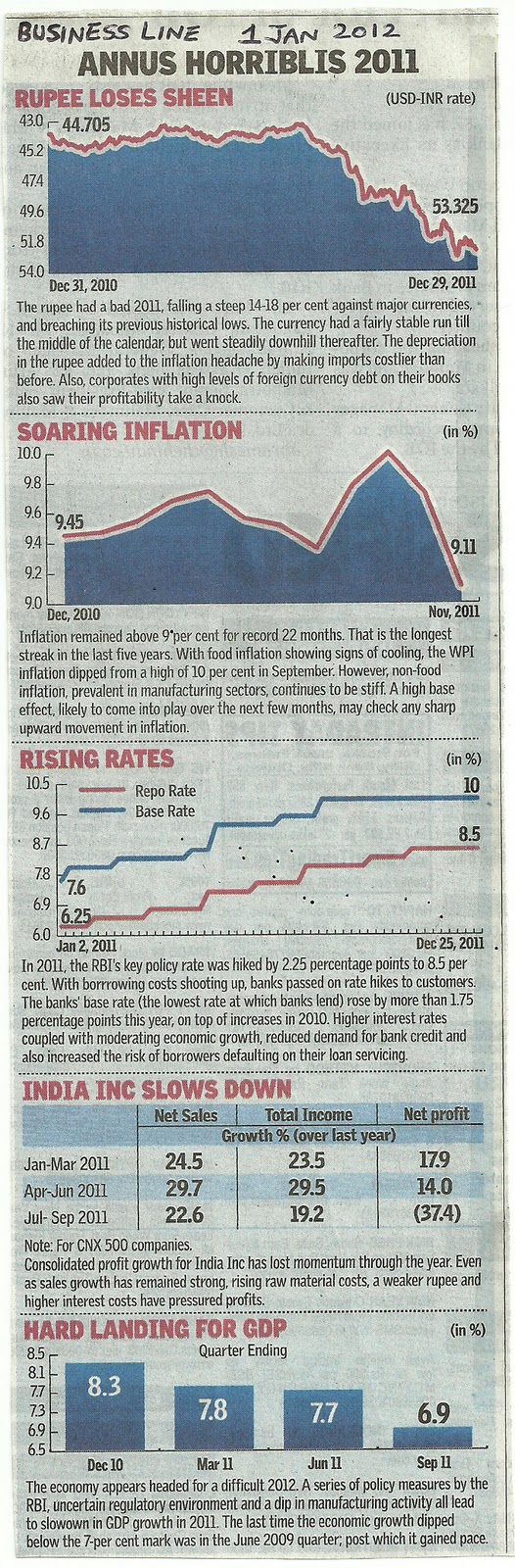
THE INDIAN RUPEE - WEAKNESS CONTINUES.....

The continuing weakness of the INR vs the USD is starting to worry both investors and regulators alike. Negative FII fundflows in the Equity markets is adding to the weakness of the INR.

At a time when inflation continues to be persistantly high, a weak INR will add to India's already increasing Crude Oil import costs.

The Equity Markets in India are preparing themselves for forex loss announcements from companies that import their raw materials and those that have large Foreign Currency borrowings.

We are now surpassing levels last reached during the heights of the financial crisis in the first quarter of CY 2009, just after the Lehman Crisis!

Energy and commodity prices were far lower in March 2009 than they are right now; so the Government and especially the Central Bank (R.B.I) will have to come up with some strategy to stabilize if not support the INR at current levels.

WATCH THIS SPACE!

Friday, March 19, 2010

HATCHBACK CARS IN INDIA

The hatchback car market in India looks all set for a fresh round of cut - throat competition.
Below is a clipping from last week's TIMES zigwheels. www.zigwheels.com

Ford India has launched the Ford Figo at a super competitive price of Rs. 3.49 lakhs (approx USD 7755, at 1USD = INR 45) for the base model.

The Indian government is also rolling back excise duty benefits on the sale of small cars and the Reserve Bank of India is also hinting at a tighter monetary policy going forward.

The Indian hatchback market is dominated by Maruti Suzuki & Hyundai Motors.

Maruti Suzuki is the dominant player and is the manufacturer of the legendary Maruti 800, the Suzuki Wagon R ( since relaunched as the Suzuki Ritz) and the Suzuki A star ( formerly the Suzuki Alto).

Hyundai India also makes the popular Hyundai Santro and the Hyundai i 10.

Tata Motors makes the Tata Indica & the Tata Nano!

Volkswagen, Ford, Fiat and GM are new entrants in the hatchback space.
In the past Fiat and GM have tried to enter this space, and were not very successful.

The hatchback segment is getting rather crowded in my opinion.

While this is great news for the customer, it means that the car makers will face margin pressures going forward.

Car makers will also have to compete with a growing second hand car market and second hand cars that are refurbished by the car companies themselves.

Consequently, investors in auto companies like Maruti Suzuki need to take note of the changing dynamics of the low margin high volume hatchback car market.

Investors in auto ancillary companies will also have to deal with shrinking profit margins. Raw material prices (steel, glass, rubber etc) are rising and car companies will look to cut costs to boost their own profitability.

A price war is great for the customer, but drastically reduces the profitability of the car makers.

Wednesday, March 17, 2010

Indian Government Bonds : 10 year benchmark yield crosses 8 percent

Growing government borrowing requirements and a tighter monetary policy will be factors driving the Indian Government Bond Market this year.

Rising yields will expose public sector banks to losses on the 'Available for sale' part of their government bond portfolios.

The strong Indian Rupee may begin to pressure exporters as well.
Interest rate sensitives will feel the pinch of the rising cost of credit, and credit offtake may slow still further

The public sector Oil companies are still awaiting a government decision on subsidy sharing. A strong Rupee somewhat cushions their under recovery on sale of retail fuels.

Friday, February 26, 2010

BUDGET DAY 2010

The Indian stock market has had a very quiet build up to Budget day 2010.
As the graph below shows: after a massive recovery from the March 2009 lows, Indian equities have been trending sideways since July 2009.


Market watchers will be looking for more sops to the agriculture sector and the infrastructure sector, and a possible gradual roll back of excise duty cuts and the stimulus package. A hike in service tax is also widely expected.

So far we are yet to hear anything on reforms towards market pricing in the Petroleum sector.
With Oil prices trading just under $80, maybe we will hear more on the governments subsidy sharing plan.


Let's see how it goes.

Friday, January 22, 2010

INDIAN EQUITY VALUATIONS

And then came the correction..........

Valuations are not just ''fairly priced'' in my opinion!!
Valuations are not cheap!
Sectors like Autos, FMCG and Engineering leave a wafer thin margin of safety for the investor.
As I have been saying in recent posts, it's definitely time to take some chips off the table.

Indian Stock Markets will have to cope with the current sell off in global equities as well as volatility and uncertainty as we head towards the Indian Union Budget.

The charts below show that equity returns in emerging markets like India are highly dependent on FII fundflows. The sustainability of these FII investments in emerging markets could face significant headwinds if the world economy heads for a ''double dip''

These charts are from the Business India Magazine - January 24, 2010.

Tuesday, February 24, 2009

S&P reduces India’s rating outlook to negative from stable.

""""S&P reduced India’s rating outlook to negative from stable, according to an e-mailed statement today, and added that “continued loose fiscal policy would result in a downgrade” in the nation’s credit rating. It affirmed India’s BBB- long-term credit rating, the lowest level in the investment grade.""""
Source: India Lowers Taxes, Straining Finances as S&P May Cut to Junk

While global economic conditions continue to be stressful, I would like to focus on the highlighted section of the above quote.

We must not forget that India isn't the only country resorting to extraordinary measures in extraordinary times. I would like to also say that unlike certain governments globally, the Indian Government hasn't ''thrown good money after bad'', and to the credit of local regulators, we have not had a massive banking collapse at a local bank or suspended trading sessions on our stock exchanges so far. As compared to many Pension Funds overseas, Government Pension Funds in India are in great shape ,mainly due to massive restrictions on speculative investments by pension funds.

Given India's large agrarian population that lives in rural areas; the government will have to continue to support Indian farmers with fertilizer subsidies and loan waivers, even as efforts to spread literacy and education across smaller towns continue.
Better to support a farmer than a lying banker any day!!!

India's massive and rapidly expanding middle class is crucial to India's long term prosperity, and its expansion is key to establishing a more equitable distribution of wealth. As a result, fuel subsidies and cuts in Indirect taxes (read: Service Tax and Excise taxes) are likely to continue to burden government finances.

I find it rather ironic that the very forces that criticized the Indian Government just a few years ago about its 'snail slow ' reforms in the Indian Banking sector, are now 'nationalizing' and pumping endless amounts of money into bankrupt and overleveraged banks.

Lastly, remember to take these comments with a pinch of salt, as S&P were one of the 'experts' that gave 'AAA' ratings to toxic Subprime CDO's & now defunct Mortgage Bond Insurers. These guys also refused to recognise the suicidal risks taken by large investment banks and financial institutions until it was too late.

As for India's continued loose fiscal policy, S&P better analyse the ever expanding US TARPS a little more closely.
They may find they've got more downgrading to do!!!!!!

More Links on the S&P negative outlook
S&P cuts ratings outlook on 12 Indian banks to negative
India's ratings may take a hit: S&P
Indian rupee weakens on S&P's outlook downgrade

Monday, February 16, 2009

Hard Hitting comments on the Indian Railway Budget

The Railway Minister Laloo Prasad Yadav has been an entertainer and shrewd politician. As the GDP growth surged, the fortunes of the railways also improved. Remember that the logistics sector tracks GDP growth.
The media proclaimed Laloo Prasad Yadav to be the expert who turned around this ailing public sector enterprise!!!!
"A rising tide lifts all boats." How is the Railways going to react to the impending slowdown in domestic and international trade?

Here is some very 'constructive' criticism of Railway Policies over the last 5- 6 years, that will hopefully encourage policies to reinvest in infrastructure and plan for long term growth opportunities of the Indian Railways.

""""

A tale of missed opportunities: Sumant Chak

BS Reporter / New Delhi February 14, 2009, 0:39 IST

The operational and financial performance sustained over the last five-six years has been commendable. Sadly, these are also years of missed opportunities, with capacity generation and modernisation of the system being the important casualties.

The system’s capacity to run trains has been exploited to saturation. The ground reality is that there has been no important capacity generation in the last five years. Similarly, older coaches, locomotives and wagons continue in service with no improvement in passenger comfort or freight carrying capacity. The dedicated freight corridor project, which signalled the intent to increase system’s capacity substantially, remains mostly on paper.
Similar is the case of a slew of projects announced over the years. Coach, wheel and locomotive factories that were promised some years back have languished in the files and none is even remotely close to fruition.
It is important to understand that the railway infrastructure is not created in a day. Unless project planning and execution are given priority, the country’s railway will not become world-class. The increasing populism in the last two budgets and this one, therefore, reflects a tale of missed opportunities. Future generations will rue today’s tardiness.

Sumant Chak, Director (International Relations), Asian Institute of Transport Development, New Delhi Former Additional Railway Board member. """"

SOURCE:http://www.business-standard.com/india/news/a-talemissed-opportunities-sumant-chak/01/30/349017/

Tuesday, August 26, 2008

2008 - THE SLOWDOWN

Global markets continue to stumble in an uncertain business environment.
Emerging markets like Brazil (BOVESPA Index), India (BSE SENSEX), and China (Shanghai Composite) have had a particularly difficult time.
So are these slowdown fears for real? Over the next few posts I will analyze the impacts of a global slowdown in the backdrop of a highly leveraged and interconnected global economy.
To begin with here are some charts -
Shipping rates
have had a volatile 2008. In the first half of 2008 a weakening USD coupled with high oil prices pushed commodities and shipping rates to new highs.


Is Chinese demand finally slowing? Or is this just a blip on the charts due to the 2008 Olympics?

2008 has been a terrible year for equities.

Fears of a US led global slowdown and a risk averse investing environment have resulted in large outflows from emerging market equities.

2008 so far----

THE LAST 5 YEARS The Chinese stock market is down very sharply since it peaked in the last quarter of 2007.
Indian Equities have fared better, over the 6month and 5 year horizon. Over the last 3 quarters however, growth rates have moderated, and as Indian companies continue to expand, with inadequate local infrastructure(transport bottlenecks and power shortages) and domestic inflation rates of just under 13%, we are in for some challenging times ahead. The Indian Financial sector has fared much better than its global counterparts, but as lending standards tighten, interest rate sensitive sectors like Automobiles and Real Estate are likely to underperform. I will soon put up my update on the Indian Economy.

Saturday, May 31, 2008

INDIAN EQUITIES 2008 - The Bullish Bear UPDATE

Here it is at last- The MEGA POST on Indian Equities.
The first five months of 2008 have been tough for global equity markets & Indian equity markets continue to struggle.
After justifying a BSE SENSEX Index of over 21,000; buyers seem hesitant to step in to buy stocks after this deep correction.

Once favorite sectors like Capital Goods, Brokerages, Real Estate and Financials, have taken a hit, while Autos, Public Sector Oil Companies, Infrastructure and Cement continue to under perform.

The Corporate sector struggled to maintain its scorching pace of earnings growth in the fourth quarter. As a result, no one’s betting on a quick recovery in markets here. An Uncertain environment in the global economy, slowing growth and rapid inflation at home, and rising Crude Oil prices have kept any attempt to pullback from recent lows in check.
Meanwhile as companies continue to expand to meet larger orders, as a fresh investment phase begins in the domestic market. Rising depreciation and Interest payments will further dent bottomlines in the coming quarters.

For the true long term Investor in India (where long term isn’t 6 months but 3 years or longer), this is a time of consolidation and selective stock picking. Your patience is going to be tested, as the markets continue to be range bound with a downward bias in the near term.

THE LONG VIEW:
The domestic demand story will continue to propel the economy forward: A rapidly expanding middle class, improving job opportunities, increasing disposable income and consumption and favourable population demographics.

As the capital expenditure cycle rolls on, many infrastructure companies and Capital goods companies stand to gain, an example being companies in the power generation and Transmission space, once fresh capacities come on stream. The Indian Telecom space is said to be the fastest growing in the world, and as these companies penetrate deeper into rural India, the growth in volumes will come, but investors must wait for it.

In my 31st December 2007 post I was cautious on valuations and also said that investor expectations must be reasonable. http://thebullishbear.blogspot.com/2007/12/smoke-mirrors-2008.html
Then came the deep correction and a return to reality: valuations are a lot more reasonable today.
When deciding whether to buy or sell or hold stocks, focus on valuations and not on the recent 52 week high of the stock.
Indian Equities will face many hurdles in 2008, as the US and world economy slows. Certain sectors will be hurt more than others and recovery times will vary. While it’s impossible to time the market, it’s also important not to get in too early.

Overall its time to be cautious and be very selective while picking stocks. Focus on the long term, and use a ‘Staggered buy on declines strategy’ to add to positions in your favourite stocks

SECTOR WISE ANALYSIS:

CAPITAL GOODS:
The sector, a long time market favorite showed some signs of slowing.
Despite growing order books and strong earnings visibility in the fourth quarter, the sector witnessed disappointments on margins and slower than expected order execution.
As companies in this space continue to expand, commencing production of higher value critical products (e.g.: higher capacity boilers and transformers etc); increasing manpower, raw materials (e.g.: Steel and Copper) and depreciation costs are going to put pressure on margins going forward.

This was clearly evident in the power sector recently, where competitive pricing resulted in some power generation companies, choosing Chinese products over those manufactured by Indian companies such as BHEL.
I would wait before any fresh buying in the large cap stocks here, as weak hands may begin to offload stocks, as earnings growth rates moderate.
I am optimistic on a Material Handling Equipment company: Elecon Engineering, a Crane Rental company: Sanghvi Movers. The earnings visibility is good, and valuations have corrected substantially. As new Cement Plants, Refineries, Power Plants, Steel Plants and Fertilizer Plants are built; Elecon Engineering and Sanghvi Movers should see strong earnings growth.
Long Term investors can remain invested; moderating their earnings expectations in the near term as these companies expand capacities

INFRASTRUCTURE:
This sector includes capital goods companies, infrastructure finance companies, engineering procurement construction (EPC) companies and earth moving machinery companies among numerous others. Valuations across the space rose astronomically over the past few years and subsequently corrected sharply. Rising cost of finance and rising prices of raw materials have added to project execution risks. Cost overruns and the inability to pass on rising raw material prices, may subdue earnings in some cases. Large players like Larsen and Toubro in the EPC space and IDFC (an infrastructure finance company with excellent asset quality) should do well in the long run. I hold shares in L&T and IDFC.
Long term prospects are extremely encouraging, given infrastructure projects like ports, airports and railways are in an expansion phase.
Smaller players are likely to feel the heat, and I would advise investors to stay with the larger players.
I would advise caution on certain companies with longer gestation periods, like Mundra Ports and GMR Infra. (For Airports). These are clearly VERY long term investments. The returns will come, but involve a considerable waiting period.

AUTOS:
After some years of consistent growth, this sector too is facing tough times.
A combination of a buoyant economy, falling interest rates, increased infrastructure spending on roads and highways, and a Supreme Court ban on overloading of freight commercial vehicles, contributed to robust growth over the past 5 years

Cars and Bikes: Model fatigue, rising interest rates, rising steel prices and cut throat competition have resulted in reduced margins.
The buyer is spoilt for choice, as various product segments are getting crowded with overlapping models from competing manufacturers, resulting in no clear market leader in this space.
Trucks and Buses:
A higher base effect coupled with rising rates took its toll. While the freight Light Commercial Vehicle (LCV) and Passenger commercial vehicle space continues to do well, there appears to be a slowdown in the freight Medium & Heavy Commercial Vehicle (M&HCV) space. Freight rates remain robust, as many new players are entering the ever expanding ‘hub and spoke distribution’ logistics space, given the fast improving intra state road networks.
Passenger Transport continued to do well, as State Road Transport Corporations added to existing fleets, especially in the intra state segment.

I am currently researching a Used Truck Finance company: Shriram Transport. The company has reported excellent earnings, even as the new truck market continues to languish. The used truck market has done well. An interesting company, with a management that holds an enviable track record; in this unconventional non banking finance space.

FINANCIALS:
The sector continues to be hassled by news of writedowns, mark-to market losses, and falling treasury income.
ICICI Bank was the first to report mark to market losses and took hits on assets related to the subprime mess, and was later followed by Axis Bank with MTM losses.
Indian banks are also being sued by clients who have reported losses on Forex derivative contracts (used to hedge currency risk).
Meanwhile credit offtake appears to be slowing. Confidence is low, and no one is sure that that we’ve seen the last of the writedowns
So overall, uncertainty has resulted in sharp corrections in the banking sector.

I am keeping an eye out for ICICI Bank. Although they have been worst hit so far and have been known to be too aggressive at times; their businesses span Insurance, Asset Management, Venture Capital, Brokerage (ICICI Securities) and banking. They are among the top3 players in the Insurance and Asset management space. I am holding on to my shares in ICICI Bank, and will wait for more pain before bottom fishing.

For the more conservative investor: HDFC and HDFC Bank are safer long term bets. The management is known to be more cautious and their asset quality is excellent. I also hold shares in HDFC and HDFC Bank.

REAL ESTATE, BROKERAGES:----->AVOID.
These were the leaders of 2007, the returns were phenomenal and the valuations were CRAZY in some cases. They have since corrected sharply in some cases by over 50 %. Real Estate prices across the country have halted their relentless surge, and prices in many parts are moderating.
These are two sectors I would stay away from, as valuations in most cases are still not reasonable.
Risks for Real Estate: Execution risk, rising interest rates and overstating the valuation of Land Banks (read: unsold inventory; land purchased at high prices)
Risks for Brokerages: A declining stock market and a fall in volume of transactions post Jan 2008, will impact earnings (i.e. brokerage fees, M&A fees as also fees on the institutional investment side.)

AUTO COMPONENT & TEXTILE EXPORTERS:-----AVOID.
Another two sectors that I would avoid. Rising raw material prices, a prolonged US slowdown, and a volatile Indian Rupee will continue to drag down earnings. Slowing Auto sales in the US will adversely affect Indian auto component manufacturers which supply the US auto industry.

CEMENT:
Fears of Supply exceeding demand by FY10, government intervention to cap cement prices, and rising raw material costs, have seen cement stocks fall sharply from their 52 Week highs. The decline in cement stocks began even before the fall in broader markets. As new capacities come on stream, supply is expected to exceed demand, leading to falling realizations for manufacturers. Meanwhile Raw material costs in terms of limestone, coal, and fuel have risen sharply.
While the near term could see lower prices for cement stocks, I am cautiously optimistic over the longer term.
Delays in adding fresh capacities & increased infrastructure investment (Airports, Sea Ports, and Irrigation Projects etc) will lead to renewed demand.
The sector may also see some consolidation, as smaller players are snapped up by the two cement giants –The Aditya Birla Group and Holcim.
I remain invested in Grasim, a company I have held shares in since the year 2001. I do not see any runaway rally here, so I will wait before adding to my position.
Investors will have to tone down their expectations of returns from this sector in the short-medium term.

STEEL:
As was the case with the cement industry, steel manufacturers are battling similar constraints, except for the fact that the industry does not face a near term supply glut. Government intervention to cap prices and rising input costs are resulting in increased margin pressure. Avoid fresh investments for now, and wait for further downside from current prices.

TELECOM:
India is the fastest growing telecom market in the world. Ever since the Reliance group commenced its telecom venture- targeting mobile phone affordability (both handset and tariff prices) the volume growth in this space has been exponential.
Ever changing legislation for GSM and CDMA operators has made this a difficult space for the retail investor to understand. Bharti Airtel and Reliance Communications (RCOM) are the two giants here. Once again I would stick with the Big 2, as I feel the changing rules and FDI Limit policies may be too much for the smaller players to cope with, in this volume driven business. While some of the smaller players might be future acquisition targets, for now the risk return equation is skewed against them in this low price – high volume market, where economies of scale is very important.
Another new development is the MTN takeover/merger/acquisition saga. First it was Bharti, and now RCOM has stepped into the ring. While it is too early to know the outcome, successful completion of such a deal would catapult one of these two into the Top 5 globally. It would be amazing to have a Giant Telecom player operating in high growth markets of the Middle East, Africa and India
However the final cost and structure of the deal would be critical to any future valuations of Bharti Airtel and RCOM. For now I am holding on to my RCOM shares. I do not hold any shares in Bharti Airtel.


Fast Moving Consumer Goods: FMCG
The FMCG sector has outperformed the broader market in 2008. Stocks like Nestle, Marico, Godrej Consumer and ITC have done very well.
I am positive on ITC, even though the company reports just a 13% rise in PAT in FY08. There are clear signs of slowing earnings growth across the sector, but the steady cash flow from the Tobacco business and a possible demerger of the hotels and FMCG (biscuits and potato chips etc) businesses could be triggers going forward. Wait for a decline before fresh buying.
Overall I would be cautious on the sector. Valuations are not too cheap, and growth rates may slow as new players enter and competition intensifies.

INDIAN IT:
A strong Rupee and fears of a prolonged US slowdown has finally slowed down the earnings momentum of the Indian IT services sector.
A volatile Indian Rupee (Rs.) that rose to Rs 39 to the USD some months ago has now pulled back to Rs43 to the USD.
The BIG 3: Infosys, TCS, and Wipro; have seen drastic cuts in their stock prices, in a rather difficult business environment.
Given my views on the US economy, and US financials in particular (Large Investment Banks are some of the biggest clients of the Indian IT industry), I would wait before buying into this sector. I would restrict my research to the larger players as I expect some mid cap companies to struggle, given the uncertain business environment: a volatile Rupee, rising wage inflation and possible upcoming billing rate cuts/IT budget cuts/ margin pressure as the US economy continues to deteriorate.
Long Term, the Big 3 should reemerge stronger, but I wouldn’t buy them just yet.

OIL AND GAS & OIL PSUs (Public sector companies.)
While stocks like Cairn India, Reliance Industries, and Reliance Petroleum have done okay, the PSU Oil companies are facing their worst times ever.
The government has refused to raise retail fuel prices (Petrol, Diesel, Kerosene and Cooking Gas) as Crude oil surges to new highs, & losses are mounting on in the Oil PSU’s books. Oil bonds and subsidies are getting messy, and something’s got to give. Upstream majors like ONGC and pipeline majors like GAIL INDIA, too are being forced to bear part of the burden for our subsidized retail fuels. As a result Capex activities are slowing and these companies are being forced to resort to borrowing for working capital.

Coming to the Reliance Group; their new refinery will be commissioned in the second half of this year, at a time when the West is falling short of refining capacity. The new complex refinery has been built in record time, and together with the existing Refinery, will be the largest Oil Refining complex in the world. Also, the gas find in the KG Basin in Andhra Pradesh will commence production later this year, which will be extremely positive for the company.
I am holding onto these stocks, and would use sharp declines when the markets correct to add to these positions.

Cairn India’s large Oil find in Rajasthan was truly a masterstroke. (Especially as Shell, who sold them the same block in Rajasthan, were unsuccessful there.) I would be cautious on Cairn’s current valuations; given that actual production is still some time away.

Disclaimer:
This is a blog of my personal views on world financial markets, focussing on India in particular. Investors must carry out their own research & make their own informed investment decisions, using qualified independent advice. Always invest with an adequate margin of safety and know your own investment risk profile. Neither the information nor any opinion expressed constitutes a solicitation to buy or sell any securities nor investments.

Friday, February 29, 2008

Indian Union Budget 2008 & beyond

The Indian equity markets ended in the red, in line with the weakness across global markets.
As far as the stock markets are concerned the Union Budget was neutral overall, and did nothing to further reforms in the run up to the upcoming elections.

Some Highlights
The Fiscal deficit = 3.1% in FY08, revenue deficit = 1.4%
Ahead of the upcoming elections, the finance minister reiterated the need for ‘inclusive’ growth, reduced excise duty on small cars and announced higher spending on education and a Rs. 60,000 Cr loan waiver/relief for farmers.
Short term capital gains tax has been raised from 10% to 15%, and the threshold limit for all IT assesses has been increased from Rs.110,000 to Rs.150,000.
http://www.equitymaster.com/budget08/comments.asp

2008 is going to be a difficult year for global stock markets. Here’s what we are up against:

Stagflation in the US : Slow growth, rising unemployment & inflation.
The rapidly declining USD, eroding the value of Forex Reserves of Central Banks.

An increased likelihood of a hard landing for the US economy.
The "Goldilocks economy theory" and the Decoupling theory are dead.
Weakening US Consumer consumption.
US Home prices continue to decline.
The global credit crunch continues.
Eventual downgrading of the US Bond Insurers. More trouble at Freddie Mac & Fannie Mae.
The Fed focusing on growth and Wall Street, and not inflation.
Food grain and oil prices at record highs.
Fears of writedowns in the Global Banking industry in the first quarter 2008.
Slowdown in foreign institutional fund flows to emerging markets.