Showing posts with label EUROZONE. Show all posts

Monday, January 14, 2013

RUCHIR SHARMA -ON WHERE TO LOOK FOR SURPRISES IN 2013!!

Once again Ruchir Sharma comes up with an original insight for the market outlook in 2013.

Below are excerpts from the ECONOMIC TIMES NEWSPAPER IN MUMBAI on Monday 14th January 2013.

LINK:
Surprises might deflate the bubbly confidence in emerging markets ...

Even as investors continue to remain bearish about developed markets in the USA and the Eurozone, they remain oddly complacent about the prospects of emerging markets in Asia.

As he says at the end of his article, "" If you're looking for negative surprises, don't look in US or Europe, the starting point of the last two global shocks and where the risks are well-telegraphed. Crises occur when the consensus is too confident, spending and debt too loose, and right now, the early warning signs are gathering in the emerging world.""


Here is a more detailed excerpt


So what surprises might deflate the bubbly confidence in emerging markets? The first candidate is China, where the consensus forecast is still for GDP growth of 8% this year despite the fact that growth slipped below that level in 2012 and the strong case that China is just too big and middle-income a country to continue growing so fast. A major growth shock in China could rattle the commodity markets and the indebted emerging market countries, as 60% of the countries in the global emerging market bond indices are heavily dependent on exports of commodities. 

Even perma-bulls on China are beginning to worry about two factors: incoming leader Xi Jinping has warned that rising corruption could lead to "the collapse of the party and the country", as he senses the popular resentment that has built up following the sharp rise in cases of bribery, graft and ostentatious spending by government officials in recent years. Second, liquidity outside the traditional banking sector is growing much too rapidly and this striking rise in liquidity is finding its way into all kinds of murky debt products. 

The main issue is that this proliferation of alternative and local sources of credit is very difficult to track, so no one can fully quantify the risks. One investment bank calls wealth management products (WMPs) the CDOs of China — a reference to collateralised debt obligations, the exotic US debt instruments that triggered the global crisis of 2008. That's extreme, but systemic risk to the financial network in China is growing. 

Another potential surprise from the emerging market world could come from a nation most likely to disrupt the spectacular boom in the global bond market. The reality is that macro stability, which so many emerging nations laboured to build in the last decade, is starting to erode in a few important markets, including some that have sizeable deficits in both the overall current account balance and the government's deficit. The twin deficits in South Africa and India are particularly worrying, in part because no one has seen a crisis in a major emerging market in 15 years, and because most investors expect 2013 to be much like 2012. If an unexpected shock comes in one of these big countries, it could prove highly contagious. 

Given the political winds in South Africa, it looks like the bigger risk. President Jacob Zuma has reversed the one major achievement of his African National Congress successors: macro stability. Government spending is rising fast, fuelling a rise in real wages that is driving up consumption, and both the government deficit and the current account deficit are now around 5% of GDP.
Currently, South Africa's financial system is ranked as one of the best in the world. But with weak foreign reserves and a very heavy foreign presence in its stock and bond markets, South Africa is highly vulnerable to capital flight. Social tensions are also on the rise as the country has one of the lowest employment rates in the world and the economy is expanding at too slow a pace to create new jobs. So, if South Africa begins to totter, its size and reputation could produce a contagion effect. 

Let us hope history and the consensus hold, and year five of the market recovery proves uneventful, and profitable. If you're looking for negative surprises, don't look in US or Europe, the starting point of the last two global shocks and where the risks are well-telegraphed. Crises occur when the consensus is too confident, spending and debt too loose, and right now, the early warning signs are gathering in the emerging world.

Monday, December 31, 2012

GOLD AND SILVER - CONSOLIDATION IN A BULL MARKET

CLIVE MAUND once again has some excellent precious metal charts


Thursday, November 22, 2012

RUCHIR SHARMA ON US ELECTION RESULTS AND THE US FISCAL CLIFF


Fantastic Article by Ruchir Sharma in the Economic Times Mumbai on Monday 12 November 2012.


EXCERPTS: (I highlighted some sentences in red colour for emphasis)

Ruchir Sharma on Why Obama won?

Even before the vote, prognosticators like Yale's Ray Fair who use just economic metrics to forecast election results pointed to a defeat for Obama, given persistently weak growth in per-capita income over his first four years. Fair was calling for Romney to win by a 51-to-48 margin. The polls showing that most voters saw the economy as the key issue only added to the mystery of how Obama beat the odds. The answer may be that, in their gut, voters understand that the US is not recovering from a normal recession, but from the worst crisis since the Depression, and, therefore, they chose to give Obama four more years, just as they did for Franklin Delano Roosevelt in 1936.
Historical evidence shows that the American economy has, in fact, not performed badly over the last four years, not when compared to its own previous track record in severe crises, or to other countries in similarly dire condition. The forecaster who expected an Obama defeat focused on how the debt problem is undermining US growth, which has fallen from a long-term rate of 3.4% in the decades before 2007 to just 2% this year, and is running slower than during the recovery phase of most post-war recessions. US economic output is now 10% below the trend line it was on before the crisis and still falling, which is the real reason for high unemployment. This case for the historically 'weak recovery' was the essence of the case against Obama's handling of the economy. 
Voters seemed to choose, intuitively if not deliberately, the historical and global perspective of Harvard economists Kenneth Rogoff and Carmen Reinhardt, who argue that the relevant point of comparison is not the dozen or so recessions the US has seen since World War II, but the very different case of systemic financial crises. These are much more traumatic and rare, and by this standard, the US is recovering lost per-capita output faster than it did following previous systemic crises, from the meltdown of 1873 through the Depression of the 1930s, and also faster than most of the eurozone nations following the systemic crisis of 2008.
Ruchir Sharma on US FISCAL CLIFF - on US SPENDING CUTS - on US DEBT

He stresses the importance of debt reduction through spending cuts rather than tax increases.

The history of financial crises suggests that Washington has to get moving and address the debt burden now. In the developed world, the two most successful cases of recovery from a debt crisis were Sweden and Finland in the 1990s, and both began by cutting debt in households and corporations, while raising public debt to stimulate the economy. That is the path the US has followed - and followed more successfully than other rich countries since 2008 - with steep declines in US corporate and household debt. But this is the critical juncture. The Scandinavian cases show that, four years into the crisis or about where the US is today, the government needs to shift aggressively from stimulating the economy to putting in place a long-term plan to lower the public debt. 
It can't be just any plan. From certain quarters of Washington, one hears a steady refrain about how the only way to balance the budget is to cut spending and raise taxes. But research clearly shows that the recovery is likely to be much stronger if the debt is reduced through spending cuts rather than tax increases. 
Over the past quarter century, eight European countries have undergone periods of sharp government debt reduction, and those that reduced debt mainly or only through spending cuts, including Britain and Austria, saw their economies speed up during the belt-tightening process, and after some initial pain. In the Netherlands, Sweden and Finland, the governments actually lowered taxes while cutting spending, and saw the GDP growth rate accelerate, sometimes by a large margin. In the two best cases, Sweden saw its GDP growth rate roughly double, and Finland saw its GDP growth rate roughly triple, both to around 3%, which is very respectable for developed economies. In contrast, the countries of southern Europe - Italy, Greece and France - tried to put the budget in balance mainly through tax increases, and all of these economies saw GDP growth slow down. 
So, economies digging out of debt perform better following spend cuts. But why? An August 2012 paper from the National Bureau of Economic Research, The Output Effect of Fiscal Consolidations, offers an extensive comparison of how countries have performed after periods of budget deficit reduction, and it concludes that the difference in results is nothing short of 'remarkable'. Spending cuts are typically followed by mild recessions, or no recession at all, while tax increases have been followed by prolonged recessions. The authors, Alberto Alesina, Carlo Favero and Francesco Giavazzi, note that the gap in performance is so sharp, it can't be explained away by differences in monetary policy; rather, the key seems to be the impact on business confidence compared to consumer confidence. Businesses tend to react to tax increases by dialling back, and to react to government spending cuts by investing more, which is what the US economy could use right now, when many businesses are sitting on record levels of cash on their balance sheets. 
Regardless, the US economy looks likely to take some pain in the coming year, as Washington begins to deal with the debt problem. The market's worst fear is the 'fiscal cliff' that looms in January, when current law would impose a combination of tax hikes and spending cuts equal to 5% of GDP, which is likely to induce a recession if Congress doesn't act. However, a risk this clearly telegraphed typically gets resolved, even in Congress. The more likely risk is that Washington begins the process of debt reduction with a compromise package that could reduce growth by nearly 2% of GDP. That's a step in the right direction, long term, but could make for a rough 2013. 
Over the coming decade, the global economic race will be decided in good part by which nations are first to tackle the debt problem, and one often overlooked factor is that the wealthy can cope with large debts more easily than the poor. By that measure, the total US debt burden of 350% of GDP may pose less of a challenge to Washington than, for example, China's total debt burden of 180% of GDP poses to Beijing. 
The bigger picture for 2013 is that if Washington can produce a credible road map to lowering public debt, it could keep the US on track to be a Breakout Nation - as the strongest growth story in the developed world - this decade.

Saturday, September 8, 2012

GERMANY'S TRADE SURPLUS AND THE INTRODUCTION OF THE EURO


I have been meaning to repost this from the Sudden debt blog by Hellasious.

It's a post that really makes you look at Eurozone crisis in a different light.
Despite all the PIIGS bashing going on, we often forget that German Exports did benefit greatly from the shift to the Euro!


Sudden Debt: One Picture Is Worth A Thousand Marks (or Merkels)...: Given what is going on in the eurozone at the moment, it is worth it to point out that the biggest beneficiary of the euro is Germany itse................

""""""A full 41% of Germany's surplus comes from France, Italy, Spain and (gasp!) Greece, where Germany is still exporting like gangbusters despite the poor country being in its fifth year of recession.  In fact, Germany's trade surplus per person with Greece is 3.6 times bigger than that with the U.S. (290 euro per Greek versus 81 euro per American)."""""""""

Wednesday, July 25, 2012

EURO ZONE DEBT CRISIS -ANY SOLUTION YET?

I guess not!

Here's an excellent cartoon by "KAL :  THE ECONOMIST : LONDON ENGLAND"

It came out around the time of the Wimbledon Tennis Tournament
It is titled....."DEUCE | Meanwhile, in the Euro Zone"

SOURCE:
https://www.nytsyn.com/cartoons/cartoons?start_date=1901-01-01&search_id=74680&page=2#783810

http://www.kaltoons.com/
Kevin Kallaugher (KAL) is the editorial cartoonist for The Economist magazine of London.
For all those who may not have heard of him, he is the artist behind the famous BUY SELL Cartoon 
http://www.kaltoons.com/wordpress/portfolio/?album=1&gallery=6

Along with INGRAM PINN of the FT, he is one of the legends of the world of Financial and Political Cartoons.


Wednesday, March 14, 2012

VIX SLIDES AS MARKETS GET COMPLACENT!


As the rally in equity markets continues, let us not forget that we still face headwinds in 2012.

Troubles in the Eurozone, record high oil prices and a possible slowdown in China.......are some of the lingering concerns.

CAVEAT EMPTOR!

Tuesday, October 4, 2011

Friday, December 31, 2010

EURO - OUTLOOK 2011

The Euro currency faced a turbulent 2010.
As concerns continue to mount over the finances of the '''PIIGS''', 2011 could mean even more volatility.

Will the easy money/quantitative easing policy of the USA or the austerity measures of the Eurozone be successful?
Here is a chart and an article by Graham Summers of Gains Pains & Capital on the EURO crisis.

Wednesday, October 20, 2010

CURRENCY VOLATILITY

Well, after trending downwards for weeks, the USD seems to have stabilized for now, and a counter trend rally in the USD is underway.

Here are some charts that tell the whole story. No one seems to want a strong currency!


  • The rally in the EUR, JPY and CHF will hurt exporters in Europe, Japan and Switzerland.

  • A weak USD meanwhile, will boost US exports.

  • The Chinese have thus far resisted any significant appreciation in the Chinese Yuan.

USD CHF : The CHF broke down below parity in its recent rally vs the USD

USD CAD : It came ever so close to testing parity vs the USD

USD JPY : Despite the efforts of the Bank of Japan to weaken the JPY, the JPY continues its relentless upward march.

EUR USD : A weak EUR helped boost Germany's GDP numbers last quarter. the recent rebound in the EUR will surely make life difficult for the Club Med nations

Conclusion:

The USD appears to be oversold in the near term and a counter trend rally is underway. The market is betting on some mega fire power solution from the US Fed at its meeting in November. If QE2 disappoints and the equity markets sell off, the USD could stage a much stronger rally!

The Equity markets have been getting far too complacent about the weak and worrying news data and unemployment numbers in the US.

Fund flows to emerging markets have boosted stock prices across the board and a correction is well overdue. These markets are ''not decoupled from the actions of the US Fed'' and when the tide starts to turn we can expect large fund outflows to have a drastically negative impact on stock prices in emerging economies

Lastly, the rally in Gold prices also appears ripe for correction and consolidation. Silver prices too, are clearly overstretched in the near term. expect lower prices if the USD stages a comback rally. It's not time to be buying the precious metals sector just yet!

Watch this space!

Tuesday, May 11, 2010

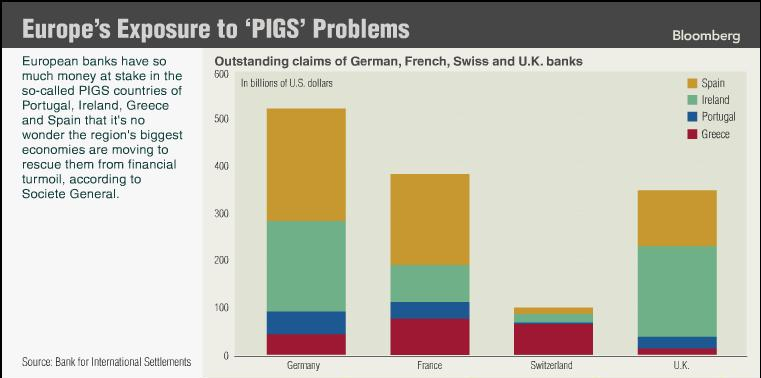
$962 Billion : Bailout of Club Med or the BANKS !!!

The markets certainly loved the mega ECB show of force.

Equity markets in Spain, Portugal and Greece soared, but did anyone notice how the financial stocks in France and Germany reacted yesterday!

AXA +21.87 %

BNP Paribas +20.90 %


Société Générale +23.89 %

Commerzbank + 8.97 %

Deutsche Bank +12.62 %


Here's an interesting take from Socio - Economics History Blog

Europe's Exposure To 'PIGS' Problem! « Socio-Economics History Blog


Friday, March 19, 2010

GREECE & the EUROZONE

Here's a fantastic cartoon by John Trever from the Albuquerque Journal.
SOURCE: Image dated : 03/11/10
http://www.cagle.com/working/100311/trever.jpg