Showing posts with label DAVID ROSENBERG. Show all posts

Saturday, May 5, 2012

GLOBAL BANKING - NO RECOVERY YET.

The ever articulate David Rosenberg has continuously maintained that the Great Recession of 2008, was no garden variety recession.

 According to him a combination of deleveraging, demographics and deflation  - the result of a post credit bubble collapse has meant that despite record stimulus packages and accounting rule changes and Central Bank Balance Sheet expansion; we are still a long way from an end to the crisis.

The Charts below clearly demonstrate how the stock prices of large multinational banks have fared during the post bubble bust scenario. 


As worries of the debt crisis in Europe continue unabated and market watchers are eagerly hoping for a QE3 to boost global equities; it's quite clear from the stock prices below that the crisis is far from over.


Friday, March 25, 2011

EVENT RISK FOR MARKETS - CAVEAT EMPTOR

Global equity markets these days seem to be totally unaffected by all the geopolitical turmoil and natural disasters of the last few months.

Once again the ever cautious David Rosenberg chips in with words of wisdom, alerting investors to the many risks that the market is currently ignoring. (Note to readers - David Rosenberg's Newsletter ends its free trial period this month, so this will be the last of his charts on this blog)

Tuesday, March 15, 2011

S&P 500 vs The FED's BALANCE SHEET

Investment Guru David Rosenberg in recent writings has commented on the positive correlation of the rally in the US Equity Markets and the size of the Balance Sheet of the US FED.

Here is yet another article from Jim Sinclair's Mineset website that supports Rosenberg's view.
This is some excellent research by Trader Dan Norcini and is worth a read.

S&P 500 Versus The Fed’s Balance Sheet
(LINK FOR CHART FROM JIM SINCLAIRS WEBSITE)

Saturday, March 12, 2011

GEOPOLITICAL NEWS IMPACTING MARKETS

The last couple of months have really been a roller coaster ride for the world economy.

Whether its the unrest in the Middle East leading to surging Crude Oil prices, or rising food prices or EU Sovereign debt troubles, or the recent Japanese Quake and resulting Tsunamis...... a lot has been going on.
The incredible damage to property and the loss of innocent lives in case of the Japanese quake is really tragic.

There was another important bit of news that went by unnoticed.
"" Wisconsin Gov. Scott Walker on Friday signed into law the controversial bill that eliminates most union rights for public employees""
Wisconsin governor signs anti-union rights bill World DAWN.COM
Wisconsin governor signs into law union curbs Reuters
Clearly the crisis on Main Street is not over yet. As David Rosenberg recently said, the impact of cost cutting and downsizing at the state and local government level will really undermine the '''ongoing consumer recovery'''
So I think that it's time that the guys on Wall Street sit up and take notice.
.
The Dow Jones may continue to brush off the impact of rising gasoline & food prices and the discontent on Main Street for now, but the prudent investor must realise that its now too late to join the equity market bandwagon. The risk reward ratio is not in favour of the ''long only'' investor and his margin of safety is far too inadequate at the current time.

Monday, February 28, 2011

US HOUSING MARKET & the 30 YEAR FIXED RATE MORTGAGE

Home prices in the U.S. will continue to face headwinds as the 30 year fixed rate mortgage rate continues to climb despite the FED's best efforts in QE2.
A combination of declining home prices, rising food and energy prices and persistantly high levels of unemployment will continue to weigh down on the economic recovery.

Thursday, February 24, 2011

IT'S NOT OVER YET !

Here's David Rosenberg with more words of caution.
It's not over yet!

Friday, January 28, 2011

INVESTING WITH THE HERD

I came across this article via David Rosenberg's article on the 24th of Jan 2011.
Here is the permalink to the NY Times article.
http://bucks.blogs.nytimes.com/2011/01/17/investing-with-the-herd/
It's an excellent article for investors to read right now, given the complacency that has crept into stock market valuations.

Carl Richards is a certified financial planner in Park City, Utah. His sketches are archived here on the Bucks blog, and other drawings are available on his personal Web site, BehaviorGap.com.

Since March 2009, we’ve watched the market rebound by 80 percent. Whether you’ve sat it out on the sidelines or think you can predict what comes next, I recommend you take a step back and remember a few things.

You are not as smart as you think. Overconfidence is a huge behavior
problem for investors.
Overconfidence is what happens precisely because we think we know a lot about the subject, but overconfidence can lead us to make mistakes that in hindsight will be glaringly obvious (but the tricky part is that we didn’t know it at the time).

Following the herd doesn’t make it safe. I know it’s exciting and fun to be an investor in Apple or Google right now. Then there’s the talk about getting access to the private initial public offering of Facebook through Goldman Sachs. Buying because everyone else is buying is not an investment strategy. These companies may be great investments, but not just because everyone else is buying their stock.

We’re social animals who feel safer in numbers, but so do sheep. We take comfort in doing what everyone else is doing, and in the back of our minds we know that even if we’re wrong, at least we’ll be wrong with a bunch of other people. But it was the same line of thinking that led us to do very stupid things in high school just because “everyone else was doing it.”

Investing is about behavior, not skill. Maybe you’ll accuse me of beating a dead horse, but successful investing is about how you behave. Buying high and selling low is dumb, but it’s worth repeating given what I’m seeing in the market today. It’s important to remember that you could own a “mediocre” mutual fund, and if you behave correctly you can outperform 99 percent of your neighbors. On the other hand, if you spend your whole life searching for the “best” investment, you’ll ruin your entire lifetime return in one single behavioral mistake.

I know that what I’ve outlined sounds obvious and easy to scoff at, but the fact that it’s obvious didn’t keep investors from loading up on tech stocks in the late 1990s, bonds in 2002, and real estate in 2006. As we enter 2011, and the excitement of our financial New Year’s resolution starts to wear off, please remember that it’s worth taking the time to stop and think before you invest.

Tuesday, January 11, 2011

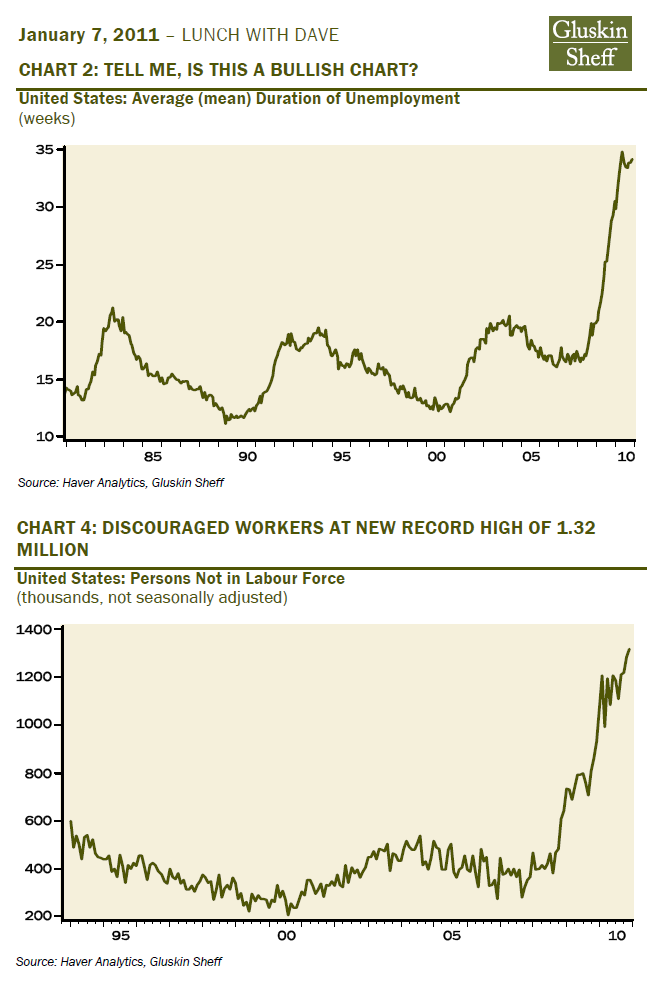
DAVID ROSENBERG on US UNEMPLOYMENT

The graphs below come from 'Lunch with Dave' - January 7, 2011.

..

Tuesday, August 10, 2010

US MEDIAN DURATION OF UNEMPLOYMENT

As the market eagerly awaits some FED news flow, here is a chart that deserves a closer look.

While the unemployment rate has continued to remain under 10%, the chart below shows that this is still one '''tough''' job market.
If the recovery is to be led by consumer consumption, then this chart must begin trending downwards!
.
Continuing stress in the housing and job market coupled with an increase in the savings rate and lacklustre credit offtake further reinforces David Rosenberg's stand that ''frugality is here to stay''

Monday, August 2, 2010

David Rosenberg - on reasons to be worried about the investing environment

Many analysts and economists ''label'' David Rosenberg a perma bear!
Below is his answer to a question during a recent interview.

Ignore David Rosenberg's sound advice and cautious outlook at your own risk!
Economic news flow continues to be dismal. Far too many structural problems remain unresolved for analysts to extrapolate earnings based on the ongoing rebound in equity markets.


Tuesday, July 20, 2010

BALTIC DRY INDEX

Well this chart is not as positive about the outlook of the world economy, as the guys on Wall Street are!
David Rosenberg refers to the slide in shipping rates since May 2010 as a ''deflationary stand - alone event''

Some may choose not to admit it, but the ''recovery'' is slowing. Lingering debt worries (both sovereign and private), continue to remind us that all is not well, and that it's time to cut back and take some chips off the table.

Thursday, July 15, 2010

DAVID ROSENBERG ON VOLATILITY

Here are some charts from David Rosenberg.
It's been one hell of a roller coaster and frankly, many investors are now sea sick!!

David Rosenberg has also been alerting our attention to the slumping Chinese equity markets and the Baltic Dry Index, which have had hardly any coverage in the financial news.
These are no ordinary times....

Sunday, June 13, 2010

VOLATILIE EQUITY MARKETS

Equity markets have been crazily volatile recently. Volatile intraday swings have been a daily occurance!

Here's David Rosenberg on market volatility


Wednesday, May 12, 2010

U.S. HOME PRICES – THE LONG, LONG TERM VIEW

Here's David Rosenberg again, this time with a chart from Prof. Robert Shiller's data.

Mean reversion is one sticky concept, that a debt addicted economy is going to have to come to terms with.
As the inventory of unsold homes and the shadow inventory of foreclosed homes continues to build, the downward pressure on home prices in the U.S.A. looks all set to continue.

Lastly, here is a link from Main Street that the guys on Wall Street should take a look at.

Food-stamp tally nears 40 million, sets record Reuters

""""""""Food stamps are the primary federal anti-hunger program, helping poor people buy food. Enrollment is highest during times of economic distress. The jobless rate was 9.9 percent, the government said on Friday.

The Agriculture Department said 39.68 million people, or 1 in 8 Americans, were enrolled for food stamps during February, an increase of 260,000 from January. USDA updated its figures on Wednesday.""""""""""""

Thursday, April 1, 2010

THE MGM STUDIO DEBT DEBACLE

Here's another failed deal from the 'LBO bubble' days of 2005.

Cheap money lead to excessive valuations for buyouts.

As I read the article below in the Economic times newspaper last week, I was reminded once again of how experts, analysts and investment bankers continued to justify deals that were irrationally dangerous and value destructive!

The only guys who benefited from these deals, were the investment bank advisers who earned massive fees on these now failing LBO deals.


Lastly, I leave you with an interview of the ever consistent, rational and down to earth - David Rosenberg.

He continues to be the lone voice advising caution and recommending measures to minimize portfolio volatility!

Link:
The bear: Dead or just sleeping? - The Globe and Mail

David Rosenberg - More downside to U.S. Home prices ?

The recovery in the U.S. housing market is taking longer than expected.
The crash in home prices has really eroded the networth of homeowners and rattled the U.S.consumer.

David Rosenberg recently highlighted the differences between Investor expectations and Consumer expectations (Wall St. vs Main St.).
In the chart below he raises a valid point of 'mean reversion' as the the shadow inventory of foreclosed homes and continuing foreclosures, continues to stress out the US Residential property market.

Monday, March 1, 2010

DAVID ROSENBERG : On the FED's non traditional programs and exit strategy!

David Rosenberg explains why the FED's exit strategy is going to be quite complicated!

Just take a closer look at the FED's asset purchases highlighted below.
After all that, things aren't back to normal!!!
Makes Dubai's $85 billion debt troubles look like a drop in the ocean!

Tuesday, February 16, 2010

THE FED OWNS $1 TRILLION OF HOUSING LOANS

Just another sign that all is well with the global economy.

Bailout the weak nations of Europe, support the US housing market, maybe even support weaker states within the US.......................miles to go before we sleep.


This is a ginormous figure!

Below is David Rosenberg's chart of the Fed's Holding of MBS!!

So are we witnessing a market driven recovery in the US housing market or simply one that has been supported by the US FED buying $1 Trillion worth of MBS ?

Are they AAA rated MBS ? ? ?

Wonder how the finances of Freddie Mac and Fannie Mae are doing ??

Sunday, February 7, 2010

DAVID ROSENBERG : WHAT WORKED IN 2009 PROBABLY WON’T WORK IN 2010

David Rosenberg at Gluskin Sheff is spot on once again.
Economists and analysts are busy extrapolating last years trends, without fully understanding the ''fragility'' of the ongoing ''recovery''.
.
A firm believer in 'the buy low & sell high' investment philosophy, he is still 'long term bullish on the commodity complex', but believes that 'the positive trend over the past year could experience a near - term pause or even a technical correction that could last for several months.'