Saturday, January 29, 2011

C.R.B. vs. B.D.I.

Below is a rather curious chart of the CRB Commodity Index vs the Baltic Dry Index.
It's interesting to note, that as commodity prices continued to trend upwards in recent weeks, the Baltic Dry Index has continued to drift downwards.


The ongoing activities of global Central bankers are once again boosting asset prices, including prices of USD denominated commodities. As speculators and hedge funds latch on to rising prices, it's quite possible that prices could rise still further.
Longer term however, this diversion in the CRB & the BDI will have to correct itself.
.
Given that the rise in the CRB is not purely end user driven, CRB prices could see a sell off if the global economy faces a double dip.
.
As Central Banks in Asia continue to raise interest rates to combat food & energy inflation, Asian economic growth could slowdown in the second half of 2011.
.
Also, let's not forget the troubles with Club Med, unemployment issues in the developed world, the troubles with state/municipal finances in the USA and the Debt and Fiscal issues of the US government.
.
If the world economy slows, the CRB Index is going to turn downwards.
Investors and speculators in the commodity markets must realise that at current prices, most commodities are trading in 'overbought' territory and leave the investor with little or no margin of safety at all
Caveat Emptor!

PRECIOUS METALS - CONSOLIDATION OR FURTHER CORRECTION ?

Over the past fortnight, the ongoing correction in the precious metals sector has caused quite a bit of heartburn for the 'goldbug' community.

While the recent troubles in Egypt have provided support to PM prices, the ongoing equity market correction could drag prices down further.


Take a look at Silver prices over the last month! That's quite a sell-off.
Mr Radomski of Sunshine Profits has an excellent chart on Gold.


I'm not buying anything yet, and will wait and watch to see how the markets open next week. Meanwhile, the USD & the Swiss Franc continued to benefit from increased market volatility.

Friday, January 28, 2011

INVESTING WITH THE HERD

I came across this article via David Rosenberg's article on the 24th of Jan 2011.
Here is the permalink to the NY Times article.
http://bucks.blogs.nytimes.com/2011/01/17/investing-with-the-herd/
It's an excellent article for investors to read right now, given the complacency that has crept into stock market valuations.

Carl Richards is a certified financial planner in Park City, Utah. His sketches are archived here on the Bucks blog, and other drawings are available on his personal Web site, BehaviorGap.com.

Since March 2009, we’ve watched the market rebound by 80 percent. Whether you’ve sat it out on the sidelines or think you can predict what comes next, I recommend you take a step back and remember a few things.

You are not as smart as you think. Overconfidence is a huge behavior
problem for investors.
Overconfidence is what happens precisely because we think we know a lot about the subject, but overconfidence can lead us to make mistakes that in hindsight will be glaringly obvious (but the tricky part is that we didn’t know it at the time).

Following the herd doesn’t make it safe. I know it’s exciting and fun to be an investor in Apple or Google right now. Then there’s the talk about getting access to the private initial public offering of Facebook through Goldman Sachs. Buying because everyone else is buying is not an investment strategy. These companies may be great investments, but not just because everyone else is buying their stock.

We’re social animals who feel safer in numbers, but so do sheep. We take comfort in doing what everyone else is doing, and in the back of our minds we know that even if we’re wrong, at least we’ll be wrong with a bunch of other people. But it was the same line of thinking that led us to do very stupid things in high school just because “everyone else was doing it.”

Investing is about behavior, not skill. Maybe you’ll accuse me of beating a dead horse, but successful investing is about how you behave. Buying high and selling low is dumb, but it’s worth repeating given what I’m seeing in the market today. It’s important to remember that you could own a “mediocre” mutual fund, and if you behave correctly you can outperform 99 percent of your neighbors. On the other hand, if you spend your whole life searching for the “best” investment, you’ll ruin your entire lifetime return in one single behavioral mistake.

I know that what I’ve outlined sounds obvious and easy to scoff at, but the fact that it’s obvious didn’t keep investors from loading up on tech stocks in the late 1990s, bonds in 2002, and real estate in 2006. As we enter 2011, and the excitement of our financial New Year’s resolution starts to wear off, please remember that it’s worth taking the time to stop and think before you invest.

Tuesday, January 11, 2011

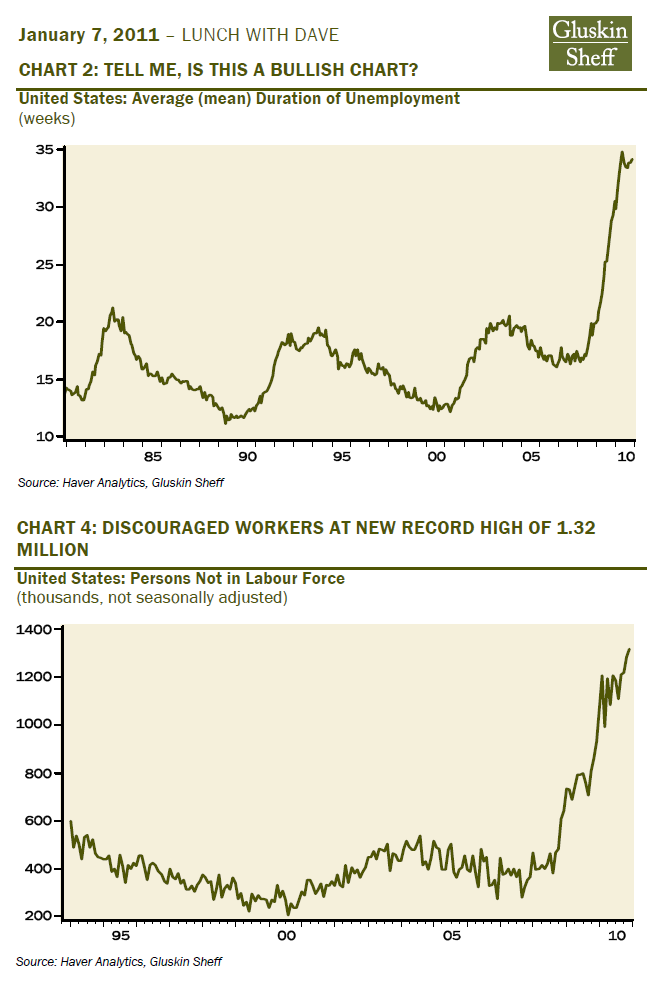
DAVID ROSENBERG on US UNEMPLOYMENT

The graphs below come from 'Lunch with Dave' - January 7, 2011.

..

Saturday, January 8, 2011

SILVER - OFF TO THE RACES !

Silver has been a star performer over the last year.
While prices have corrected slightly from a level of just over $31/oz, the overbought condition in silver means that there could be further downside in the near term if lasts week's weakness in the commodity markets persists.

Below is a chart from some excellent analysis from Adam Hamilton of www.ZealLLC.com

Friday, December 31, 2010

EURO - OUTLOOK 2011

The Euro currency faced a turbulent 2010.
As concerns continue to mount over the finances of the '''PIIGS''', 2011 could mean even more volatility.

Will the easy money/quantitative easing policy of the USA or the austerity measures of the Eurozone be successful?
Here is a chart and an article by Graham Summers of Gains Pains & Capital on the EURO crisis.

Sunday, December 19, 2010

INDIAN EQUITIES : FII & Domestic Institutional Fundflows

2010 has been a good year for Indian Equities. The FMCG (Consumer staples ) sector, Auto sector & Banking sector have performed well this year. Valuations are no longer cheap, and the margin of safety for investors has narrowed substantially.

Link - Domestic institutions turn cautious, go on selling spree ...
As usual, FII fundflows continue to dictate market direction, but as the above article points out, Domestic Institutional investors - Mutual Funds are booking profits.

Saturday, December 18, 2010

UPDATE : 30 YEAR US TREASURY BOND

The recent sell off in US Treasuries comes at a time when the FED continues onward with its QE2 programme.

The USD too has weakened somewhat over the last few months, even against the troubled EURO.

Could this Bond market sell off further complicate the attempts of the FED to revive the ''global'' economy? Falling Bond prices means that yields will rise, a fact that will not go down well in a market where credit growth is actually contracting. If mortgage rates start to rise, the US housing market will face further headwinds.

WATCH THIS SPACE!

Friday, December 17, 2010

A TALE OF TWO INDIAS !

The Economist magazine recently published an article regarding India on 25.11.2010 titled

Graft in India - Rotten to the Core? Coping with the aftermath of a massive scam !!!
And who's to say that they are off the mark as far as the story goes.


We have been on a never ending roller coaster of scams.

  • IPL - Cricket scam -issues regarding benami -ownership structures of teams
  • Commonwealth games scam.
  • Adarsh Building scam in Mumbai - Illegal Building on Army land
  • Telecom 2G scam - That's a mega one!
  • Public Sector bank officials involved in a loans for bribes scam.
  • Stock price rigging scam being investigated by SEBI.
  • Nira Radia tapes - involving journalists, industrialists etc!

So we have massive wealth disparity, income inequality, corruption, rural poverty, poor infrastructure and then we have on the other hand an ecomnomy that's doing fantastically well, while the world economy is still reeling under the strain of slowing consumer consumption and record debt levels.


.
.
.
.
.
.

.
.
.
.

..
.
.
..
.
..
.
.
.


While its going to be a never ending discussion about the politicians, industrialists and other individuals involved in these scams, there are some facts and lessons that an investor in Indian markets can take away from this mess.

  • While the Indian Economy does present a fantastic investment opportunity to both Indian and overseas investors, it can be bumpy ride at times.

  • While the Indian government continues to move slowly on / ignore vital issues like wealth disparity, rural poverty, overburdened infrastructure and the poor state of primary education and healthcare facilities across India, they must realise that this economic boom cannot continue unless they start to tackle the above mentioned critical problems and target "inclusive growth".

  • Remember to curtail investments to firms where the management has a credible track record and takes care of the interests of all stakeholders concerned - & not just themselves! You may come acoss an interesting investment opportunity, but if the management has a dodgy track record, just stay out!

  • If SEBI fails to rein in the Equity market scamsters, it will result in a massive blow to SME (Small and medium enterprises) businesses in India. The SMEs are the ones most affected by these stock rigging scams because a tightening of bank credit across the SME sector will deny working capital loans to many deserving and good quality small cap companies in India

  • The incredible progress that has been made by Corporate India has been made inspite of our politicians and not because of them!

  • While I'm not condoning the massive, almost blatant and shameless corruption here in India; we live in a world where politicians in most countries are no better than the ones we have here. It may be less blatant but sadly,corruption goes on!

  • There is incredible corruption,short termism and lack of leadership in global politics today.As someone rightly said, " The people who want to be in politics are not the people whom you want to be in politics". No politician is willing to fix a problem that he can kick further down the road, an example being the *crazy debt crisis* facing the western world today! Imagine asking consumers who have no savings to start overspending and re- leveraging again - Thats both WRONG & insane!

  • Lastly, remember that the prudent investor does not chase an over extended stock market rally. Remember to wait for pull backs and always look to invest in good quality stocks, with managements that have an established track record!