The Bullish Bear is a long time fan of Ray Dalio.!

Tuesday, October 29, 2013


Sunday, October 20, 2013
Thursday, September 26, 2013
MUST READ ARTICLES ON "OF TWO MINDS" BLOG
Charles Hugh Smith has some fantastic posts on his blog:
http://www.oftwominds.com
The Big-Picture Economy, Part 3: Scarcity, Risk and Debt
(September 25, 2013)
The Big-Picture Economy, Part 2: Surplus, Spending and Debt
(September 24, 2013)
(September 24, 2013)
The Big-Picture Economy, Part 1: Labor, Imports and the Dollar
(September 23, 2013)
(September 20, 2013)(September 23, 2013)
Friday, August 23, 2013
DHIRENDRA KUMAR ON THE SAD STATE OF THE INDIAN ECONOMY
A Long and Dark Journey
Our country’s economy is being run aground, and there’s little serious effort to revive it
LINK:
Here's an excerpt from his article
Let’s use a medical analogy for what is happening to our country’s economy. The global financial crisis of 2008 was like an infectious disease that spread rapidly. India was hit too, but we probably had better immunity than many others. On the other hand, India’s current economic crisis is like a cancer. Treatment is possible but it’s difficult and expensive and has a lot of harmful side effects. But the biggest problem is the doctor himself seems disinterested in the cancer. Instead, he and his assistants seem intent on fighting other incidental symptoms with treatments that will actually make the cancer worse.
However, the decline of the rupee is merely one symptom of the underlying disease. The core problems are that on one hand, the government’s expenditure is out of control and on the other, we are less and less competitive in the world. There’s a cascade of causes and effects that are interconnected in a web in which we are trapped. Excess government expenditure means huge borrowings. Government borrowing crowds out industry. Massive consumption expenditure by the government drives up inflation. Poor infrastructure and labour quality constraint supply and therefore make inflation out of control. High domestic inflation means that to remain competitive, the rupee must fall.
The relaxation of FDI limits is based on the notion that low limits are what is holding back investors. This is a fantasy. Poor infrastructure, corruption, red tape and a hostile regulatory and tax environment are the actual problems. If ownership limits were the issue then we wouldn’t have seen so many Indian business houses so interested in investing abroad.
I’m sorry for taking such a pessimistic view, but there are only a few silver linings and things will get worse before they get better.
Tuesday, August 20, 2013

US TREASURY BOND YIELDS - Where are they headed if the FED begins to taper??

Here is more from Michael Snyder of The Economic Collapse blog, and he addresses the all important question;
What Is Going To Happen If Interest Rates Continue To Rise Rapidly?
LINK:
Guest Post: What Is Going To Happen If Interest Rates Continue To ...USD INR - THE DOWNWARD SPIRAL INTENSIFIES

The INR is down almost 19% vs the USD since the beginning of May 2013!
Inaction and lack of reforms by the government have continued to compound problems of food inflation and currency depreciation.
At the present time, local investors are faced with volatile and mostly negative returns in both the equity markets and also the Indian Debt market, which has been severely rattled by sharply rising Government bond yields.
The only asset class that has managed to outperform and provide a hedge to local investors is GOLD.(thanks to a currency depreciation)
EXCELLENT POST FROM ZERO HEDGE:
Indian Rupee Collapses - Worst Day In 20 Years | Zero Hedge
The Indian Govenment has been steadily raising import duty on gold, in its continuing effort to rein in the current account deficit.

Watch this space.
As valuations in the Indian Equity markets start to look attractive, remember that the country now faces a rather tricky situation of slowing growth, steady/persistant inflation, and a weak currency.
GDP growth rates of under 5% are now a distinct possibility.
While a sub 5% growth rate may appear robust to readers in the developed world----in emerging markets like India, it is extremely worrying.
Unemployment and non performing bank loans will be serious problems over the next few years, if we are unable to get the economy back on track.
The inability of the RBI to cut interest rates (due to a rapidly depreciating currency and a rising current account deficit) will add to the woes of a struggling manufacturing sector. Stock prices of companies in the engineering / capital goods space are now trading at 8 year lows, and hopes of a recovery look bleak at the moment.
The Banking sector too has faced a drastic sell off in stock prices since May 2013. Public Sector banks will face considerable stress and even at todays discounted valuations, they still remain a high risk buy- meant only for those who are ready to weather more turmoil in the sector.
Perhaps, private sector bank stocks need to correct too, as expectations of growth are adjusted downward. Many private sector banks trade at expensive price/book ratios even after the initial sell off
Lastly, FMCG (Consumer staples), Pharmacaeuticals, and Information Technology (IT Services) remain the last pillars of strength.
Buying in these sectors should be done with extreme caution, as valuations may not leave an adequate margin of safety for the investor.
These sectors will continue to relatively outperform the benchmark indices, as they function with nominal government price controls (FMCG) and in the case of export oriented Pharmacaeuticals and IT companies - are beneficiaries of currency depreciation.
Saturday, June 29, 2013
GOLD : POST THE RECORD SLAM DUNK
Gold continued to sell off this week, and as the weak 'long' hands finally throw in the towel, gold sliced downwards through multiple support levels.

Where will it end?
More on this below.
The Feds own balance sheet has expanded drastically over the last 6 years even as quarterly GDP growth rates hover at just under 2%

Bernanke has suggested that the Fed would gradually reduce its bond -buying, and cease it altogether by mid 2014.
This has resulted in a sell off in the US bond market.
The US 10 Year Bond yield spiked upwards to just under 2.6% (from just under 1.6%)
Bernanke will have to keep an eye on the rising cost of borrowings, lest it derail the ongoing housing market recovery and destroy the ''wealth effect' he has tried so hard to create by boosting asset prices, i.e. US Equities and Housing.
With Federal Government debt at record highs, the last thing the FED needs is a rising cost of government borrowing.

The FED may have to keep its bond buying program going, just to keep the cost of borrowing low, and also to pacify the panicky bond market bulls who are currently weary that the long bull run in bonds is drawing to a close.
Coming to precious metals, The Bullish Bear continues to be a long term gold bull and views the current ''crash'' as a cyclical correction (albeit a severe one) in a secular gold bull run.
As Jim Sinclair once said " The price of gold is going much higher. The problems that give gold its reason to go higher are growing, not waning."
After a one way bull run over the last decade, this correction will really stress test the weak hands that bought into gold over the last two years at prices of $1300-$1700.
As the momentum has shifted to the downside, pinpointing a bottom at this stage is impossible.
However the drastic the sell off can result in a rebound from these oversold levels.
Gold and Gold stocks are deeply oversold at the moment.
The Commitments of Traders Report (CoT) provides an important insight:-
Source:
In Gold We Trust 2013; Long Term Gold Price Target $2,230 June 27th, 2013
(An extremely detailed and well written report)
The commitments of traders report (CoT)1currently shows – from a contrarian perspective – a clearly positive situation. It confirms that a great deal of speculation has been wrung out of the sector in the first half of this year. Many trend-following speculators in COMEX gold futures have apparently not only thrown in their bullish towels, but have embraced the downward momentum for gold by selling futures short. On the other hand, large commercial interests, the natural hedgers, considered by many as the “smart money” in gold futures, have very strongly reduced their net short positions.
From October of 2012 to June, 2013, the commercial hedgers reduced their net hedges (net short futures positions) by 84%. They currently hold the smallest net short position since February, 2005. This means that the largest, most deep-pocketed and best informed traders have positioned themselves for higher gold prices.
Compared to October of last year, large and small speculators have decreased their net long positions by 91% and 99% respectively.
For the same period the large speculators have increased their gross short positions seven-fold to record high bets the price of gold will fall further. Because they tend to trade with the current trend and momentum, generally more short-term oriented speculators reach their highest gross short positions at or near important long-term low turning points for the price of gold. Conversely, the commercials seek to hedge longer-term price risk. Commercial hedgers tend to reach their least net short positions at or near important gold price lows.
The commercial hedgers have not been net long gold since 2001 with gold then near $270, but following the 30-plus percent correction for gold since September, 2011, the industry hedgers and bullion banks are now the closest to becoming net long in 12 years. Indeed, on June 4, 2013 U.S. bullion-trading banks reported a 29,622-contract net long position for the first time since July of 2008 during the financial crisis with gold then USD $939. In our opinion this signals an attractive counter-cyclical entry point. The current positioning data in the futures market are what we would only expect in a mature downtrend and are a recipe for a pronounced rally.
For now, the Bullish Bear is cautiously monitoring the precious metals sell off.
Fresh buying can be avoided for now, until the dust settles.
Aggressive buyers could start accumulating on declines via staggered purchases. (start with allocating 5-10% of your total precious metals outlay on declines). While its too early to call a bottom, the substantial correction has provided a decent margin of safety.
I would recommend that investors 50-60% book profits on short positions in precious metals.
A near term low may be in, and a short covering pull back could occur.
Watch this space!
MORE LINKS:
Physical Gold Market In Disconnect
As Premiums Hit Record June 26, 2013
Citi:
Are Gold And Silver Finding A Bottom?
The Golden (Sentiment) Rule: If It Isn’t Off The Chart Now, It
Soon Will Be
Gold
and Gold Stocks –Signs of Life – Pater Tenebrarum June 28,2013
”””””””””””””””
So what can we conclude? For one thing we can certainly conclude that there has already been an 'overshoot' in the gold stocks. As we have pointed out with respect to 'long term oversold' signals, once gold stocks become as oversold as they have recently been, the historical record suggests that a rally of between 55% to 550% can be expected to start from the eventual bottom.Moreover, we know for a fact that gold stocks most of the time tend to lead gold. This is very likely simply a result of the fact that the people who buy gold futures in many cases are also trading gold stocks. It would make sense for them to load up on gold stocks before they move into gold futures in size. Therefore, every serious divergence that appears could be a sign of an impending trend change. Whether this will be just a short term trend change, a medium term one or a long term one remains to be seen. Certainly the technical damage to date suggests that it will take some doing and a lot of back and forth before the sector truly gets back on its feet.However, what we cannot firmly conclude yet is that the cyclical bear market is over. The evidence is just too flimsy to come to that kind of conclusion at this point. There are many alternative possibilities worth considering: the gold stocks may simply be subject to some short covering. There may be some shenanigans going on related to end-of-quarter window dressing. It may simply be a pause, relieving oversold conditions before the long term downtrend resumes.It is therefore simply not possible to sound the 'all clear'. However, as we have emphasized previously, anyone buying at these levels with a very long term time horizon probably won't make a mistake. The major fundamental trends that have supported the gold bull market have not changed – although there have certainly been a number of medium term gold-bearish fluctuations in the support previously provided by negative real interest rates, credit spreads and forever rising US budget deficits. However, these fluctuations have in our opinion not truly altered the long term outlook. The painful measures that would be required for long term solutions of the problems besetting the global economy have not been taken and are unlikely to be taken in the foreseeable future. It seems far more likely that what government will resort to will be measures that are inherently gold-bullish.With regard to the recent 'signs of life', let us watch and see what develops. It certainly could be that we have just seen a major trend change, even though we have to reserve judgment on that for the moment. Nevertheless, the divergence we have just observed is no doubt quite noteworthy. It is precisely the type of divergence we would expect to see once the medium to long term trend does in fact change.””””””””
Monday, February 18, 2013
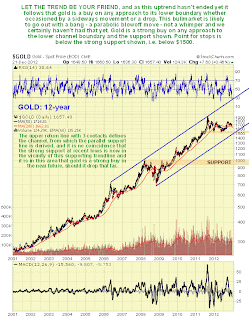
GOLD - TAKE A LOOK AT THE BIG PICTURE
As Gold prices have corrected over the last week, I think its time to once again take a look at a long term gold chart.
Mr P. Radomski of SUNSHINE PROFITS has an excellent long term gold chart

Perhaps the sell off can push gold down towards $1550.
Long term gold bulls must remain focussed on the long term trend.
Mr P. Radomski of SUNSHINE PROFITS has an excellent long term gold chart

Perhaps the sell off can push gold down towards $1550.
Long term gold bulls must remain focussed on the long term trend.
As Jim Sinclair said on 14/5/2012 -
The price of gold is going much higher. the problems that give gold its reason to go higher are growing not waning.Wednesday, February 13, 2013
FED ACTIONS AND THE FINANCIAL CRISIS - SUMMARY BY GAINS PAINS AND CAPITAL
Graham Summers of Gains, Pains and Capital in a recent write up on Feb 4, 2013, very aptly sums up the actions of the US Fed
""""""""""""""
""""""""""""""
Here's a recap of some of the larger Fed moves during the Crisis:
- Cutting interest rates from 5.25-0.25% (Sept '07-today).
- The Bear Stearns deal/ taking on $30 billion in junk mortgages (Mar '08).
- Opening various lending windows to investment banks (Mar '08).
- Hank Paulson spends $400 billion on Fannie/ Freddie (Sept '08).
- The Fed takes over insurance company AIG for $85 billion (Sept '08).
- The Fed doles out $25 billion for the automakers (Sept '08)
- The Fed kicks off the $700 billion TARP program (Oct '08)
- The Fed buys commercial paper from non-financial firms (Oct '08)
- The Fed offers $540 billion to backstop money market funds (Oct '08)
- The Fed agrees to back up to $280 billion of Citigroup's liabilities (Oct '08).
- $40 billion more to AIG (Nov '08)
- The Fed backstops $140 billion of Bank of America's liabilities (Jan '09)
- Obama's $787 Billion Stimulus (Jan '09)
- QE 1 buys $1.25 trillion in Treasuries and mortgage debt (March '09)
- QE lite buys $200-300 billion of Treasuries and mortgage debt (Aug '10)
- QE 2 buys $600 billion in Treasuries (Nov '10)
- Operation Twist reshuffles $400 billion of the Fed's portfolio (Oct '11)
- QE 3 buys $40 billion of Mortgage Backed Securities monthly (Sept '12)
- QE 4 buys $45 billion worth of Treasuries monthly (Dec '12)
The Fed is not the only one. Collectively, the world's Central Banks have pumped over $10 trillion into the financial system since 2007. This money printing has resulted in a massive expansion of Central Bank balance sheets, spread inflation into the system, and done nothing to address the key solvency issues that lead up to the great crisis."""""""""
Monday, February 4, 2013
JAPANESE GOVERNMENT DEBT AND THE JAPANESE YEN
Record high government debt that has so far been domestically funded, record low interest rates (positive real rates & until recently an appreciating Japanese Yen) and a current account surplus has enabled the Japan to continue to muddle its way through just over two decades of deflation.
According to Martin Feldstein -Even without the prospect of faster inflation and a declining yen, fundamental conditions in Japan point to higher interest rates. The Japanese government has been able to sell its bonds to domestic buyers because of the high rate of domestic saving. The excess of saving over investment has given Japan a current account surplus, allowing the country to finance all of the government borrowing domestically, with enough left over to invest in dollar-denominated bonds and other foreign securities. But that is coming to an end.
As the current administration promises to weaken the Japanese Yen and attempts to inflate its way out of debt, the stage may be set for a tragic end.
According to Martin Feldstein -Even without the prospect of faster inflation and a declining yen, fundamental conditions in Japan point to higher interest rates. The Japanese government has been able to sell its bonds to domestic buyers because of the high rate of domestic saving. The excess of saving over investment has given Japan a current account surplus, allowing the country to finance all of the government borrowing domestically, with enough left over to invest in dollar-denominated bonds and other foreign securities. But that is coming to an end.
The household saving rate has collapsed in recent years, falling to less than two per cent. The combination of high corporate saving and low business investment has sustained the current account surplus, allowing Japan to fund its budget deficit domestically. But the surplus has fallen sharply in the past five years, from roughly six per cent of GDP in 2007 to only one per cent now. With a falling rate of household saving and the prospect of new fiscal deficits, the current account will soon be negative, forcing Japan to sell its debt to foreign buyers.
As Satyajit Das says in his article - " Japans toxic combination of weak economic performance,large budget deficits,high and increasing levels of government debt,declining household savings and looming current account deficits is unsustainable."
WATCH THIS SPACE!
LINKS:
Monday, January 14, 2013
RUCHIR SHARMA -ON WHERE TO LOOK FOR SURPRISES IN 2013!!
Once again Ruchir Sharma comes up with an original insight for the market outlook in 2013.
Below are excerpts from the ECONOMIC TIMES NEWSPAPER IN MUMBAI on Monday 14th January 2013.
Below are excerpts from the ECONOMIC TIMES NEWSPAPER IN MUMBAI on Monday 14th January 2013.
LINK:
Surprises might deflate the bubbly confidence in emerging markets ...Even as investors continue to remain bearish about developed markets in the USA and the Eurozone, they remain oddly complacent about the prospects of emerging markets in Asia.
As he says at the end of his article, "" If you're looking for negative surprises, don't look in US or Europe, the starting point of the last two global shocks and where the risks are well-telegraphed. Crises occur when the consensus is too confident, spending and debt too loose, and right now, the early warning signs are gathering in the emerging world.""
Here is a more detailed excerpt
So what surprises might deflate the bubbly confidence in emerging markets? The first candidate is China, where the consensus forecast is still for GDP growth of 8% this year despite the fact that growth slipped below that level in 2012 and the strong case that China is just too big and middle-income a country to continue growing so fast. A major growth shock in China could rattle the commodity markets and the indebted emerging market countries, as 60% of the countries in the global emerging market bond indices are heavily dependent on exports of commodities.
Even perma-bulls on China are beginning to worry about two factors: incoming leader Xi Jinping has warned that rising corruption could lead to "the collapse of the party and the country", as he senses the popular resentment that has built up following the sharp rise in cases of bribery, graft and ostentatious spending by government officials in recent years. Second, liquidity outside the traditional banking sector is growing much too rapidly and this striking rise in liquidity is finding its way into all kinds of murky debt products.
The main issue is that this proliferation of alternative and local sources of credit is very difficult to track, so no one can fully quantify the risks. One investment bank calls wealth management products (WMPs) the CDOs of China — a reference to collateralised debt obligations, the exotic US debt instruments that triggered the global crisis of 2008. That's extreme, but systemic risk to the financial network in China is growing.
Another potential surprise from the emerging market world could come from a nation most likely to disrupt the spectacular boom in the global bond market. The reality is that macro stability, which so many emerging nations laboured to build in the last decade, is starting to erode in a few important markets, including some that have sizeable deficits in both the overall current account balance and the government's deficit. The twin deficits in South Africa and India are particularly worrying, in part because no one has seen a crisis in a major emerging market in 15 years, and because most investors expect 2013 to be much like 2012. If an unexpected shock comes in one of these big countries, it could prove highly contagious.
Given the political winds in South Africa, it looks like the bigger risk. President Jacob Zuma has reversed the one major achievement of his African National Congress successors: macro stability. Government spending is rising fast, fuelling a rise in real wages that is driving up consumption, and both the government deficit and the current account deficit are now around 5% of GDP.
Currently, South Africa's financial system is ranked as one of the best in the world. But with weak foreign reserves and a very heavy foreign presence in its stock and bond markets, South Africa is highly vulnerable to capital flight. Social tensions are also on the rise as the country has one of the lowest employment rates in the world and the economy is expanding at too slow a pace to create new jobs. So, if South Africa begins to totter, its size and reputation could produce a contagion effect.
Let us hope history and the consensus hold, and year five of the market recovery proves uneventful, and profitable. If you're looking for negative surprises, don't look in US or Europe, the starting point of the last two global shocks and where the risks are well-telegraphed. Crises occur when the consensus is too confident, spending and debt too loose, and right now, the early warning signs are gathering in the emerging world.
Sunday, January 6, 2013
GOLD - INTRADAY VOLATILITY ----
As the FED threatened to end its policy of limitless QE, Gold sold off rapidly.

From levels of just under $1690, Gold went all the way down to under $1630.
I would like to advise readers to take another look at Clive Maund's chart from my post on 31.12.2012.
Corrections down to the $1500-$1550, will complete the ongoing consolidation in gold bullion and will provide good buying opportunities.
Brace yourselves for volatility, and don't take your eye off the big picture.
As US Federal debt levels continue to rise, even as unemployment numbers stay stubbornly high; the US Fed will face it's toughest test yet.
The last thing that US homeowners need is a rising mortgage rate, so I remain skeptical of Bernanke's comments last week!

From levels of just under $1690, Gold went all the way down to under $1630.
I would like to advise readers to take another look at Clive Maund's chart from my post on 31.12.2012.
Corrections down to the $1500-$1550, will complete the ongoing consolidation in gold bullion and will provide good buying opportunities.
Brace yourselves for volatility, and don't take your eye off the big picture.
As US Federal debt levels continue to rise, even as unemployment numbers stay stubbornly high; the US Fed will face it's toughest test yet.
The last thing that US homeowners need is a rising mortgage rate, so I remain skeptical of Bernanke's comments last week!
Monday, December 31, 2012
GOLD AND SILVER - CONSOLIDATION IN A BULL MARKET
CLIVE MAUND once again has some excellent precious metal charts
.gif)

.gif)
Wednesday, December 12, 2012
IKEA - ADAPTING TO THE INDIAN CONSUMER
Ikea: Swedish social democracy meets DIY-unfriendly Indians - The ...
by Sanjay Badhe December 11, 2012 ECONOMIC TIMES
Even as the FDI in RETAIL debate rages on in India, here's an interesting article of how IKEA will have to adapt to the Indian Consumer.
Will IKEA be a hit or a miss in India?....... and will the DIY approach work in a country where cheap labour and cheap (although sometimes poorly made) furniture will result in stiff competition for IKEA.
"""""""""""""""""
"""""""""""""""""""""""""""
by Sanjay Badhe December 11, 2012 ECONOMIC TIMES
Even as the FDI in RETAIL debate rages on in India, here's an interesting article of how IKEA will have to adapt to the Indian Consumer.
Will IKEA be a hit or a miss in India?....... and will the DIY approach work in a country where cheap labour and cheap (although sometimes poorly made) furniture will result in stiff competition for IKEA.
"""""""""""""""""
So will IKEA adopt a cookie cutter approach-similar stores and products-which is the easiest to roll out and implement in India?
From the early days, IKEA has pushed the concept that both the furniture and stores should be unpretentious-standardised design, flat pack furniture, self service, friendly store design where it is easy for shoppers to choose and select, minimal advertising with a dependence on its catalogue and so on. And it passes on all the savings to consumers.
But, will concepts such as flat pack, take home and self assemble work here? Many Indians may not be open to the DIY model even though IKEA believes that getting the customer to put together the product gives a sense of involvement and pride. Will IKEA give the model a twist, as it did in the Middle East, to offer assembly and delivery at a price? In fact, India might well get an independent service of assemblers of IKEA furniture!
IKEA may also have to compromise on its store size because poor availability of space and high costs. IKEA prefers standalone stores, complete with service areas and storage, rather than malls although in the Middle East it does have stores inside malls. IKEA's awareness and image too would need attention. Interestingly, in India the brand might be seen as 'aspirational and fashionable' as in other emerging markets, and not the value-driven brand that it is in Europe. This might be good at the beginning, but could prove to be a problem for the value-driven Indian consumer.
Also, while the catalogue is critical, catalogue-based sales have not been very successful in India. Argos, a catalogue sales retailer that entered India in collaboration with K Raheja group's Shoppers Stop and HyperCity chains, has shut shop.
Will IKEA go for smaller, specific catalogues, arranged by categories, for India? Will it use electronic catalogues and use an online version?
IKEA's image is built around 'Swedishness', with liberal use of Swedish flag colours of blue and yellow as well as Nordic names for products. Will the lack of a 'Sweden perception' in India actually make the IKEA concept difficult to sell here?
Perhaps IKEA has to listen to the Indian consumer, before deciding its strategy in India.
"""""""""""""""""""""""""""
Tuesday, December 11, 2012
BAYERN MUNICH - FOOTBALL PROFITS
Earn it like Bayern - Business Standard -By Olaf Storbeck
Above is a link to an article from Business Standard Newspaper Mumbai, dated 20/11/2012.
Sound management, good regulation and steady ownership do matter.
"""""""""""
""""""""""""""""""""""
Above is a link to an article from Business Standard Newspaper Mumbai, dated 20/11/2012.
Sound management, good regulation and steady ownership do matter.
"""""""""""
In the mid-60s, the executives of a minuscule football club from southern Germany, Bayern Munich, travelled north toCologne to visit the country’s most successful team. They wanted to learn how to run a professional sports club. And, learn they did. Bayern has dominated the Bundesliga, Germany’s professional league, ever since.
It has also shown that the sport can be run as a financially successful business. The club has made a profit 20 years in a row. Revenue in the 2011-12 season rose 14 per cent to euro 332 million, with Ebitda up 63 per cent to euro 69 million. And, Bayern sits on a cash pile of euro 127 million.
Good regulation and steady ownership do matter. Bundesliga rules require that more than 50 per cent of the voting shares in the professional team belong to the club and its members. This prevents star-struck Russian oligarchs, bored US businessmen or spendthrift sheikhs to burn hundreds of millions buying professional teams on hazardous business plans. It also repels investors of the private equity type. Next to the club, two corporate investors ( Adidas and Audi) each hold about nine per cent of the shares in the professional team.
Bayern’s careful avoidance of the celebrity carnival sort that is the norm at clubs like Real Madrid or Manchester United is another reason for its economic success. The club shuns vanity hires, runs a successful academy, and keeps a significantly lower salary bill than its competitors. Bayern only spends 50 per cent of its revenue on players’ wages — against 70 per cent for the average English club, according to Deloitte. On the revenue side, German rules limit the clubs’ over-dependence on TV rights, inducing prudent behaviour.
Bayern’s financial clout should keep growing. The club is currently looking for a third external investor to pay about euro 100 million for a nine per cent share of the professional entity. And, a listing isn’t on the cards.
In the near future, new financial “fair play” rules edicted by the Union of European Football Associations ( UEFA), will hamper all teams’ ability to go on unsustainable spending sprees. This will play to Bayern’s advantage, and further consolidate its standing both on the domestic and international stage.
""""""""""""""""""""""
Friday, November 23, 2012

Thursday, November 22, 2012
RUCHIR SHARMA ON US ELECTION RESULTS AND THE US FISCAL CLIFF
Fantastic Article by Ruchir Sharma in the Economic Times Mumbai on Monday 12 November 2012.
EXCERPTS: (I highlighted some sentences in red colour for emphasis)
Ruchir Sharma on Why Obama won?
Even before the vote, prognosticators like Yale's Ray Fair who use just economic metrics to forecast election results pointed to a defeat for Obama, given persistently weak growth in per-capita income over his first four years. Fair was calling for Romney to win by a 51-to-48 margin. The polls showing that most voters saw the economy as the key issue only added to the mystery of how Obama beat the odds. The answer may be that, in their gut, voters understand that the US is not recovering from a normal recession, but from the worst crisis since the Depression, and, therefore, they chose to give Obama four more years, just as they did for Franklin Delano Roosevelt in 1936.
Historical evidence shows that the American economy has, in fact, not performed badly over the last four years, not when compared to its own previous track record in severe crises, or to other countries in similarly dire condition. The forecaster who expected an Obama defeat focused on how the debt problem is undermining US growth, which has fallen from a long-term rate of 3.4% in the decades before 2007 to just 2% this year, and is running slower than during the recovery phase of most post-war recessions. US economic output is now 10% below the trend line it was on before the crisis and still falling, which is the real reason for high unemployment. This case for the historically 'weak recovery' was the essence of the case against Obama's handling of the economy.
Voters seemed to choose, intuitively if not deliberately, the historical and global perspective of Harvard economists Kenneth Rogoff and Carmen Reinhardt, who argue that the relevant point of comparison is not the dozen or so recessions the US has seen since World War II, but the very different case of systemic financial crises. These are much more traumatic and rare, and by this standard, the US is recovering lost per-capita output faster than it did following previous systemic crises, from the meltdown of 1873 through the Depression of the 1930s, and also faster than most of the eurozone nations following the systemic crisis of 2008.
Ruchir Sharma on US FISCAL CLIFF - on US SPENDING CUTS - on US DEBT
He stresses the importance of debt reduction through spending cuts rather than tax increases.
The history of financial crises suggests that Washington has to get moving and address the debt burden now. In the developed world, the two most successful cases of recovery from a debt crisis were Sweden and Finland in the 1990s, and both began by cutting debt in households and corporations, while raising public debt to stimulate the economy. That is the path the US has followed - and followed more successfully than other rich countries since 2008 - with steep declines in US corporate and household debt. But this is the critical juncture. The Scandinavian cases show that, four years into the crisis or about where the US is today, the government needs to shift aggressively from stimulating the economy to putting in place a long-term plan to lower the public debt.
It can't be just any plan. From certain quarters of Washington, one hears a steady refrain about how the only way to balance the budget is to cut spending and raise taxes. But research clearly shows that the recovery is likely to be much stronger if the debt is reduced through spending cuts rather than tax increases.
Over the past quarter century, eight European countries have undergone periods of sharp government debt reduction, and those that reduced debt mainly or only through spending cuts, including Britain and Austria, saw their economies speed up during the belt-tightening process, and after some initial pain. In the Netherlands, Sweden and Finland, the governments actually lowered taxes while cutting spending, and saw the GDP growth rate accelerate, sometimes by a large margin. In the two best cases, Sweden saw its GDP growth rate roughly double, and Finland saw its GDP growth rate roughly triple, both to around 3%, which is very respectable for developed economies. In contrast, the countries of southern Europe - Italy, Greece and France - tried to put the budget in balance mainly through tax increases, and all of these economies saw GDP growth slow down.
So, economies digging out of debt perform better following spend cuts. But why? An August 2012 paper from the National Bureau of Economic Research, The Output Effect of Fiscal Consolidations, offers an extensive comparison of how countries have performed after periods of budget deficit reduction, and it concludes that the difference in results is nothing short of 'remarkable'. Spending cuts are typically followed by mild recessions, or no recession at all, while tax increases have been followed by prolonged recessions. The authors, Alberto Alesina, Carlo Favero and Francesco Giavazzi, note that the gap in performance is so sharp, it can't be explained away by differences in monetary policy; rather, the key seems to be the impact on business confidence compared to consumer confidence. Businesses tend to react to tax increases by dialling back, and to react to government spending cuts by investing more, which is what the US economy could use right now, when many businesses are sitting on record levels of cash on their balance sheets.
Regardless, the US economy looks likely to take some pain in the coming year, as Washington begins to deal with the debt problem. The market's worst fear is the 'fiscal cliff' that looms in January, when current law would impose a combination of tax hikes and spending cuts equal to 5% of GDP, which is likely to induce a recession if Congress doesn't act. However, a risk this clearly telegraphed typically gets resolved, even in Congress. The more likely risk is that Washington begins the process of debt reduction with a compromise package that could reduce growth by nearly 2% of GDP. That's a step in the right direction, long term, but could make for a rough 2013.
Over the coming decade, the global economic race will be decided in good part by which nations are first to tackle the debt problem, and one often overlooked factor is that the wealthy can cope with large debts more easily than the poor. By that measure, the total US debt burden of 350% of GDP may pose less of a challenge to Washington than, for example, China's total debt burden of 180% of GDP poses to Beijing.
The bigger picture for 2013 is that if Washington can produce a credible road map to lowering public debt, it could keep the US on track to be a Breakout Nation - as the strongest growth story in the developed world - this decade.
Saturday, September 22, 2012


Subscribe to:
Posts (Atom)