The richest 1 percent of Americans now take home almost 24 percent of income, up from almost 9 percent in 1976. As Timothy Noah of Slate noted in an excellent series on inequality, the United States now arguably has a more unequal distribution of wealth than traditional banana republics like Nicaragua, Venezuela and Guyana.
C.E.O.’s of the largest American companies earned an average of 42 times as much as the average worker in 1980, but 531 times as much in 2001. Perhaps the most astounding statistic is this: From 1980 to 2005, more than four-fifths of the total increase in American incomes went to the richest 1 percent.
That’s the backdrop for one of the first big postelection fights in Washington — how far to extend the Bush tax cuts to the most affluent 2 percent of Americans. Both parties agree on extending tax cuts on the first $250,000 of incomes, even for billionaires. Republicans would also cut taxes above that.
The richest 0.1 percent of taxpayers would get a tax cut of $61,000 from President Obama. They would get $370,000 from Republicans, according to the nonpartisan Tax Policy Center. And that provides only a modest economic stimulus, because the rich are less likely to spend their tax savings.
At a time of 9.6 percent unemployment, wouldn’t it make more sense to finance a jobs program? For example, the money could be used to avoid laying off teachers and undermining American schools.
Likewise, an obvious priority in the worst economic downturn in 70 years should be to extend unemployment insurance benefits, some of which will be curtailed soon unless Congress renews them. Or there’s the Trade Adjustment Assistance program, which helps train and support workers who have lost their jobs because of foreign trade. It will no longer apply to service workers after Jan. 1, unless Congress intervenes.
So we face a choice. Is our economic priority the jobless, or is it zillionaires?
USD CHF : The CHF broke down below parity in its recent rally vs the USD
USD CAD : It came ever so close to testing parity vs the USD
USD JPY : Despite the efforts of the Bank of Japan to weaken the JPY, the JPY continues its relentless upward march.
EUR USD : A weak EUR helped boost Germany's GDP numbers last quarter. the recent rebound in the EUR will surely make life difficult for the Club Med nations
Conclusion:
The USD appears to be oversold in the near term and a counter trend rally is underway. The market is betting on some mega fire power solution from the US Fed at its meeting in November. If QE2 disappoints and the equity markets sell off, the USD could stage a much stronger rally!
The Equity markets have been getting far too complacent about the weak and worrying news data and unemployment numbers in the US.
Fund flows to emerging markets have boosted stock prices across the board and a correction is well overdue. These markets are ''not decoupled from the actions of the US Fed'' and when the tide starts to turn we can expect large fund outflows to have a drastically negative impact on stock prices in emerging economies
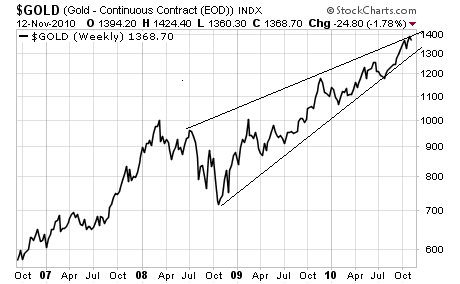
Lastly, the rally in Gold prices also appears ripe for correction and consolidation. Silver prices too, are clearly overstretched in the near term. expect lower prices if the USD stages a comback rally. It's not time to be buying the precious metals sector just yet!
Watch this space!
I recently came across some gold charts while reading a link I found at kitco.com
Could gold and silver have a repeat performance of those parabolic moves?
Well all I can say is who knows! Gold has been the top performing asset class of the last decade. The Every bull market has corrections along the way and the precious metals sector is no exception. So expect corrections and panic selling as part of the ongoing gold bullion bull market. The fundamentals are rock solid and long term buy and hold strategy is advised.
Once again I would like to warn investors not to try to time the precious metals market or indulge in leveraged trades when gold prices are rising. Instead look to buy in only after sell offs and corrections rather than chasing rising prices.

Overall, I continue to be wary of the ongoing rally in equity markets that seem to refuse to acknowledge poor economic data as well as the total lack of confidence on main street (especially in the developed world).
Are equity markets adequately factoring in a possible slow down in the second half of 2010? - I think not
Remember, it's better to be realistic that hopelessly optimistic.
I am still bullish on precious metals. We are also entering a 'seasonally strong' period for precious metals. Caveat Emptor - A sell off in equity markets will trigger a sell off in precious metals.
Expect upcoming posts on Gold, Silver and Indian Equities in coming weeks.
.