Wednesday, May 12, 2010

U.S. HOME PRICES – THE LONG, LONG TERM VIEW

Here's David Rosenberg again, this time with a chart from Prof. Robert Shiller's data.

Mean reversion is one sticky concept, that a debt addicted economy is going to have to come to terms with.
As the inventory of unsold homes and the shadow inventory of foreclosed homes continues to build, the downward pressure on home prices in the U.S.A. looks all set to continue.

Lastly, here is a link from Main Street that the guys on Wall Street should take a look at.

Food-stamp tally nears 40 million, sets record Reuters

""""""""Food stamps are the primary federal anti-hunger program, helping poor people buy food. Enrollment is highest during times of economic distress. The jobless rate was 9.9 percent, the government said on Friday.

The Agriculture Department said 39.68 million people, or 1 in 8 Americans, were enrolled for food stamps during February, an increase of 260,000 from January. USDA updated its figures on Wednesday.""""""""""""

Tuesday, May 11, 2010

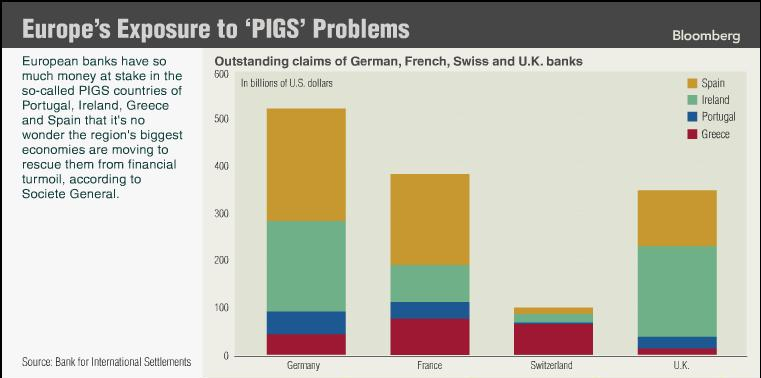
$962 Billion : Bailout of Club Med or the BANKS !!!

The markets certainly loved the mega ECB show of force.

Equity markets in Spain, Portugal and Greece soared, but did anyone notice how the financial stocks in France and Germany reacted yesterday!

AXA +21.87 %

BNP Paribas +20.90 %


Société Générale +23.89 %

Commerzbank + 8.97 %

Deutsche Bank +12.62 %


Here's an interesting take from Socio - Economics History Blog

Europe's Exposure To 'PIGS' Problem! « Socio-Economics History Blog


Friday, May 7, 2010

MANIC MARKETS - 6 May, 2010 !

Well, here we go again.
I don't know what happened, or why, or who, or whom!!
Let' s wait for more clarifications...
Nice move in Gold...........over $1,200 again!
As I said recently, this is just not the time to be taking on any undue risks.


Wednesday, May 5, 2010

INSURANCE COMPANIES IN INDIA

Below is a chart of the financial performance of Insurance companies in India.

Public sector behemoths like L.I.C. & New India Assurance have continued to maintain their stranglehold over the Indian Insurance sector.

ICICI Prudential, HDFC Standard Life & Bajaj Allianz have continued to gain market share, but have yet to make profits.

Equity market analysts are always trying to value the above above three insurance companies - to calculate the sum of parts valuation of their listed parent companies.

At this stage it's worth pointing out, that it may take a while for these guys to be profitable.
Cut throat competition and well established incumbents are delaying their break even dates.

Warren Buffett is rumored to be interested in the Indian Insurance sector.
In the long run, this sunrise industry is set for many decades of exponential growth, given the low penetration of insurance products in the Indian economy.

In the near term, we may be headed for a shake out or consolidation, as weak hands throw in the towel or sell out to larger players.

Watch this space.

......AND THE 'VIX' SOARS

Over the last couple of years, I've grown wary, well almost fearful when anyone says that any financial mess or crisis is '''contained'''.

Now, whenever I hear that the damage has been contained, I have come to expect the eventual cost of the crisis to be a whole lot more than initially estimated.

Some say that the crisis in Club Med is contained and that there is no risk of contagion.
Still others say that the finances of some states in the U.S.A., are not as terrible as pessimists may fear.

The prudent reader must read between the lines and ignore the noise in financial news as he makes his/her investment decisions.

The US is not immune to the current crisis in the Eurozone. A weak Euro will hurt US exports to Europe and subsidize European exports to the U.S.A.

Emerging market exporters are not immune to a slowdown in developed markets in the west.

As I've said in recent posts, it's not a time to be taking unnecessary risks.
Gold prices in the meantime have held up really well, despite a rally in the USD and a sudden sell off in global equity markets.

Thursday, April 29, 2010

INDIAN EQUITIES INDICES : % Weights by Sector.

Take a look at the newspaper clipping below.

The Indian Equity market provides international investors with an exposure to a well diversified emerging economy, that is not overly dependent on exports or raw materials and has a large domestic market.

BRIC nations like Brazil and Russia are more heavily concentrated on the commodity sector (basic raw materials).

China is an export oriented BRIC country.

However as the article says, the Agriculture and Trade sector are both absent from the NIFTY & BSE SENSEX.

Another point worth noting is the gradual rise in the % weight of the Banking and Financial services sector.
Internationally, both the FTSE (U.K) and the Hang Seng (Hong Kong) have considerable exposure to banking and financial services.

A Benchmark index must be truly representative of the underlying economy, and currently I feel that the Banking and Financial services' % weight in the index is too high.

In the long run, I would hope that sectors like Pharmaceuticals, Telecom, and Cement are given a greater share of the index.

The Automobile and FMCG sectors are also vital components when it comes to gauging consumer consumption demand.

INDIAN MONSOONS 2010

The monsoon rainfall last year was well below average.
As India waits for the arrival of the south west monsoon, everyone's hoping for a normal monsoon this year.

Insufficient rainfall resulted in rising food prices, as the prices of vegetables and food grains soared.

Last year, consumer demand in rural areas held up pretty well despite a poor monsoon. Continuing inflation, especially ''food price'' inflation will have a dampening effect on consumer consumption in the auto, FMCG & durable goods sectors.

Thus, a back to back season of insufficient rainfall will have serious repercussions for the Indian economy.

In the meantime, the India Meteorological Department (IMD) has forecast a normal monsoon across the country this year.

'''Lending a quantitative perspective to the available indications, IMD said the total rainfall during the June-September monsoon season would be 98 per cent of the long period average. This assessment is subject to a model error of ± 5 per cent.'''


Lastly, just a warning for those who may blindly follow the forecasts of the IMD!!

''''Last year too IMD had predicted a near-normal rainfall of 96 per cent. Two months later, in June, it issued an update scaling down its assessment to 93 per cent of normal. Both these predictions went awry. IMD then revised its forecast for a third time in August, this time predicting 87 per cent of normal rains.

These predictions, however, turned out wrong and the country received only 77 per cent of normal rainfall. This led to a drought in large parts of the country.'''''


Links:

TAKE A LOOK-India forecasts normal monsoon rainfall

Monsoon to dispel clouds over sugar, grain

MD predicts normal monsoon

Thursday, April 1, 2010

THE MGM STUDIO DEBT DEBACLE

Here's another failed deal from the 'LBO bubble' days of 2005.

Cheap money lead to excessive valuations for buyouts.

As I read the article below in the Economic times newspaper last week, I was reminded once again of how experts, analysts and investment bankers continued to justify deals that were irrationally dangerous and value destructive!

The only guys who benefited from these deals, were the investment bank advisers who earned massive fees on these now failing LBO deals.


Lastly, I leave you with an interview of the ever consistent, rational and down to earth - David Rosenberg.

He continues to be the lone voice advising caution and recommending measures to minimize portfolio volatility!

Link:
The bear: Dead or just sleeping? - The Globe and Mail

David Rosenberg - More downside to U.S. Home prices ?

The recovery in the U.S. housing market is taking longer than expected.
The crash in home prices has really eroded the networth of homeowners and rattled the U.S.consumer.

David Rosenberg recently highlighted the differences between Investor expectations and Consumer expectations (Wall St. vs Main St.).
In the chart below he raises a valid point of 'mean reversion' as the the shadow inventory of foreclosed homes and continuing foreclosures, continues to stress out the US Residential property market.