Showing posts with label INDIAN ELECTIONS. Show all posts

Friday, August 23, 2013

DHIRENDRA KUMAR ON THE SAD STATE OF THE INDIAN ECONOMY

A Long and Dark Journey

Our country’s economy is being run aground, and there’s little serious effort to revive it
LINK:

Here's an excerpt from his article

Let’s use a medical analogy for what is happening to our country’s economy. The global financial crisis of 2008 was like an infectious disease that spread rapidly. India was hit too, but we probably had better immunity than many others. On the other hand, India’s current economic crisis is like a cancer. Treatment is possible but it’s difficult and expensive and has a lot of harmful side effects. But the biggest problem is the doctor himself seems disinterested in the cancer. Instead, he and his assistants seem intent on fighting other incidental symptoms with treatments that will actually make the cancer worse.

However, the decline of the rupee is merely one symptom of the underlying disease. The core problems are that on one hand, the government’s expenditure is out of control and on the other, we are less and less competitive in the world. There’s a cascade of causes and effects that are interconnected in a web in which we are trapped. Excess government expenditure means huge borrowings. Government borrowing crowds out industry. Massive consumption expenditure by the government drives up inflation. Poor infrastructure and labour quality constraint supply and therefore make inflation out of control. High domestic inflation means that to remain competitive, the rupee must fall.

The relaxation of FDI limits is based on the notion that low limits are what is holding back investors. This is a fantasy. Poor infrastructure, corruption, red tape and a hostile regulatory and tax environment are the actual problems. If ownership limits were the issue then we wouldn’t have seen so many Indian business houses so interested in investing abroad.
I’m sorry for taking such a pessimistic view, but there are only a few silver linings and things will get worse before they get better.

Tuesday, August 20, 2013

USD INR - THE DOWNWARD SPIRAL INTENSIFIES

The Indian Rupee  has continued it slide versus the USD.
The INR is down almost 19% vs the USD since the beginning of May 2013!

Inaction and lack of reforms by the government have continued to compound problems of food inflation and currency depreciation.

At the present time, local investors are faced with volatile and mostly negative returns in both the equity markets and also the Indian Debt market, which has been severely rattled by sharply rising Government bond yields.

The only asset class that has managed to outperform and provide a hedge to local investors is GOLD.(thanks to a currency depreciation)

EXCELLENT POST FROM ZERO HEDGE:

Indian Rupee Collapses - Worst Day In 20 Years | Zero Hedge

The Indian Govenment has been steadily raising import duty on gold, in its continuing effort to rein in the current account deficit.

Watch this space. 
As valuations in the Indian Equity markets start to look attractive, remember that the country now faces a rather tricky situation of slowing growth, steady/persistant inflation, and a weak currency.

GDP growth rates of under 5% are now a distinct possibility.

While a sub 5% growth rate may appear robust to readers in the developed world----in emerging markets like India, it is extremely worrying.

Unemployment and non performing bank loans will be  serious problems over the next few years, if we are unable to get the economy back on track.


The inability of the RBI to cut interest rates (due to a rapidly depreciating currency and a rising current account deficit) will add to the woes of a struggling manufacturing sector. Stock prices of companies in the engineering / capital goods space are now trading at 8 year lows, and hopes of a recovery look bleak at the moment.

The Banking sector too has faced a drastic sell off in stock prices since May 2013. Public Sector banks will face considerable stress and even at todays discounted valuations, they still remain a high risk buy- meant only for those who are ready to weather more turmoil in the sector.

Perhaps, private sector bank stocks need to correct too, as expectations of growth are adjusted downward. Many private sector banks trade at expensive price/book ratios even after the initial sell off

Lastly, FMCG (Consumer staples), Pharmacaeuticals, and Information Technology (IT Services) remain the last pillars of strength.
Buying in these sectors should be done with extreme caution, as valuations may not leave an adequate margin of safety for the investor. 

These sectors will continue to relatively outperform the benchmark indices, as they function with nominal government price controls (FMCG) and in the case of export oriented Pharmacaeuticals and IT companies - are beneficiaries of currency depreciation.


Monday, September 3, 2012

RUCHIR SHARMA - On INDIA'S GDP, INFLATION & ECONOMIC OUTLOOK


Ruchir Sharma | Morgan Stanley
'Ratings downgrade possible; inflation worrying'

"""""Something similar is true of Indian policy as well that what we need to do first is stop doing any harm. So, even the first objective now seems to be that let's go back to where we were on February 28 before we had a terrible budget, lets reverse all those steps first then lets take it. In India's case its about lets stop doing any harm, lets reverse some of the damaging stuff that we have done over the past few months and not expect any big bang reforms which is going to transform everything in a second because those sort of sentiment swings are never healthy.
Can monetary policy do something about inflation or it can't?
This is where the intellectual debate goes on. I really think that the bigger fault lies with our spending habits rather than to do with the interest rates policy out here. You cannot keep spending as you said you can’t keep writing cheques which a country can’t cash. The average spending in India has been growing government spending about 15% a year ever since the UPA came to power in 2004 before that it was more like 10-11%. To me that is the fundamental problem.  """""""

Friday, August 17, 2012

INDEPENDENCE DAY -15.08.2012 - INDIA @65


Well, after a year of policy inaction, high inflation, and slowing growth; it's now 65 years since Indian Independence.

Below are links to a couple of articles that are well worth a read.
Ruchir Sharma and Swami Aiyar have an interesting take on Indian Independence and the Outlook for India's economic growth rate amidst a slowing and deleveraging global economy

RUCHIR SHARMA :
India's breakout path: It needs to break global growth script, not slavishly follow it


SWAMINATHAN AIYAR:
Independence Day: Why Partition was a good thing for India

Thursday, July 26, 2012

CRUDE OIL OVERVIEW -BUSINESS LINE NEWSPAPER - July 1, 2012

The Sunday Business Line Newspaper from ''THE HINDU'', on July 1, 2012 discusses the average price of an Indian Basket of Crude Oil and compares $/barrel and INR/barrel prices.

Crude Oil imports account for just over a third of  India's imports; and thus high Crude Oil prices coupled with a weak INR have resulted in persistent inflation despite high interest rates set by the RBI.

Also, this situation has resulted in rising government Petroleum (Oil sector) subsidies as the Indian Government continues to heavily subsidize retail fuels like Diesel, Cooking Gas and Kerosene.

If the price of Crude Oil refuses to correct despite a slowing world economy, and if the Indian Rupee fails to regain lost ground vs the USD; the Indian Government will have to rethink its policy of "unsustainable" Petroleum sector subsidies and instead plan for a gradual move to market driven - prices for fuel sold by the Oil Marketing companies.

Saturday, January 7, 2012

INDIAN EQUITIES -DEBT WORRIES SURFACE AS THE ECONOMY SLOWS

As the Indian Economy slows, a number of Indian Corporates may find that they over-stretched themselves while the going was good, and are now saddled with heavy debts to repay.

It's not that borrowing for business expansion is a bad thing in itself, it's just that some over-leveraged Corporates will struggle with debt servicing in 2012.

Some sectors that come to mind are the Airlines, Oil services, Ship- building and infrastructure.


Investors must keep in mind that although many stocks in these sectors trade at record low valuations, the Risk -Reward ratio may still not favour investors at this stage.

Remember some stocks have been beaten down for well deserved reasons, and investors must analyse their own risk return profiles before jumping in now.

In my view, many companies will need some debt restructuring before they can trurn things around.
This could mean that the banking sector too could take a while to recover, at least until interest rate cuts expected in the near future ease the liquidity concern of some cash strapped corporates.

Invest wisely!

Indian Equities - Looking Back at 2011 - PART 2

Here are a couple more articles to round up our look back at 2011!

Monday, January 2, 2012

INDIAN EQUITIES - LOOKING BACK AT 2011

Here are some articles from last year that I think are worth a read.

Indian Equities have been faced with a toxic combination of Policy inaction, high interest rates, a very weak Indian Rupee and waves of instability from western markets, primarily the EU.

The articles below provide some interesting views on the Outlook for 2011. Mukul Pal's contrarian outlook, highlights the point that beaten down sectors that have been written off by Mr. Market could surprise us in 2012!

Saturday, November 26, 2011

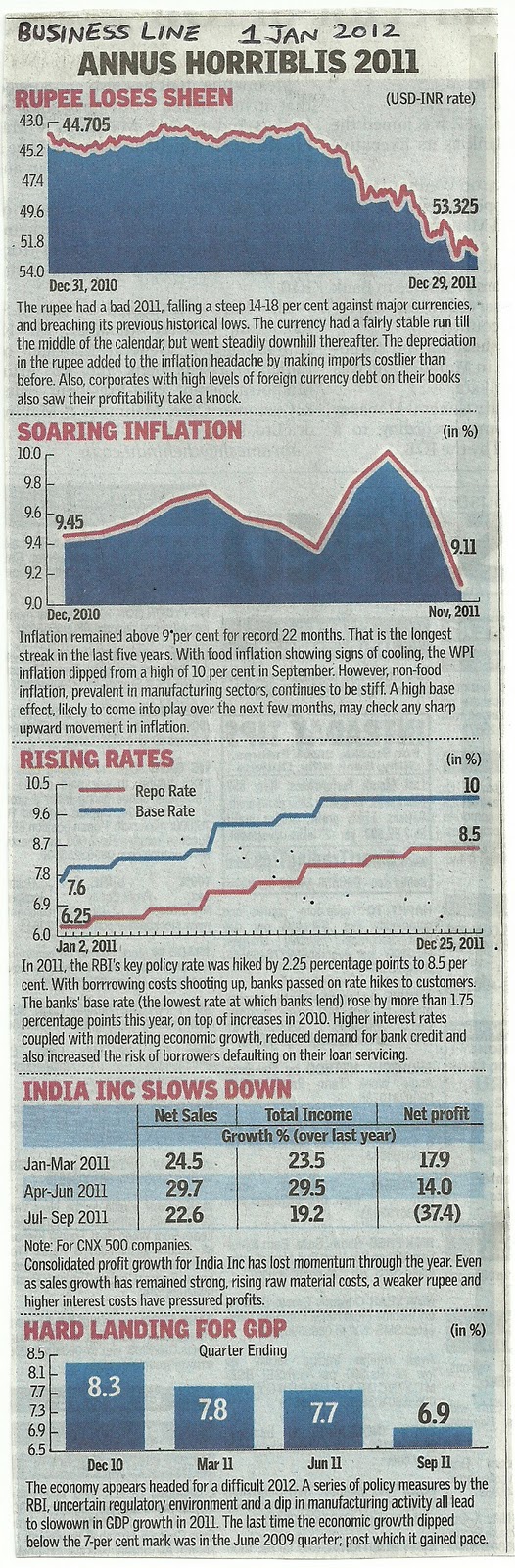
INDIAN RUPEE : FOREX FLUCTUATION & INDIAN POLICY REFORMS

Here is a good article from today's Business Standard Newspaper in Mumbai.
Rupee fall pares India Inc's profit by a fourth in Q2

If the weakness in the INR continues, upcoming FCCB redemptions, USD denominated foreign Currency borrowings and the rising cost of imported raw materials will continue to add to the woes of Indian Corporates in the results of the third quarter.

Many blame the INR weakness on FII selling in the Indian Equity markets.
While FII selling has played its part, I feel the ongoing Government policy malaise and concerns over the Government's Fiscal Deficit continue to weigh down the INR.
Currency downgrades by the Rating Agencies will add to the downward pressure on the INR.

Also, it's about time that the Indian Government gets down to implementing many long delayed reforms.

Some sectors in dire need of reforms
POWER SECTOR - Poor financial health of State Electricity Boards (SEBs) is forcing them to resort to  load shedding of power even as Power producers are left with surplus power that they are unable to sell. These SEB's must move towards a market determined pricing of power sold by them to distribution companies.
Merchant Power sales and Power trading are also facing many unresolved policy issues.
Under construction Ultra Mega Power Projects also face uncertainities due to fuel linkages (read: Coal allocation issues and royalty issues on Coal imported from Indonesia).
.
MINING SECTOR - Confusion over a proposed Mining Tax, profit sharing with locals displaced by Mining projects, Land acquisition delays and mining scams and corruption have delayed many Mining & Smelter projects.
.
FERTILIZER SECTOR - Partial implementation of the Nutrient Based Subsidy Scheme (NBS) and the delays in decontrol of Urea pricing have compounded the problems of the sector. Heavily subsidised Urea fertilizer has resulted in farmers opting to use Urea over DAP fertilizer. Excessive use of Urea has upset the balance of soil nutrients and has thus resulted in lower crop yields.
Any further delay in decontrolling Urea fertilizer pricing will add to government subsidies as the government continues to import Urea shortfall from overseas. A weak INR will add to the cost of imported Urea fertilizer.
.
TELECOM SECTOR - The ongoing 2G scandal and corruption cases continue to dominate news in the telecom sector. What the government must take a look at is reforming regulations that will promote consolidation in the Telecom sector. Recent issues of 3G roaming should also be clarified by the TRAI and the government, to avoid any further uncertainty in this sector.
.
AVIATION SECTOR - A combination of ''below cost '' fares by Air India,  record high ATF prices, ultra competitive air ticket prices, and record high debt of the airlines themselves has resulted in some serious structural problems in the Indian Aviation sector. FDI limits in Indian Aviation will have to be liberalised and a more viable tax structure on ATF will have to be worked out, if the existing carriers are to survive as going concerns. Perhaps the government will have to look at the development of "Low cost airports'' from which the Low Cost Carriers can operate, given the expensive Landing and Parking Costs at the country's main airports.
.
OIL SECTOR - Massive delays in implementation of a clear and viable Gas Pricing policy is delaying further development of Oil and Gas Blocks in the KG Basin. Until this vital issue is resolved, Fuel Linkage issues of Power & Fertilizer Plants will not be resolved. The longer it takes for this Gas to reach the market, the more will be the delays of construction of new Power and Fertilizer Plants.
Also the" retail fuel pricing - under recovery problem" of the Oil Marketing companies (OMCs) remains unresolved. Massive subsidies on retail fuels sold by the OMCs have weakened their finances over the last decade.
A weak INR+ high Crude Oil price is adding to the under recovery burden of the OMCs.
If the government fails to move to a market determined pricing mechanism for Retail fuels soon, these OMCs will soon need to be bailed out by the government.
.
All in all, it's about time that the government takes a step forward, and gets downto resolving these 'bottle neck' issues that are plaguing the Indian Economy at the moment.

If some of the supply side issues are worked upon, then perhaps the subsequent drop in inflation and an improvement in the government's fiscal deficit targets, will help the INR to regain some lost ground.

Tuesday, November 22, 2011

THE INDIAN RUPEE - WEAKNESS CONTINUES.....

The continuing weakness of the INR vs the USD is starting to worry both investors and regulators alike. Negative FII fundflows in the Equity markets is adding to the weakness of the INR.

At a time when inflation continues to be persistantly high, a weak INR will add to India's already increasing Crude Oil import costs.

The Equity Markets in India are preparing themselves for forex loss announcements from companies that import their raw materials and those that have large Foreign Currency borrowings.

We are now surpassing levels last reached during the heights of the financial crisis in the first quarter of CY 2009, just after the Lehman Crisis!

Energy and commodity prices were far lower in March 2009 than they are right now; so the Government and especially the Central Bank (R.B.I) will have to come up with some strategy to stabilize if not support the INR at current levels.

WATCH THIS SPACE!

Friday, July 15, 2011

INDIAN EQUITIES - AN UPDATE

Here's an article titled - 'A Two - Tier Market' by Akash Prakash from the Business Standard Newspaper dated 8th of July 2011 - Mumbai edition..


He addresses the issue overvaluation of the consumer-staples sector and highlights the difficulties of buying high-quality companies at a reasonable price in the Indian Stock Market.
.


Currently, many consumer staple stock trade with PE ratios of 30-35!
.


On the other hand, investors continue to shy away from industries that are in need of capital, mainly due to concerns of poor earning visibility. Many infrastructure companies are facing great difficulty in raising capital.


The article is a fantastic read.

Tuesday, June 28, 2011

INDIAN PETROLEUM SECTOR SUBSIDY CONUNDRUM

The Government of india finally implemented a long overdue price hike in diesel, LPG & Kerosene.

Even as inflation statistics continue to remain uncomfortably high, the government had to finally bite the bullet!
The government must come up with a long term viable pricing policy for petroleum products.
The Oil Marketing companies like BPCL, HPCL & Indian Oil cannot afford to keep subsidizing retail fuel prices. Currently their profitability is dependent on Oil bonds - a government handout!
.
Upstream marketing companies like ONGC & GAIL are helping the government to bear the losses from under recoveries, and this is preventing them from investing in Oil Assets and building Oil & Gas infrastructure like gas pipelines etc
.
The government will also have to step up investment in public transport infrastructure like metro rail projects & urban bus transport networks. Perhaps such a move will help reduce traffic congestion and in the long run reduce our heavy dependence on petrol and diesel.
.
Lastly I would like to point out that a large chunk of the levied retail fuel price on fuels like petrol and diesel, consists of govenment taxes that does not go to the oil companies, but is a major source of government revenue!
.
It's time that a truly sustainable long term fuel pricing policy is formulated.
With Crude Oil prices that continue to trade around $100/barrel, the government must come up with such a policy as soon as possible.
Below is an announcement by the Govt of India in the Economic Times on the 27th of June 2011.

Tuesday, March 2, 2010

INDIA's PETROLEUM SUBSIDY CONUNDRUM & the Kirit Parikh Committee Report

The Kirit Parikh Committee Report on subsidies in the Petroleum Retailing sector has made quite a few headlines in local news.
Link: http://petroleum.nic.in/reportprice.pdf

Recommendations include -

  • Free market pricing of Petrol and Diesel. The Kirit Parikh report suggests an additional levy of Rs. 80,000 on a diesel vehicle, citing that the higher excise must offset benefits vis-a-vis petrol vehicles. The report submits there is no need to subsidise users of diesel cars and SUVs, vehicles which are used for personal purposes.
  • Allowing periodic price increases for cooking gas (LPG) and Kerosene, based on performance of the agricultural sector and the rate of expansion of rural electrification. This will help rural India gradually adjust to the price hikes. Kerosene is used for lighting purposes in rural areas, so expanding rural electrification will reduce dependence on kerosene for lighting purposes
  • Excluding GAIL - the gas transmission behemoth from the under recovery subsidy burden.
All in all, the ever expanding petroleum sector subsidies are proving to be a real drain on the finances of the Indian government.
Oil subsidies are currently treated as an ''off balance sheet item''.
Implementation of these recommendations will thus present a ''truer'' picture of India's fiscal deficit.
To give you an idea of just how large the oil subsidy has been: -
From 2003-04 to 2008-09 total under recoveries amounted to Rs. 2,99,222 crores.


The market capitalization of India's largest private sector Giant - Reliance Industries is Rs. 3,23,235 crores!!!

The market capitalisation of the Benchmark BSE SENSEX index is Rs. 24,81,009 crores!


Question is : Does the Government have the political will to work past all the implementation issues and carry out these recommendations in the current inflationary environment?

Everyone knows that something need to be done.
The current pricing mechanism is just not sustainable with Crude Oil prices trading at $80!

Oil subsidies are the single biggest ''stimulus'' package that the government has provided to the economy.

But there is no free lunch!!

The balance sheets of government run oil sector companies are in bad shape.
The government too is struggling with 'oil bond' issues.

So can or will the government bite the bullet or continue to avoid tackling the issue head on, just as the Finance Minister chose to avoid discussing any specifics on implementing the Kirit Parikh report in the current Union Budget.


Friday, February 26, 2010

BUDGET DAY 2010

The Indian stock market has had a very quiet build up to Budget day 2010.
As the graph below shows: after a massive recovery from the March 2009 lows, Indian equities have been trending sideways since July 2009.


Market watchers will be looking for more sops to the agriculture sector and the infrastructure sector, and a possible gradual roll back of excise duty cuts and the stimulus package. A hike in service tax is also widely expected.

So far we are yet to hear anything on reforms towards market pricing in the Petroleum sector.
With Oil prices trading just under $80, maybe we will hear more on the governments subsidy sharing plan.


Let's see how it goes.

Friday, January 22, 2010

INDIAN EQUITY VALUATIONS

And then came the correction..........

Valuations are not just ''fairly priced'' in my opinion!!
Valuations are not cheap!
Sectors like Autos, FMCG and Engineering leave a wafer thin margin of safety for the investor.
As I have been saying in recent posts, it's definitely time to take some chips off the table.

Indian Stock Markets will have to cope with the current sell off in global equities as well as volatility and uncertainty as we head towards the Indian Union Budget.

The charts below show that equity returns in emerging markets like India are highly dependent on FII fundflows. The sustainability of these FII investments in emerging markets could face significant headwinds if the world economy heads for a ''double dip''

These charts are from the Business India Magazine - January 24, 2010.

Tuesday, June 16, 2009

INDIAN ECONOMY : GETTING BACK ON TRACK

The Indian economy has survived the global turmoil, and is now looking to consolidate its position as one of the few countries with a positive GDP growth rate that is driven by domestic consumption.

The Equity markets went into overdrive after a 'positive' election result, and the FIIs who were panic selling in March 2009, are now re emerging from the rubble with buy recommendations of various stocks!


While I'm not doubting India's positive long term prospects, there is clearly a lot of work to be done. As Jim Rogers recently said Indian politicians are big on promises, but execution quite often disappoints.

This brings me to a newspaper clipping from the Times of India, Mumbai, June 4, 2009. I have no idea of the accuracy of the survey undertaken, but I will say that irrespective of the political party in government, bureaucracy and red tape have always been major stumbling blocks!


India has tremendous potential - a hard working population, strong and growing household savings, and increasing levels of literacy albeit at a slow pace.
Unfortunately, if we do not clean up our act soon enough, we will continue to suffer from 'non inclusive growth', unfulfilled potential and a growing rural - urban divide.

COMING TO THE INDIAN GDP


Well the numbers look impressive (lets not forget we are battling a global slowdown!)

Here's a closer look -
Sectors like manufacturing and construction are slowing down.
Funding issues have started to stress expansion projects across sectors as companies have turned to conserving cash and paying down debt.

The figures of the recent quarters have been positively impacted by government stimulus packages ( reflected by rising government expenditure) as well as a sixth pay commission pay hike for government employees.

As the government looks to control its deficit in the upcoming budget, some subsidies and recent stimulus incentives may have to be rolled back, given that tax collections are expected to decline.

It's a wait and watch game for now, and the second half of 2009 looks as challenging as ever!

Friday, May 15, 2009

INDIAN ELECTIONS 2009

Well, its time for the election results!

Once all the campaigning and election promises are over and done with, there's a whole lot of work that is yet to be done.


This is a Financial Blog, so I'm not going to get drawn into an election debate, but I'd still like to make a few points.


  • India has survived the global financial tsunami, with its economy and banking system in far better shape than many countries.

  • While politicians from every political party are only too eager to take credit for this, there were obviously other reasons for that outcome.

  • The Indian Central Bank ( The RBI) has been very prudent through this crisis, monitoring the balance sheets of banks and avoiding frantic interest rate cuts. While Bank non - performing loans will definitely rise as the economy slows, overall most banks look to be in good shape. Leverage levels in the banking system, are far far lower than those at the largest US Banks.

  • The Indian Economy is a domestically oriented one, in comparison to some of her Asian counterparts who are export driven economies. Domestic demand has held up well so far. (although rising unemployment over the next year could hurt demand.) GDP growth isn't driven by Indian IT service exports or the financial sector alone. Agriculture and Industry (mining, manufacturing, electricity) as well as other Services (transport, communication and construction) make vital contributions

  • Although India will be unable to match the strong growth rates of recent years, current GDP growth rate estimates range from a conservative 4.5% to an optimistic 6.5%. I would think the lower end estimate to is more realistic; as I do not believe we are near the end of this down turn just yet

  • Given increasing levels of urbanisation, there is still a lot of infrastructure that needs to be set up. Transport infrastructure and Power Generation investments will have to increase, irrespective of which government comes to power.

  • Over the last few months, every political party has been campaigning aggressively and trying to secure allies incase the need of a coalition government arises ( a very likely outcome!). As the game of 'side swapping' and 'outside support' take centrestage over the next week, I hope these guys don't forget that they have a country to run.

  • India has great potential to emerge stronger from these trying times. Indians are savers and hard workers; and as a bonus: Companies operating here have a huge domestic market to cater to.

  • Lets not froget that they are many many people in this country for whom the Sensex at 21,000 and the BRIC (Brazil, Russia, India, china) nation concept means nothing!!!! Years of neglect by the political system post election time has resulted in extremely poor standards of living. Given that a social security/ welfare system is out of reach to so many, the government will have to pay close attention to the needs of this section of 'emerging India ' when times get tough.

  • Over the next 6 months many difficult decisions will have to be taken as unemployment numbers and bank non performing assets rise. This means labour disputes at factories and companies (especially the ones that over extended themselves) will need to approach the banks for debt restructuring. The government will have to work towards finding a solution to these problems rather than just resorting to populist policies at a time when tough decisions are needed.

The Equity markets here have been following global markets upward since early March, so lets wait and see how they respond to the results when they open on Monday morning.

Lastly, here is a clipping from the Business Standard newspaper( 8th May, 2009)


..