Showing posts with label INDIAN RUPEE. Show all posts

Saturday, January 7, 2012

INDIAN EQUITIES -DEBT WORRIES SURFACE AS THE ECONOMY SLOWS

As the Indian Economy slows, a number of Indian Corporates may find that they over-stretched themselves while the going was good, and are now saddled with heavy debts to repay.

It's not that borrowing for business expansion is a bad thing in itself, it's just that some over-leveraged Corporates will struggle with debt servicing in 2012.

Some sectors that come to mind are the Airlines, Oil services, Ship- building and infrastructure.


Investors must keep in mind that although many stocks in these sectors trade at record low valuations, the Risk -Reward ratio may still not favour investors at this stage.

Remember some stocks have been beaten down for well deserved reasons, and investors must analyse their own risk return profiles before jumping in now.

In my view, many companies will need some debt restructuring before they can trurn things around.
This could mean that the banking sector too could take a while to recover, at least until interest rate cuts expected in the near future ease the liquidity concern of some cash strapped corporates.

Invest wisely!

Indian Equities - Looking Back at 2011 - PART 2

Here are a couple more articles to round up our look back at 2011!

Monday, January 2, 2012

INDIAN EQUITIES - LOOKING BACK AT 2011

Here are some articles from last year that I think are worth a read.

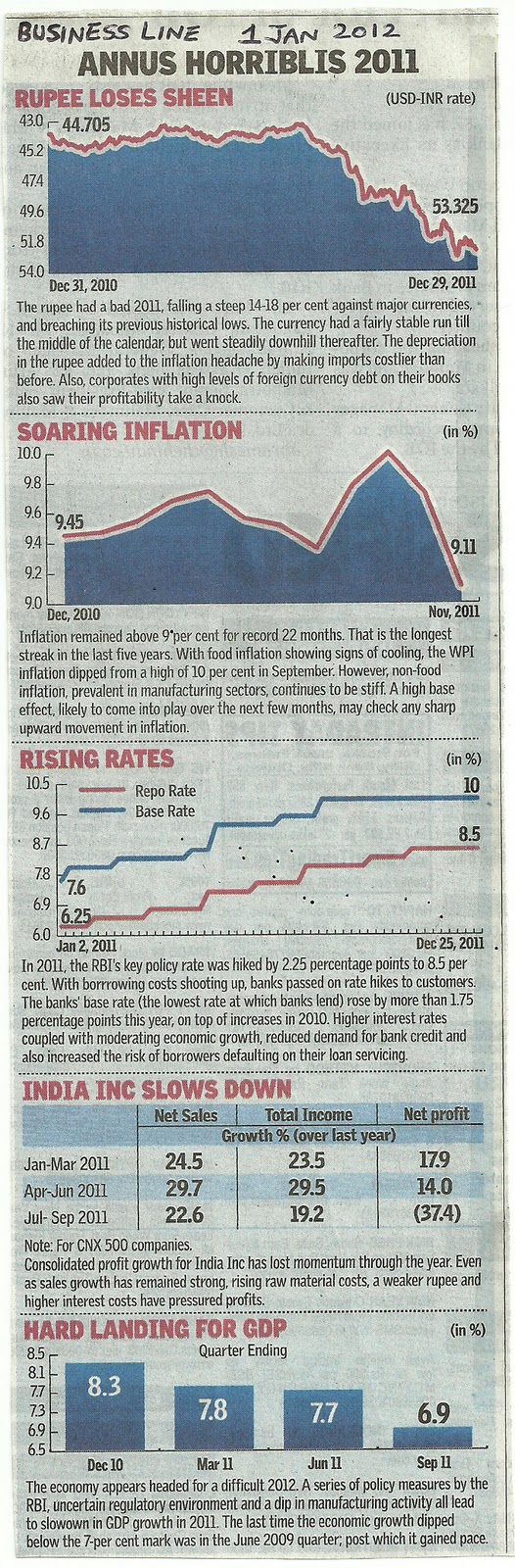
Indian Equities have been faced with a toxic combination of Policy inaction, high interest rates, a very weak Indian Rupee and waves of instability from western markets, primarily the EU.

The articles below provide some interesting views on the Outlook for 2011. Mukul Pal's contrarian outlook, highlights the point that beaten down sectors that have been written off by Mr. Market could surprise us in 2012!

Saturday, November 26, 2011

INDIAN RUPEE : FOREX FLUCTUATION & INDIAN POLICY REFORMS

Here is a good article from today's Business Standard Newspaper in Mumbai.
Rupee fall pares India Inc's profit by a fourth in Q2

If the weakness in the INR continues, upcoming FCCB redemptions, USD denominated foreign Currency borrowings and the rising cost of imported raw materials will continue to add to the woes of Indian Corporates in the results of the third quarter.

Many blame the INR weakness on FII selling in the Indian Equity markets.
While FII selling has played its part, I feel the ongoing Government policy malaise and concerns over the Government's Fiscal Deficit continue to weigh down the INR.
Currency downgrades by the Rating Agencies will add to the downward pressure on the INR.

Also, it's about time that the Indian Government gets down to implementing many long delayed reforms.

Some sectors in dire need of reforms
POWER SECTOR - Poor financial health of State Electricity Boards (SEBs) is forcing them to resort to  load shedding of power even as Power producers are left with surplus power that they are unable to sell. These SEB's must move towards a market determined pricing of power sold by them to distribution companies.
Merchant Power sales and Power trading are also facing many unresolved policy issues.
Under construction Ultra Mega Power Projects also face uncertainities due to fuel linkages (read: Coal allocation issues and royalty issues on Coal imported from Indonesia).
.
MINING SECTOR - Confusion over a proposed Mining Tax, profit sharing with locals displaced by Mining projects, Land acquisition delays and mining scams and corruption have delayed many Mining & Smelter projects.
.
FERTILIZER SECTOR - Partial implementation of the Nutrient Based Subsidy Scheme (NBS) and the delays in decontrol of Urea pricing have compounded the problems of the sector. Heavily subsidised Urea fertilizer has resulted in farmers opting to use Urea over DAP fertilizer. Excessive use of Urea has upset the balance of soil nutrients and has thus resulted in lower crop yields.
Any further delay in decontrolling Urea fertilizer pricing will add to government subsidies as the government continues to import Urea shortfall from overseas. A weak INR will add to the cost of imported Urea fertilizer.
.
TELECOM SECTOR - The ongoing 2G scandal and corruption cases continue to dominate news in the telecom sector. What the government must take a look at is reforming regulations that will promote consolidation in the Telecom sector. Recent issues of 3G roaming should also be clarified by the TRAI and the government, to avoid any further uncertainty in this sector.
.
AVIATION SECTOR - A combination of ''below cost '' fares by Air India,  record high ATF prices, ultra competitive air ticket prices, and record high debt of the airlines themselves has resulted in some serious structural problems in the Indian Aviation sector. FDI limits in Indian Aviation will have to be liberalised and a more viable tax structure on ATF will have to be worked out, if the existing carriers are to survive as going concerns. Perhaps the government will have to look at the development of "Low cost airports'' from which the Low Cost Carriers can operate, given the expensive Landing and Parking Costs at the country's main airports.
.
OIL SECTOR - Massive delays in implementation of a clear and viable Gas Pricing policy is delaying further development of Oil and Gas Blocks in the KG Basin. Until this vital issue is resolved, Fuel Linkage issues of Power & Fertilizer Plants will not be resolved. The longer it takes for this Gas to reach the market, the more will be the delays of construction of new Power and Fertilizer Plants.
Also the" retail fuel pricing - under recovery problem" of the Oil Marketing companies (OMCs) remains unresolved. Massive subsidies on retail fuels sold by the OMCs have weakened their finances over the last decade.
A weak INR+ high Crude Oil price is adding to the under recovery burden of the OMCs.
If the government fails to move to a market determined pricing mechanism for Retail fuels soon, these OMCs will soon need to be bailed out by the government.
.
All in all, it's about time that the government takes a step forward, and gets downto resolving these 'bottle neck' issues that are plaguing the Indian Economy at the moment.

If some of the supply side issues are worked upon, then perhaps the subsequent drop in inflation and an improvement in the government's fiscal deficit targets, will help the INR to regain some lost ground.

Tuesday, November 22, 2011

THE INDIAN RUPEE - WEAKNESS CONTINUES.....

The continuing weakness of the INR vs the USD is starting to worry both investors and regulators alike. Negative FII fundflows in the Equity markets is adding to the weakness of the INR.

At a time when inflation continues to be persistantly high, a weak INR will add to India's already increasing Crude Oil import costs.

The Equity Markets in India are preparing themselves for forex loss announcements from companies that import their raw materials and those that have large Foreign Currency borrowings.

We are now surpassing levels last reached during the heights of the financial crisis in the first quarter of CY 2009, just after the Lehman Crisis!

Energy and commodity prices were far lower in March 2009 than they are right now; so the Government and especially the Central Bank (R.B.I) will have to come up with some strategy to stabilize if not support the INR at current levels.

WATCH THIS SPACE!

Tuesday, October 4, 2011

INDIAN RUPEE - WEAK ASIAN CURRENCY

The Indian Rupee has joined its Asian peers and has weakened against the USD over the last few  months.

A weak Indian Rupee will make India's Crude Oil imports more expensive and thus add to inflationary pressures.
.
A weak Indian Rupee will also hurt the profitability of Indian Corporates with large USD denominated borrowings.
.
On the other hand, a weak Indian Rupee will boost the profitability of Indian IT exporters and export oriented Crude Oil Refineries

Watch this space!!

Friday, July 15, 2011

INDIAN EQUITIES - AN UPDATE

Here's an article titled - 'A Two - Tier Market' by Akash Prakash from the Business Standard Newspaper dated 8th of July 2011 - Mumbai edition..


He addresses the issue overvaluation of the consumer-staples sector and highlights the difficulties of buying high-quality companies at a reasonable price in the Indian Stock Market.
.


Currently, many consumer staple stock trade with PE ratios of 30-35!
.


On the other hand, investors continue to shy away from industries that are in need of capital, mainly due to concerns of poor earning visibility. Many infrastructure companies are facing great difficulty in raising capital.


The article is a fantastic read.

Friday, December 17, 2010

A TALE OF TWO INDIAS !

The Economist magazine recently published an article regarding India on 25.11.2010 titled

Graft in India - Rotten to the Core? Coping with the aftermath of a massive scam !!!
And who's to say that they are off the mark as far as the story goes.


We have been on a never ending roller coaster of scams.

  • IPL - Cricket scam -issues regarding benami -ownership structures of teams
  • Commonwealth games scam.
  • Adarsh Building scam in Mumbai - Illegal Building on Army land
  • Telecom 2G scam - That's a mega one!
  • Public Sector bank officials involved in a loans for bribes scam.
  • Stock price rigging scam being investigated by SEBI.
  • Nira Radia tapes - involving journalists, industrialists etc!

So we have massive wealth disparity, income inequality, corruption, rural poverty, poor infrastructure and then we have on the other hand an ecomnomy that's doing fantastically well, while the world economy is still reeling under the strain of slowing consumer consumption and record debt levels.


.
.
.
.
.
.

.
.
.
.

..
.
.
..
.
..
.
.
.


While its going to be a never ending discussion about the politicians, industrialists and other individuals involved in these scams, there are some facts and lessons that an investor in Indian markets can take away from this mess.

  • While the Indian Economy does present a fantastic investment opportunity to both Indian and overseas investors, it can be bumpy ride at times.

  • While the Indian government continues to move slowly on / ignore vital issues like wealth disparity, rural poverty, overburdened infrastructure and the poor state of primary education and healthcare facilities across India, they must realise that this economic boom cannot continue unless they start to tackle the above mentioned critical problems and target "inclusive growth".

  • Remember to curtail investments to firms where the management has a credible track record and takes care of the interests of all stakeholders concerned - & not just themselves! You may come acoss an interesting investment opportunity, but if the management has a dodgy track record, just stay out!

  • If SEBI fails to rein in the Equity market scamsters, it will result in a massive blow to SME (Small and medium enterprises) businesses in India. The SMEs are the ones most affected by these stock rigging scams because a tightening of bank credit across the SME sector will deny working capital loans to many deserving and good quality small cap companies in India

  • The incredible progress that has been made by Corporate India has been made inspite of our politicians and not because of them!

  • While I'm not condoning the massive, almost blatant and shameless corruption here in India; we live in a world where politicians in most countries are no better than the ones we have here. It may be less blatant but sadly,corruption goes on!

  • There is incredible corruption,short termism and lack of leadership in global politics today.As someone rightly said, " The people who want to be in politics are not the people whom you want to be in politics". No politician is willing to fix a problem that he can kick further down the road, an example being the *crazy debt crisis* facing the western world today! Imagine asking consumers who have no savings to start overspending and re- leveraging again - Thats both WRONG & insane!

  • Lastly, remember that the prudent investor does not chase an over extended stock market rally. Remember to wait for pull backs and always look to invest in good quality stocks, with managements that have an established track record!

Wednesday, March 17, 2010

Indian Government Bonds : 10 year benchmark yield crosses 8 percent

Growing government borrowing requirements and a tighter monetary policy will be factors driving the Indian Government Bond Market this year.

Rising yields will expose public sector banks to losses on the 'Available for sale' part of their government bond portfolios.

The strong Indian Rupee may begin to pressure exporters as well.
Interest rate sensitives will feel the pinch of the rising cost of credit, and credit offtake may slow still further

The public sector Oil companies are still awaiting a government decision on subsidy sharing. A strong Rupee somewhat cushions their under recovery on sale of retail fuels.

Wednesday, January 6, 2010

WELCOME TO 2010 !

Well i'm back again!
Before I begin posting new stuff for 2010, let's just take a quick look back at investment returns of the last decade!

Here's a chart from Jesse's Café Américain. Even as Gold and Silver have been star outperformers, its just amazing how little coverage they get on CNBC!

Chart of the day covers a multi decade DJIA return chart.


Clearly the 1980's and 1990'S were years of blockbuster returns in US equities.
Expert stock pickers like Warren Buffett generated market beating returns over this period.
Looking at returns over the 1960's and 1970's is almost frightening! Can the current ipod-blackberry-google search generation cope with it!
It's happened before, but can we cope with marginal returns while servicing a massive debt overhang this time round?

The Indian equity markets had a fantastic last decade.
Just a few years prior to 2000, India's manufacturing sector was in bad shape. Over the last decade, these same manufacturers have bounced back - cutting costs, improving efficiency and product quality.

Companies in the IT services space have also survived the 2000 IT/ dotcom meltdown, and have become globally recognised franchises.
The current decade will need record investments in infrastructure development if India is to emerge as a ''superpower'' by 2025!!
Reducing income disparity and improving the standard of living of people in rural India are also crucial to India's future development.

Lastly, I'd like to draw your attention to the CBOE VIX volatility Index.
Jesse's Café Américain has a good chart on the VIX.
We are not out of the woods yet! The world economy is getting ''addicted'' financial stimulus packages and ever expanding government debt and deficits.
Those looking for jobs and those trying to hang onto jobs they ''despise'' are clearly not as optimistic as equity market analysts are.
I will be putting up a post on ''what to look forward to'' and ''what to look out for'' in 2010. I'm working on it now, but it should be up in a couple of days.

Friday, February 27, 2009

Weakness in Asian currencies continues

Source: Re closes at record low of 50.48
Continued capital outflows and stock markets sinking to new lows, have resulted in considerable downward pressure on Asian Currencies in 2009.
Most of the countries in the list are export oriented economies.
As demand from customers in the US & Europe continues to slow, producers in Asia are going to struggle.
Weak local currencies might help exporters to some extent, but that may not be enough to stimulate demand in Western Markets.
Meanwhile Gold has risen to new highs in most local currencies ( except the JPY), boosted further by weak asian currencies.
Lastly, the questions everyone should be now asking are -
How long can the Asian Export Economies continue to allow their currencies to slide vs the USD? &
Are Asian Central Banks safe in USD Treasury Bonds even as the US Government continues to bailout every entity that is too big to fail?