

Showing posts with label SOVEREIGN FUNDS. Show all posts
Showing posts with label SOVEREIGN FUNDS. Show all posts
Thursday, March 15, 2012


Wednesday, August 5, 2009
Dubai Financial Support Fund : DUBAI RECOVERY ?
Launched in July 2009, the Support Fund “ is being established with the specific purpose of providing financial support and liquidity to Government and Government-Related Entities (GREs) undertaking projects of strategic importance within Dubai that contribute towards the overall economic development of the Emirate.”
“The Dubai Financial Support Fund will be responsible for managing the proceeds of the
The emirate of
Forays into Shipping & Ports and international investments by the emirate’s sovereign wealth funds also ran into rough waters as world stock markets started to slide, and GDP growth rates tanked.
The oil price crash last year also scared foreign investors away from Dubai debt (raising concerns of solvency at $35 Crude Oil), as it’s a well known fact that the emirate of Abu Dhabi holds the majority of the UAE’s oil reserves.
The U.A.E's Central bank took up the first tranche of a $20 billion bond issue in February this year. The emirate of
Even as the level of risk aversion is receding (blame that on the green shoots!), investors are still concerned about new corporate and government debt issues.
Some cite issues regarding transparency. Which entities get the money? How does it get deployed? Is it going to be backed by the U.A.E. Government?
Still others remain wary of emerging market debt in general, especially from countries with high exposure to ‘bubble’ sectors like Real Estate (
Sky high valuations and excessive debt, raise concerns about the debt servicing ability of the borrower.
Another worrying factor is the overwhelmingly large percentage of investors (rather than genuine homeowners) in the Dubai Property market. We all know what happens when everyone tries to exit a market at the same time!
Lastly, if the global economic recovery is slower than expected or we were to have another down leg in the equity markets, how would Oil prices react?
How would the Dubai debt markets react to $35 Oil?
I end this post by highlighting a few points
- I respect the view of the
- Long Term Investments require a long term investment horizon.I’m disappointed that many acquisitions have been debt funded and that too sometimes at high prices. Servicing this debt during the downturn can prove to be very stressful.
- Real Estate Risk : Massive 'debt funded' construction projects could be saddled with large inventories if the recovery takes longer than expected, an outcome that is quite probable in an ‘investor’ driven property market.
Source Links:
U.A.E. Central Bank Steps In to Support Dubai Debt (Update1 ...
Sheikh Mohammed launches Dubai Financial Support Fund to sustain ...
ANALYSIS - Dubai's opaque $10 bln bond plan leaves investors wary ...
Saudi Gazette - Dubai launches Financial Support Fund to bolster ...
Full Coverage: IFB:- Dubai to borrow second $10bln
Istithmar World Capital »Istithmar World
Dubai World
Nakheel may Revise Terms of $750m Sukuk
Dubai housing prices plunge by half from peak - BusinessWeek
Saturday, November 22, 2008
CITI NEVER SLEEPS
............and neither do any of their investors it would seem, given the way the stock has tanked!!!

The Government of Singapore, the Abu Dhabi Investment Authority, the Kuwait Investment Authority and Prince Alwaleed bin Talal of Saudi Arabia have all seen their investments slide sharply in value.
A few weeks ago, I commented on the lack of interest from Sovereign Wealth Funds to invest in global financial institutions. Do they know something that we don’t!!
A year ago, these guys were stepping up to the plate as white knights, but now they seem to have abandoned these ‘emergency one time cash infusions’ in institutions that are losing money faster than the automakers.
The management has tried to reassure panic stricken investors, but after the Lehman Brothers debacle, no ones taking any chances.
CITIGROUP vs. GM
If push came to shove, which one would they bailout?
White-collar jobs vs blue-collar jobs?
Could the Fed & Treasury risk a collapse at Citigroup?
Are we in for a ‘Bailout Weekend’, and could we expect a government rescue by Monday?
WATCH THIS SPACE!!!
The Government of Singapore, the Abu Dhabi Investment Authority, the Kuwait Investment Authority and Prince Alwaleed bin Talal of Saudi Arabia have all seen their investments slide sharply in value.
A few weeks ago, I commented on the lack of interest from Sovereign Wealth Funds to invest in global financial institutions. Do they know something that we don’t!!
A year ago, these guys were stepping up to the plate as white knights, but now they seem to have abandoned these ‘emergency one time cash infusions’ in institutions that are losing money faster than the automakers.
The management has tried to reassure panic stricken investors, but after the Lehman Brothers debacle, no ones taking any chances.
CITIGROUP vs. GM
If push came to shove, which one would they bailout?
White-collar jobs vs blue-collar jobs?
Could the Fed & Treasury risk a collapse at Citigroup?
Are we in for a ‘Bailout Weekend’, and could we expect a government rescue by Monday?
WATCH THIS SPACE!!!
Friday, February 8, 2008
TEMASEK HOLDINGS
“Temasek Holdings is an Asia investment house headquartered in Singapore. With a multinational staff of more than 300 people, we manage a portfolio of over S$160 billion, or more than US$100 billion, focused primarily in Asia. We are committed to fostering a sustainable future for our shareholder, staff, portfolio companies and the community.” http://www.temasekholdings.com.sg/
Here is a wikipedia link with recent updates of investment stakes held by Temasek.
http://en.wikipedia.org/wiki/Temasek_Holdings


Recent High Profile Investments
After its recent investment in Merrill Lynch, Temasek now owns approximately 9.4% of Merrill Lynch.
It recently announced that it owns 19% of Standard Chartered.(up from 13% on 31 mar 07)
Its sister concern, the Government of Singapore Investment Corp, invested almost $ 10 Billion in UBS AG recently.
Temasek and The Government of Singapore Investment Corp operate as Investment Management Companies / Private Equity Arms / Sovereign Wealth funds of the Singapore Government. GIC was set up to manage Singapore's foreign reserves.
Over the years Temasek has been a long term investor mainly in Asian markets, acquiring sizable stakes in large companies.
Here is a list of its major investments as on 31st March 2007.
http://www.temasekholdings.com.sg/our_portfolio_portfolio_highlights_major_investments.htm#fs7
Over the years Temasek has been a long term investor mainly in Asian markets, acquiring sizable stakes in large companies.
Here is a list of its major investments as on 31st March 2007.
http://www.temasekholdings.com.sg/our_portfolio_portfolio_highlights_major_investments.htm#fs7
Here is a wikipedia link with recent updates of investment stakes held by Temasek.
http://en.wikipedia.org/wiki/Temasek_Holdings
For an accurate list of investment holdings, please refer to the annual statement from Temasek as of 31 March 2008, which will be put up later this year.
TEMASEK INVESTMENTS BY REGION AND SECTOR http://www.temasekholdings.com.sg/
Recent High Profile Investments
After its recent investment in Merrill Lynch, Temasek now owns approximately 9.4% of Merrill Lynch.
It recently announced that it owns 19% of Standard Chartered.(up from 13% on 31 mar 07)
Its sister concern, the Government of Singapore Investment Corp, invested almost $ 10 Billion in UBS AG recently.
The current activities of Sovereign funds such as Temasek mark an inflection point in the history of financial markets. With a shift of wealth and assets from west to east, investors from Asia are acquiring businesses in the west, during a crisis, at exceedingly low prices.
The new buyers will gain access to western markets, by acquiring well established businesses and brand names. They will also indirectly acquire a foothold in the subsidiaries of large multinational corporation businesses built up in Asia over the last few decades .
Over the long term, this will be the biggest loss for investors and business owners in the west, being forced to sell out when prices are down.
The new buyers will gain access to western markets, by acquiring well established businesses and brand names. They will also indirectly acquire a foothold in the subsidiaries of large multinational corporation businesses built up in Asia over the last few decades .
Over the long term, this will be the biggest loss for investors and business owners in the west, being forced to sell out when prices are down.
Tuesday, January 15, 2008
The Goldilocks Economy : Return of the Bears
Post the Dot com crash, 9/11 and the subsequent Fed rate cuts, the US economy went from a Stock market bubble to a Housing Bubble.
Cheap money has resulted in
Cheap money has resulted in
- Inflated asset prices,
- Rising raw material prices(oil, base metals, metal ores, and coal)
- An extreme out performance across emerging markets,
- Overleveraged and overvalued LBO deals
- Rising home prices in the US coupled with refinancing of home mortgages at lower rates, enabling the US consumer to spend his way out of a recession post 9/11.
- An exponential expansion in mortgage backed derivatives fuelled by a once booming US housing market.
Here's what happened>>>
Fed Rates hit a 45 year low of 1% in 2003.  The US Stock Market rallied, as the Goldilocks economy(moderate economic growth : not too hot or cold & low inflation, ) continued on its way.
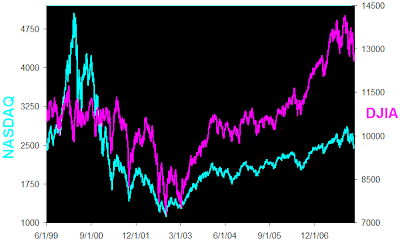 Through 2004 & 2005 the US Dollar staged a comeback as interest rates started to rise, only to resume its downtrend in 2006 as the US Housing market started to crumble.

High debt levels, falling US home prices, and rising interest rates have resulted in a mega catastrophe. US Consumer Confidence is low and as the economy continues to slow, the US consumer will cut back on spending. Huge cash infusions by Central Banks and bailouts by Arab and Asian investors have been unavoidable as leading investment banks are struggling to meet regulatory capital adequacy requirements. The mess in the derivative markets continues, with concerns over losses in Credit-default swaps, and many mortgage backed derivative securities now being seen as toxic WMDs.
Uncontrolled credit expansion encourages reckless consumption and excessive leverage. When the prices of leveraged & overvalued assets start to unwind, the consequences are disastrous.
So are we heading for a "Stagflationary" Bear Market in the US?
Slow economic growth, Inflation and relatively high unemployment = Stagflation
Gold has always done well in such periods, when Central Banks are unable to raise rates to combat inflation due to slowing growth.
Meanwhile, economies such as India and China are consuming increasing quantities of oil, raw materials and food grains as the standard of living across the region continues to rise. Due to their low cost advantage, Asian economies are emerging as manufacturing centres of the world, as production activities continue to shift to developing economies.
Friday, November 30, 2007
WORLD'S LARGEST SOVEREIGN WEALTH FUNDS

http://www.economist.com/printedition/displayStory.cfm?story_id=9230598&fsrc=RSS
The recent "bailout" of Citigroup by the Abu Dhabi Investment Authority (ADIA) has once again highlighted the crucial role that sovereign funds will play in financial markets in the future.
The Abu Dhabi Investment Authority is the world's largest sovereign wealth fund(as mentioned in 'The Economist' article). Since 1976, the fund has never publicly revealed its total assets or published any accounts & provides very little information about its investments: in fact its website provides just its contact details.http://www.adia.ae/
But if the $875 Billion figure is accurate, the Citigroup deal represents just 0.86% of its overall assets.
Citigroup, the world's largest bank is paying junk bond rates (11%), to secure a $7.5 billion capital injection to shore up its balance sheet. The investment is via convertible securities that will convert to Citigroup common stock at $31.83 to $37.24 a share over the next two to four years.
The questions one needs to ask are 'How bad is the situation at Citigroup?' and 'How large are the fourth quarter writedowns going to be?'
The Citigroup stock is down over 43 % from it 52 week high, and the mortgage and credit crisis shows no signs of abating.
Heres yesterdays US dollar update from Economist magazine.
http://www.economist.com/opinion/displayStory.cfm?Story_ID=10215040

Subscribe to:
Posts (Atom)