Showing posts with label OPEC. Show all posts

Tuesday, June 28, 2011

INDIAN PETROLEUM SECTOR SUBSIDY CONUNDRUM

The Government of india finally implemented a long overdue price hike in diesel, LPG & Kerosene.

Even as inflation statistics continue to remain uncomfortably high, the government had to finally bite the bullet!
The government must come up with a long term viable pricing policy for petroleum products.
The Oil Marketing companies like BPCL, HPCL & Indian Oil cannot afford to keep subsidizing retail fuel prices. Currently their profitability is dependent on Oil bonds - a government handout!
.
Upstream marketing companies like ONGC & GAIL are helping the government to bear the losses from under recoveries, and this is preventing them from investing in Oil Assets and building Oil & Gas infrastructure like gas pipelines etc
.
The government will also have to step up investment in public transport infrastructure like metro rail projects & urban bus transport networks. Perhaps such a move will help reduce traffic congestion and in the long run reduce our heavy dependence on petrol and diesel.
.
Lastly I would like to point out that a large chunk of the levied retail fuel price on fuels like petrol and diesel, consists of govenment taxes that does not go to the oil companies, but is a major source of government revenue!
.
It's time that a truly sustainable long term fuel pricing policy is formulated.
With Crude Oil prices that continue to trade around $100/barrel, the government must come up with such a policy as soon as possible.
Below is an announcement by the Govt of India in the Economic Times on the 27th of June 2011.

Monday, May 2, 2011

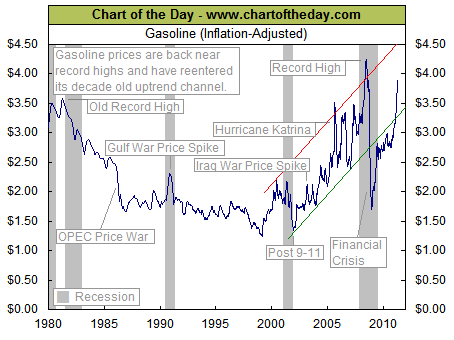
RISING GASOLINE PRICES

A chart from http://www.chartoftheday.com/.

A weak USD and high Crude Oil prices has resulted in rapidly rising gasoline prices.

Saturday, July 3, 2010

JON STEWART : An Energy Independent Future!

The Daily Show With Jon StewartMon - Thurs 11p / 10c
An Energy-Independent Future
http://www.thedailyshow.com/
Daily Show Full EpisodesPolitical HumorTea Party

Just remember, it's not just the U.S.A!!!!!

For the forseeable future, Crude Oil will remain the main fuel source driving the world's ''oil hungry'' economies.

As car sales zoom in China & India, consumption of refined petrochemical products will rise.

This means that the world's oil companies will have to continue to drill for crude oil in deep offshore blocks. Increasing fuel efficiency and enforcing ''clean fuel '' norms can only take us so far. It's time to prepare disaster managment plans for deep off shore drilling.

Accidents may occur, but it will be a whole lot better if the drillers and regulators have disaster management plans and solutions in place before such unfortunate accidents occur again, instead of continuing a never ending blame game!


Friday, January 30, 2009

THE SLIPPERY CRUDE OIL MARKET

A year ago, almost no one would expect Crude Oil to trade below $40 by Christmas 2008!!

The world was preoccupied with growing Indian and Chinese Oil consumption, Peak Oil and a never ending demand for refined petroleum products.
With drastically slowing GDP growth rates the world over, prospects for Crude Oil are not too bright.

Prices are expected to slide further as inventories build up.

Longer term I am an Bullish on Crude Oil, and would exercise caution while taking aggressive short positions in Crude Oil.
THE END OF CHEAP OIL?
Analysing Fundamentals:
While cheap credit and availability of financing may have encouraged almost ''wasteful'' oil consumption recently; on the supply side - there has been no addition of ' Easy Oil' to exising oil fields. Moreover, recent discoveries like the Tupi oil field off the coast of Brazil are unviable at current prices.

As the world battles deflation (read: unemployment + bank failures + debt defaults + credit contraction), geopolitical tensions are likely to flare up.

The USD and other 'paper' currencies are battling a toxic cocktail of bailouts & stimulus packages. Currency Volatility and Currency Crisis could result in higher nominal Crude Oil prices.

I am keeping a close watch on Crude Oil prices and will put up some more analysis on the Gold-Oil Ratio soon.

Monday, June 2, 2008

FUEL CRISIS : AIRLINES

As Crude Oil prices continue to trade above the $125 mark, Airlines around the world are struggling with their Aviation Turbine Fuel (Jet Fuel) Bills.

"""" “For every dollar that the price of fuel increases, our costs go up by US$1.6 billion,” said Giovanni Bisignani, IATA Director General and CEO at the Association’s 64th Annual General Meeting and World Air Transport Summit (WATS/AGM) """"""


"""""The International Air Transport Association (IATA) called on governments, industry partners and labour to address the fuel crisis that is pushing airlines into the red. IATA forecasts a loss of US$2.3 billion for 2008 based on an average oil price of US$106.5 per barrel Brent crude."""""""

http://www.iata.org/index.htm
http://www.iata.org/pressroom/pr/2008-06-02-02.htm
http://www.iata.org/pressroom/pr/2008-06-02-01.htm

After the Bear Stearns bailout, Airlines are going to be next, unless oil prices cool off soon.

Meanwhile in India, ATF prices are among the most expensive in the world, as the government subsidises other fuels such as Petrol, Diesel, Kerosene and Cooking Gas (LPG).
http://economictimes.indiatimes.com/Economy/Govt_moves_towards_fuel_price_hike/articleshow/3090992.cms

As a result, most airlines in India are now resorting to raising the fuel surcharge on tickets
http://economictimes.indiatimes.com/News/News_By_Industry/Air_fares_head_north_as_carriers_hike_fuel_surcharge/articleshow/3094206.cms

Tuesday, May 27, 2008

TRADING CRUDE OIL FUTURES IN THE MIDDLE EAST

The Dubai Gold and Commodities Exchange (DGCX), has launched its West Texas Intermediate Light Sweet Crude oil (DWTI) and Brent Crude Oil (DBRC) futures contracts.

The Iranian Oil Bourse was launched in February this year. http://en.wikipedia.org/wiki/Iranian_Oil_Bourse

Crude Oil has pulled back from its recent highs, and prices continue to remain volatile
Are we heading towards pricing Crude Oil in a basket of currencies as against USD contracts ?
Will we see Middle East Oil exporters drop/change their USD pegs ?

http://www.reuters.com/article/ousiv/idUSL2565817720080525?sp=true
While its too early to know what might happen, these moves could possibly lead to some drastic changes in the way Crude Oil is traded.
WATCH THIS SPACE !!


Here are some links:
http://www.gulf-times.com/site/topics/article.asp?cu_no=2&item_no=220806&version=1&template_id=48&parent_id=28
http://www.marketwatch.com/news/story/commodities-corner-oils-tense-trading/story.aspx?guid=%7BECDC33C0-2A10-4616-8274-158A8C593379%7D&dist=hplatest
http://www.ameinfo.com/158332.html

Monday, December 31, 2007

SMOKE & MIRRORS 2008 ! !

2008 can be best described as the year of Smoke & Mirrors.
Reassuring comments and massive liquidity infusions from central bankers, never-ending losses at investment banks, rising inflation and slowing global growth: 2008 will keep you guessing. It will be an ongoing game of hide and seek, cover ups, assurances, lies and blame games, in the US election year

“Smoke and mirrors is a metaphor for a deceptive, fraudulent or insubstantial explanation or description. The source of the name is based on magicians' illusions, where magicians use smoke and mirrors to accomplish illusions such as making objects disappear, when they really don't disappear at all. The expression may have a connotation of virtuosity or cleverness in carrying out such a deception.” (Source: wikipedia)


AVOIDING A US RECESSION IN 2008

A cautious approach to investing in 2008 is best advised. The world’s equity markets are near their recent highs, despite turmoil in the credit markets, record high oil prices and food prices, large write downs in the US financial sector, and a rapidly slowing US economy.

In a bid to build confidence in the system, Central Banks around the world have continued to pump liquidity into the markets, in an attempt to revive a frozen credit market and illiquid derivative market. Banks are refusing to lend against asset backed securities including mortgage backed securities as confidence is low, and no one is sure of the asset quality on the counterparty’s books; with banks still unwilling to disclose the full extent of their losses.

The credit crisis of July and August this year has still not abated and continues to haunt world markets. 2008 will see more write-offs, bailouts, fund infusions and maybe takeovers of large US and European financial companies, by investors from the Middle East and Asia.

Outrageous bonuses paid to investment bankers and CEOs at financial institutions are going to be questioned. Their short term oriented decisions and dangerous underestimation of risk have resulted in large losses that have eroded the capital of such banks.

US ECONOMY 2008

  • Crisis in the housing market: An inventory glut, rising mortgage payments and increasing defaults
  • Cutbacks in US Consumer spending & Falling consumer confidence: Layoffs in the manufacturing sector as well as high profile jobs in the financial sector will affect both consumer consumption and the housing market.
    As a result of heavy discounting at US retailers November sales were better than expected. 2008 will be a difficult year for US retailers.
  • Credit crunch arising from the sub prime crisis & risks of increasing defaults in 2008.
    Wall Street is demanding FED rate cuts. The Fed is caught between a rock and a hard place, with rising inflation, slowing growth and a declining US Dollar.
  • Resetting of mortgages poses another risk to the default rate, even as the US government is coming up with all kinds of schemes to freeze mortgage resetting, ahead of an election year.
  • The ill-conceived SIV Bailout conduit appears to be a non starter, with many banks moving SIVs back onto their own balance sheets.
  • Write downs and write offs in the US financial sector, are spreading to financial Institutions around the world. European & Japanese banks and large Insurance companies may be holding a lot of junk paper.

  • Large Bond Insurers in the US, face losing their AAA ratings, due to potential subprime and CDO losses. Bond Insurers have ventured beyond the usual municipal securities into structured finance such as collateralized debt obligations, guaranteeing about $1.2 trillion of structured finance debt. Caught up in the subprime mess, they will need to raise additional capital to meet regulatory capital adequacy requirements.
    Bankruptcies and loss of AAA ratings at Large bond insurers will affect the credibility of the bond market as a whole, something the market is refusing to acknowledge at the moment.

Avoiding a global slowdown
Net US exports have grown due to a strong global economy. In the event of a US slowdown/ recession, the world market will struggle to decouple from the US.
Any slowdown / cutback in US consumer spending will hurt Asian economies that are large exporters to the US. As a result, Asian demand for exports from the US will fall sharply.
These Asian exporters in turn have been importers of industrial commodities and raw materials from South America, Australia and Africa, and Crude oil mainly from the Middle East.
The Decoupling theory will not work, if the US goes into recession.

OUTLOOK 2008

The best strategy for 2008 is to maintain liquidity in ones portfolio. Fresh buying in equities may be delayed, but booking profit in overvalued sectors would be advisable.

GOLD

I expect GOLD to outperform. Gold can be bought on declines, which will occur when Equity markets correct, as gold is liquidated to meet margin calls. Rising inflation and a falling USD are very gold positive. December 2007 marks the first time that gold has made a monthly and annual closing above $ 800.

CURRENCIES

The US Dollar will face strong headwinds, and this should be positive for Non- USD currencies. The USD may strengthen in the short term, when world equity markets correct, as investors exit foreign currencies and return to the USD. Longer term the USD will continue to decline.


I continue to be cautious on the Euro and the GBP. Though they will continue to strengthen, a strong Euro is hurting European exporters (e.g.: Airbus, B.M.W) while the recent slowdown in UK growth rates, high debt levels & a weakening housing market may force rate cuts in the UK. Political intervention cannot be ruled out.


Carry trade currencies such as the Swiss Franc and the Japanese Yen will strengthen if the markets crash/correct sharply.

‘Commodity’ currencies such as the Brazilian Real, South African Rand, Canadian Dollar and Australian Dollar, will react negatively to news of slowdown in consumption of Industrial Commodities and Oil.

The Oil producing nations of the Middle East may be forced to unpeg their currencies from the US Dollar if local inflation rates rise further, and the USD continues to decline.

Other currencies that should do well against the USD will be the Singapore Dollar and the Swedish Kroner.

OIL

Oil prices will be very volatile. A weakening USD is oil positive, but a slowing world economy will reduce oil consumption. The US is the world’s largest oil consumer. A US slowdown would be oil negative.

EQUITY MARKETS


Markets around the world appear to be ignoring all of the above mentioned risks and concerns. I am bearish on the US Stock markets. Valuations are not cheap and expectations are far too optimistic given the problems the US is currently facing.
Tightening of global liquidity and lack of depth in Asian and emerging stock markets can result in sharp corrections in these markets, which have seen a phenomenal run up over the last five years.
While I am buying select Indian Equities, I continue to book profit in many long term holdings. If you are entering into a new position today, make sure that valuations are reasonable and that you are ready to adopt a long term buy on declines and hold strategy. Avoid buying into popular sectors that are overvalued and leave you with no margin of safety as an investor.

I will put up a detailed note on Indian Equities soon.

Invest wisely and safely in 2008. Heres wishing everyone a very Happy New Year!

Saturday, December 8, 2007

OPEC OIL


Source: OPEC

SAUDI ARABIA & OPEC

Saudi Arabia, the world's largest oil producing nation and the key "swing" oil exporter, has always dominated OPEC decisions.

The GHAWAR oil field located in Saudi Arabia is the world's largest oil field. The field is entirely owned and operated by Saudi Aramco, the nationalized Saudi oil company. Discovered in 1948, it measures 280 km by 30 km and has more than 70 billion barrels of remaining reserves of Arabian Light crude (33 API). Ghawar’s producing capability of more than five million barrels per day is unmatched by any single entity in the world.

Other large oil fields include Cantarell in Mexico producing 2 million barrels per day, Burgan in Kuwait producing 1 million barrels per day and Da Qing in China producing 1 million barrels a day.


Points to note :
  • Oil prices are near their all time highs.
  • OPEC members are concerned about a falling US Dollar.
  • Middle Eastern countries are considering removing their US Dollar peg.
  • Pricing of Oil in a basket of currencies in the future as against USD denominated contracts currently.
  • The USA is the No. 1 Oil consumer.
  • Impact of a US slowdown/recession on Oil prices.
  • Impact of a US slowdown/recession on Asian economies (that export to the USA), that are currently large oil consumers.
  • Impact of declining production at large oil fields such as Ghawar and Cantarell, as well as oil fields in the North Sea.