Thursday, July 26, 2012
CRUDE OIL OVERVIEW -BUSINESS LINE NEWSPAPER - July 1, 2012
Wednesday, March 14, 2012
Saturday, January 7, 2012
Saturday, November 26, 2011
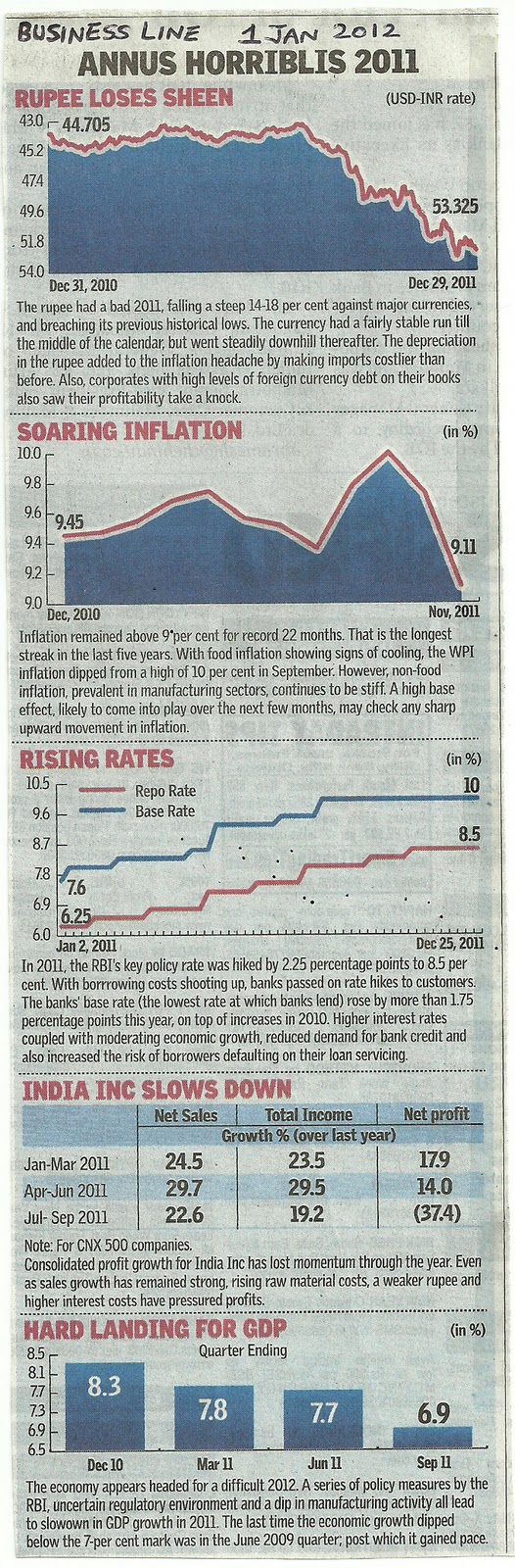
INDIAN RUPEE : FOREX FLUCTUATION & INDIAN POLICY REFORMS
Rupee fall pares India Inc's profit by a fourth in Q2
If the weakness in the INR continues, upcoming FCCB redemptions, USD denominated foreign Currency borrowings and the rising cost of imported raw materials will continue to add to the woes of Indian Corporates in the results of the third quarter.
Many blame the INR weakness on FII selling in the Indian Equity markets.
While FII selling has played its part, I feel the ongoing Government policy malaise and concerns over the Government's Fiscal Deficit continue to weigh down the INR.
Currency downgrades by the Rating Agencies will add to the downward pressure on the INR.
Also, it's about time that the Indian Government gets down to implementing many long delayed reforms.
Some sectors in dire need of reforms
POWER SECTOR - Poor financial health of State Electricity Boards (SEBs) is forcing them to resort to load shedding of power even as Power producers are left with surplus power that they are unable to sell. These SEB's must move towards a market determined pricing of power sold by them to distribution companies.
Merchant Power sales and Power trading are also facing many unresolved policy issues.
Under construction Ultra Mega Power Projects also face uncertainities due to fuel linkages (read: Coal allocation issues and royalty issues on Coal imported from Indonesia).
.
MINING SECTOR - Confusion over a proposed Mining Tax, profit sharing with locals displaced by Mining projects, Land acquisition delays and mining scams and corruption have delayed many Mining & Smelter projects.
.
FERTILIZER SECTOR - Partial implementation of the Nutrient Based Subsidy Scheme (NBS) and the delays in decontrol of Urea pricing have compounded the problems of the sector. Heavily subsidised Urea fertilizer has resulted in farmers opting to use Urea over DAP fertilizer. Excessive use of Urea has upset the balance of soil nutrients and has thus resulted in lower crop yields.
Any further delay in decontrolling Urea fertilizer pricing will add to government subsidies as the government continues to import Urea shortfall from overseas. A weak INR will add to the cost of imported Urea fertilizer.
.
TELECOM SECTOR - The ongoing 2G scandal and corruption cases continue to dominate news in the telecom sector. What the government must take a look at is reforming regulations that will promote consolidation in the Telecom sector. Recent issues of 3G roaming should also be clarified by the TRAI and the government, to avoid any further uncertainty in this sector.
.
AVIATION SECTOR - A combination of ''below cost '' fares by Air India, record high ATF prices, ultra competitive air ticket prices, and record high debt of the airlines themselves has resulted in some serious structural problems in the Indian Aviation sector. FDI limits in Indian Aviation will have to be liberalised and a more viable tax structure on ATF will have to be worked out, if the existing carriers are to survive as going concerns. Perhaps the government will have to look at the development of "Low cost airports'' from which the Low Cost Carriers can operate, given the expensive Landing and Parking Costs at the country's main airports.
.
OIL SECTOR - Massive delays in implementation of a clear and viable Gas Pricing policy is delaying further development of Oil and Gas Blocks in the KG Basin. Until this vital issue is resolved, Fuel Linkage issues of Power & Fertilizer Plants will not be resolved. The longer it takes for this Gas to reach the market, the more will be the delays of construction of new Power and Fertilizer Plants.
Also the" retail fuel pricing - under recovery problem" of the Oil Marketing companies (OMCs) remains unresolved. Massive subsidies on retail fuels sold by the OMCs have weakened their finances over the last decade.
A weak INR+ high Crude Oil price is adding to the under recovery burden of the OMCs.
If the government fails to move to a market determined pricing mechanism for Retail fuels soon, these OMCs will soon need to be bailed out by the government.
.
All in all, it's about time that the government takes a step forward, and gets downto resolving these 'bottle neck' issues that are plaguing the Indian Economy at the moment.
If some of the supply side issues are worked upon, then perhaps the subsequent drop in inflation and an improvement in the government's fiscal deficit targets, will help the INR to regain some lost ground.
Wednesday, August 10, 2011
MARKET UPDATE: THESE ARE CRAZY DAYS
Tuesday, June 28, 2011
INDIAN PETROLEUM SECTOR SUBSIDY CONUNDRUM
Even as inflation statistics continue to remain uncomfortably high, the government had to finally bite the bullet!
The government must come up with a long term viable pricing policy for petroleum products.
The Oil Marketing companies like BPCL, HPCL & Indian Oil cannot afford to keep subsidizing retail fuel prices. Currently their profitability is dependent on Oil bonds - a government handout!
.
Upstream marketing companies like ONGC & GAIL are helping the government to bear the losses from under recoveries, and this is preventing them from investing in Oil Assets and building Oil & Gas infrastructure like gas pipelines etc
.
The government will also have to step up investment in public transport infrastructure like metro rail projects & urban bus transport networks. Perhaps such a move will help reduce traffic congestion and in the long run reduce our heavy dependence on petrol and diesel.
.
Lastly I would like to point out that a large chunk of the levied retail fuel price on fuels like petrol and diesel, consists of govenment taxes that does not go to the oil companies, but is a major source of government revenue!
.
It's time that a truly sustainable long term fuel pricing policy is formulated.
With Crude Oil prices that continue to trade around $100/barrel, the government must come up with such a policy as soon as possible.
Below is an announcement by the Govt of India in the Economic Times on the 27th of June 2011.
Monday, May 2, 2011
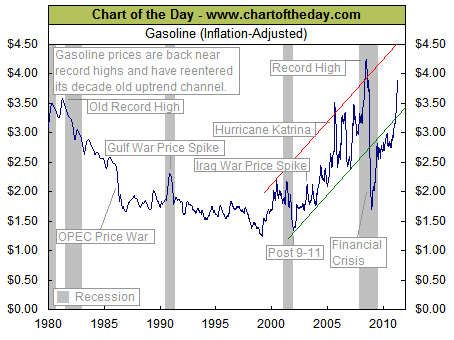
RISING GASOLINE PRICES
A weak USD and high Crude Oil prices has resulted in rapidly rising gasoline prices.
Saturday, July 3, 2010
JON STEWART : An Energy Independent Future!
| The Daily Show With Jon Stewart | Mon - Thurs 11p / 10c | |||
| An Energy-Independent Future | ||||
| http://www.thedailyshow.com/ | ||||
| ||||
Just remember, it's not just the U.S.A!!!!!
For the forseeable future, Crude Oil will remain the main fuel source driving the world's ''oil hungry'' economies.
As car sales zoom in China & India, consumption of refined petrochemical products will rise.
This means that the world's oil companies will have to continue to drill for crude oil in deep offshore blocks. Increasing fuel efficiency and enforcing ''clean fuel '' norms can only take us so far. It's time to prepare disaster managment plans for deep off shore drilling.
Accidents may occur, but it will be a whole lot better if the drillers and regulators have disaster management plans and solutions in place before such unfortunate accidents occur again, instead of continuing a never ending blame game!
Tuesday, March 2, 2010
INDIA's PETROLEUM SUBSIDY CONUNDRUM & the Kirit Parikh Committee Report
Link: http://petroleum.nic.in/reportprice.pdf
Recommendations include -
- Free market pricing of Petrol and Diesel. The Kirit Parikh report suggests an additional levy of Rs. 80,000 on a diesel vehicle, citing that the higher excise must offset benefits vis-a-vis petrol vehicles. The report submits there is no need to subsidise users of diesel cars and SUVs, vehicles which are used for personal purposes.
- Allowing periodic price increases for cooking gas (LPG) and Kerosene, based on performance of the agricultural sector and the rate of expansion of rural electrification. This will help rural India gradually adjust to the price hikes. Kerosene is used for lighting purposes in rural areas, so expanding rural electrification will reduce dependence on kerosene for lighting purposes
- Excluding GAIL - the gas transmission behemoth from the under recovery subsidy burden.
Oil subsidies are currently treated as an ''off balance sheet item''.
Implementation of these recommendations will thus present a ''truer'' picture of India's fiscal deficit.
To give you an idea of just how large the oil subsidy has been: -
From 2003-04 to 2008-09 total under recoveries amounted to Rs. 2,99,222 crores.
The market capitalization of India's largest private sector Giant - Reliance Industries is Rs. 3,23,235 crores!!!
The market capitalisation of the Benchmark BSE SENSEX index is Rs. 24,81,009 crores!
Question is : Does the Government have the political will to work past all the implementation issues and carry out these recommendations in the current inflationary environment?
Everyone knows that something need to be done.
The current pricing mechanism is just not sustainable with Crude Oil prices trading at $80!
Oil subsidies are the single biggest ''stimulus'' package that the government has provided to the economy.
But there is no free lunch!!
The balance sheets of government run oil sector companies are in bad shape.
The government too is struggling with 'oil bond' issues.
So can or will the government bite the bullet or continue to avoid tackling the issue head on, just as the Finance Minister chose to avoid discussing any specifics on implementing the Kirit Parikh report in the current Union Budget.
Monday, November 23, 2009
BEWARE THE CONSENSUS VIEW!
Friday, January 30, 2009
THE SLIPPERY CRUDE OIL MARKET
The world was preoccupied with growing Indian and Chinese Oil consumption, Peak Oil and a never ending demand for refined petroleum products.

With drastically slowing GDP growth rates the world over, prospects for Crude Oil are not too bright.
Prices are expected to slide further as inventories build up.
Longer term I am an Bullish on Crude Oil, and would exercise caution while taking aggressive short positions in Crude Oil.
THE END OF CHEAP OIL?
Analysing Fundamentals: While cheap credit and availability of financing may have encouraged almost ''wasteful'' oil consumption recently; on the supply side - there has been no addition of ' Easy Oil' to exising oil fields. Moreover, recent discoveries like the Tupi oil field off the coast of Brazil are unviable at current prices.
As the world battles deflation (read: unemployment + bank failures + debt defaults + credit contraction), geopolitical tensions are likely to flare up.
The USD and other 'paper' currencies are battling a toxic cocktail of bailouts & stimulus packages. Currency Volatility and Currency Crisis could result in higher nominal Crude Oil prices.
I am keeping a close watch on Crude Oil prices and will put up some more analysis on the Gold-Oil Ratio soon.
Saturday, December 13, 2008
COMMODITY MELTDOWN !!
This deleveraging commodity meltdown has been much faster than most expected, as speculators and leveraged hedge funds have bailed on this once '''must have sector'''. Now that the'weak hands' have been forced out, commodities look interesting again!!!
Welcome to Commodities round 2!

While I am not a big fan of Base metals/metal ores, even these commodities have seen a sharp selloff! Given the global slowdown and recession we are in, industrial metals and ores could take a while to recover.
GOLD - meanwhile has held its own amidst all the turmoil in the credit markets, stock market and in the real economy. I repeat that Gold IS NOT A METAL, but a currency that is a true store of value.
It is one of the most liquid mediums of exchange; something that many high networth individuals who are trapped in ILLIQUID HEDGE FUNDS may now realise!
I continue to be quite optimistic on soft commodities, such as corn, wheat, soybean and other agriculturals, which continue to see growing demand in emerging markets along with the alarming possibilites of reduced acerage and farmer bankruptcies on the back of the recent food grain price collapse.
I have never been a supporter of using 'food for fuel', but irrespective of the meltdown in the ethanol industry, these food crops look interesting at this stage.
Coming to Crude Oil, although the selloff has been sharp, in the near term a demand slowdown can cap any attempts of a rally here. However you must remember that the recent strength in the USD has been showing some sings of weakening lately, and any USD currency volatility / crisis in 2009 will support crude oil prices even if demand fails to recover.
Longer term I remain an oil bull, given the lack of fresh capacities added, as also growing consumption in Asian economies.

Will post more on Crude Oil and Soft Commodities in coming weeks.
Saturday, July 12, 2008
GOLD: THE PERFECT STORM
- Tensions in the Middle East,
- A possible Bailout of the GSEs,
- Surging Crude Oil prices
- A possible DJIA close below 11,000??
Wait and Watch!!
Monday, June 2, 2008
FUEL CRISIS : AIRLINES
"""" “For every dollar that the price of fuel increases, our costs go up by US$1.6 billion,” said Giovanni Bisignani, IATA Director General and CEO at the Association’s 64th Annual General Meeting and World Air Transport Summit (WATS/AGM) """"""
"""""The International Air Transport Association (IATA) called on governments, industry partners and labour to address the fuel crisis that is pushing airlines into the red. IATA forecasts a loss of US$2.3 billion for 2008 based on an average oil price of US$106.5 per barrel Brent crude."""""""
http://www.iata.org/index.htm
http://www.iata.org/pressroom/pr/2008-06-02-02.htm
http://www.iata.org/pressroom/pr/2008-06-02-01.htm
After the Bear Stearns bailout, Airlines are going to be next, unless oil prices cool off soon.
Meanwhile in India, ATF prices are among the most expensive in the world, as the government subsidises other fuels such as Petrol, Diesel, Kerosene and Cooking Gas (LPG).
http://economictimes.indiatimes.com/Economy/Govt_moves_towards_fuel_price_hike/articleshow/3090992.cms
As a result, most airlines in India are now resorting to raising the fuel surcharge on tickets
http://economictimes.indiatimes.com/News/News_By_Industry/Air_fares_head_north_as_carriers_hike_fuel_surcharge/articleshow/3094206.cms
Tuesday, May 27, 2008
TRADING CRUDE OIL FUTURES IN THE MIDDLE EAST
The Iranian Oil Bourse was launched in February this year. http://en.wikipedia.org/wiki/Iranian_Oil_Bourse
Crude Oil has pulled back from its recent highs, and prices continue to remain volatile
Are we heading towards pricing Crude Oil in a basket of currencies as against USD contracts ?
Will we see Middle East Oil exporters drop/change their USD pegs ?
http://www.reuters.com/article/ousiv/idUSL2565817720080525?sp=true
While its too early to know what might happen, these moves could possibly lead to some drastic changes in the way Crude Oil is traded.
WATCH THIS SPACE !!
Here are some links:
http://www.gulf-times.com/site/topics/article.asp?cu_no=2&item_no=220806&version=1&template_id=48&parent_id=28
http://www.marketwatch.com/news/story/commodities-corner-oils-tense-trading/story.aspx?guid=%7BECDC33C0-2A10-4616-8274-158A8C593379%7D&dist=hplatest
http://www.ameinfo.com/158332.html
Friday, February 29, 2008
Indian Union Budget 2008 & beyond
The Indian equity markets ended in the red, in line with the weakness across global markets.
As far as the stock markets are concerned the Union Budget was neutral overall, and did nothing to further reforms in the run up to the upcoming elections.
Some Highlights
The Fiscal deficit = 3.1% in FY08, revenue deficit = 1.4%
Ahead of the upcoming elections, the finance minister reiterated the need for ‘inclusive’ growth, reduced excise duty on small cars and announced higher spending on education and a Rs. 60,000 Cr loan waiver/relief for farmers.
Short term capital gains tax has been raised from 10% to 15%, and the threshold limit for all IT assesses has been increased from Rs.110,000 to Rs.150,000.
http://www.equitymaster.com/budget08/comments.asp
2008 is going to be a difficult year for global stock markets. Here’s what we are up against:
Stagflation in the US : Slow growth, rising unemployment & inflation.
The rapidly declining USD, eroding the value of Forex Reserves of Central Banks.
An increased likelihood of a hard landing for the US economy.
The "Goldilocks economy theory" and the Decoupling theory are dead.
Weakening US Consumer consumption.
US Home prices continue to decline.
The global credit crunch continues.
Eventual downgrading of the US Bond Insurers. More trouble at Freddie Mac & Fannie Mae.
The Fed focusing on growth and Wall Street, and not inflation.
Food grain and oil prices at record highs.
Fears of writedowns in the Global Banking industry in the first quarter 2008.
Slowdown in foreign institutional fund flows to emerging markets.
Tuesday, January 15, 2008
The Goldilocks Economy : Return of the Bears
Cheap money has resulted in
- Inflated asset prices,
- Rising raw material prices(oil, base metals, metal ores, and coal)
- An extreme out performance across emerging markets,
- Overleveraged and overvalued LBO deals
- Rising home prices in the US coupled with refinancing of home mortgages at lower rates, enabling the US consumer to spend his way out of a recession post 9/11.
- An exponential expansion in mortgage backed derivatives fuelled by a once booming US housing market.
Here's what happened>>>
Fed Rates hit a 45 year low of 1% in 2003.
The US Stock Market rallied, as the Goldilocks economy(moderate economic growth : not too hot or cold & low inflation, ) continued on its way.
Through 2004 & 2005 the US Dollar staged a comeback as interest rates started to rise, only to resume its downtrend in 2006 as the US Housing market started to crumble.
High debt levels, falling US home prices, and rising interest rates have resulted in a mega catastrophe. US Consumer Confidence is low and as the economy continues to slow, the US consumer will cut back on spending. Huge cash infusions by Central Banks and bailouts by Arab and Asian investors have been unavoidable as leading investment banks are struggling to meet regulatory capital adequacy requirements. The mess in the derivative markets continues, with concerns over losses in Credit-default swaps, and many mortgage backed derivative securities now being seen as toxic WMDs.
Uncontrolled credit expansion encourages reckless consumption and excessive leverage. When the prices of leveraged & overvalued assets start to unwind, the consequences are disastrous.
So are we heading for a "Stagflationary" Bear Market in the US?
Slow economic growth, Inflation and relatively high unemployment = Stagflation
Gold has always done well in such periods, when Central Banks are unable to raise rates to combat inflation due to slowing growth.
Meanwhile, economies such as India and China are consuming increasing quantities of oil, raw materials and food grains as the standard of living across the region continues to rise. Due to their low cost advantage, Asian economies are emerging as manufacturing centres of the world, as production activities continue to shift to developing economies.
Monday, January 14, 2008
The Bullish Bear on REUTERS ! !
Here are the Links :
http://www.reuters.com/article/blogBurst/investing?type=hotStocksNews&w1=B7ovpm21IaDoL40ZFnNfGe&w2=B7pJeHult9GszE37UXlSpmUm&src=blogBurst_investingNews&bbPostId=Cz6oZBKat1SiPCzCCiaoTiqh6vBB9orR4tFaYuB51ZqKndcCXt&bbParentWidgetId=B7gSUbux1hpbz8uOa7TWsLnV
http://www.reuters.com/article/blogBurst/investing?bbPostId=Cz6oZBKat1SiPCzCCiaoTiqh6vBD6J6UuNbgMUCz9LhOt7RnVMC
http://www.reuters.com/article/blogBurst/investing?bbPostId=Cz6oZBKat1SiPCzCCiaoTiqh6vCzBI1xV3Pgj1MBEAYpBRABEO8
http://www.reuters.com/article/blogBurst/investing?bbPostId=Cz6oZBKat1SiPCzCCiaoTiqh6vCzEeSknsLIbVKCz8d7NOQ0SuGJ
Sunday, January 6, 2008
THE GOLD/OIL RATIO
Gold-Oil Ratio = Price of Gold (per oz.) / Price of Crude Oil (per barrel)
Rising oil prices result in decreased consumption and a slow down in the economy, and negatively affect stock markets. On the other hand, in times of crisis, uncertainty and rising inflation gold is always looked to as a safe haven.
Recently, we have seen both gold and oil rally, as the US Dollar continues to decline.
So are we overdue for a pull back?
A high gold oil ratio = either gold is too expensive or oil is too cheap = SELL GOLD, BUY OIL
A low Gold Oil Ratio = either gold is too cheap or oil is too expensive = BUY GOLD, SELL OIL
Historically, the Gold Oil ratio has support between 8 and 10 barrels per ounce of gold, & spikes over 20 are shortlived.
Is the gold oil ratio going to rebound?
1) oil falls and gold rises
2) gold rises faster than oil
3) oil falls faster than gold
With all the momentum in gold prices recently; fueled by a rising unemployment rate, an increased likelyhood of a recession in the US and a falling USD, gold prices could rise still further, even though gold currently looks overbought.
The possibility of a large FED rate cut is adding to the strength in gold.
Fresh buying can be avoided, waiting for a pull back.
Oil prices are facing a psychological resistance at the $100 mark. Geopolitical concerns, supply disruptions and a falling usd are fuelling high oil prices. A break past $ 100 could propel prices still higher, while a recession in the US will be oil negative.
Monday, December 31, 2007
SMOKE & MIRRORS 2008 ! !
2008 can be best described as the year of Smoke & Mirrors.
Reassuring comments and massive liquidity infusions from central bankers, never-ending losses at investment banks, rising inflation and slowing global growth: 2008 will keep you guessing. It will be an ongoing game of hide and seek, cover ups, assurances, lies and blame games, in the US election year
“Smoke and mirrors is a metaphor for a deceptive, fraudulent or insubstantial explanation or description. The source of the name is based on magicians' illusions, where magicians use smoke and mirrors to accomplish illusions such as making objects disappear, when they really don't disappear at all. The expression may have a connotation of virtuosity or cleverness in carrying out such a deception.” (Source: wikipedia)
AVOIDING A US RECESSION IN 2008
A cautious approach to investing in 2008 is best advised. The world’s equity markets are near their recent highs, despite turmoil in the credit markets, record high oil prices and food prices, large write downs in the US financial sector, and a rapidly slowing US economy.
In a bid to build confidence in the system, Central Banks around the world have continued to pump liquidity into the markets, in an attempt to revive a frozen credit market and illiquid derivative market. Banks are refusing to lend against asset backed securities including mortgage backed securities as confidence is low, and no one is sure of the asset quality on the counterparty’s books; with banks still unwilling to disclose the full extent of their losses.
The credit crisis of July and August this year has still not abated and continues to haunt world markets. 2008 will see more write-offs, bailouts, fund infusions and maybe takeovers of large US and European financial companies, by investors from the Middle East and Asia.
Outrageous bonuses paid to investment bankers and CEOs at financial institutions are going to be questioned. Their short term oriented decisions and dangerous underestimation of risk have resulted in large losses that have eroded the capital of such banks.
US ECONOMY 2008
- Crisis in the housing market: An inventory glut, rising mortgage payments and increasing defaults
- Cutbacks in US Consumer spending & Falling consumer confidence: Layoffs in the manufacturing sector as well as high profile jobs in the financial sector will affect both consumer consumption and the housing market.
As a result of heavy discounting at US retailers November sales were better than expected. 2008 will be a difficult year for US retailers. - Credit crunch arising from the sub prime crisis & risks of increasing defaults in 2008.
Wall Street is demanding FED rate cuts. The Fed is caught between a rock and a hard place, with rising inflation, slowing growth and a declining US Dollar. - Resetting of mortgages poses another risk to the default rate, even as the US government is coming up with all kinds of schemes to freeze mortgage resetting, ahead of an election year.
- The ill-conceived SIV Bailout conduit appears to be a non starter, with many banks moving SIVs back onto their own balance sheets.
- Write downs and write offs in the US financial sector, are spreading to financial Institutions around the world. European & Japanese banks and large Insurance companies may be holding a lot of junk paper.
- Large Bond Insurers in the US, face losing their AAA ratings, due to potential subprime and CDO losses. Bond Insurers have ventured beyond the usual municipal securities into structured finance such as collateralized debt obligations, guaranteeing about $1.2 trillion of structured finance debt. Caught up in the subprime mess, they will need to raise additional capital to meet regulatory capital adequacy requirements.
Bankruptcies and loss of AAA ratings at Large bond insurers will affect the credibility of the bond market as a whole, something the market is refusing to acknowledge at the moment.
Avoiding a global slowdown
Net US exports have grown due to a strong global economy. In the event of a US slowdown/ recession, the world market will struggle to decouple from the US.
Any slowdown / cutback in US consumer spending will hurt Asian economies that are large exporters to the US. As a result, Asian demand for exports from the US will fall sharply.
These Asian exporters in turn have been importers of industrial commodities and raw materials from South America, Australia and Africa, and Crude oil mainly from the Middle East.
The Decoupling theory will not work, if the US goes into recession.
OUTLOOK 2008
The best strategy for 2008 is to maintain liquidity in ones portfolio. Fresh buying in equities may be delayed, but booking profit in overvalued sectors would be advisable.
GOLD
I expect GOLD to outperform. Gold can be bought on declines, which will occur when Equity markets correct, as gold is liquidated to meet margin calls. Rising inflation and a falling USD are very gold positive. December 2007 marks the first time that gold has made a monthly and annual closing above $ 800.
CURRENCIES
The US Dollar will face strong headwinds, and this should be positive for Non- USD currencies. The USD may strengthen in the short term, when world equity markets correct, as investors exit foreign currencies and return to the USD. Longer term the USD will continue to decline.
I continue to be cautious on the Euro and the GBP. Though they will continue to strengthen, a strong Euro is hurting European exporters (e.g.: Airbus, B.M.W) while the recent slowdown in UK growth rates, high debt levels & a weakening housing market may force rate cuts in the UK. Political intervention cannot be ruled out.
Carry trade currencies such as the Swiss Franc and the Japanese Yen will strengthen if the markets crash/correct sharply.
‘Commodity’ currencies such as the Brazilian Real, South African Rand, Canadian Dollar and Australian Dollar, will react negatively to news of slowdown in consumption of Industrial Commodities and Oil.
The Oil producing nations of the Middle East may be forced to unpeg their currencies from the US Dollar if local inflation rates rise further, and the USD continues to decline.
Other currencies that should do well against the USD will be the Singapore Dollar and the Swedish Kroner.
OIL
Oil prices will be very volatile. A weakening USD is oil positive, but a slowing world economy will reduce oil consumption. The US is the world’s largest oil consumer. A US slowdown would be oil negative.
EQUITY MARKETS
Markets around the world appear to be ignoring all of the above mentioned risks and concerns. I am bearish on the US Stock markets. Valuations are not cheap and expectations are far too optimistic given the problems the US is currently facing.
Tightening of global liquidity and lack of depth in Asian and emerging stock markets can result in sharp corrections in these markets, which have seen a phenomenal run up over the last five years.
While I am buying select Indian Equities, I continue to book profit in many long term holdings. If you are entering into a new position today, make sure that valuations are reasonable and that you are ready to adopt a long term buy on declines and hold strategy. Avoid buying into popular sectors that are overvalued and leave you with no margin of safety as an investor.
I will put up a detailed note on Indian Equities soon.
Invest wisely and safely in 2008. Heres wishing everyone a very Happy New Year!