Showing posts with label INFLATION. Show all posts

Saturday, November 26, 2011

INDIAN RUPEE : FOREX FLUCTUATION & INDIAN POLICY REFORMS

Here is a good article from today's Business Standard Newspaper in Mumbai.
Rupee fall pares India Inc's profit by a fourth in Q2

If the weakness in the INR continues, upcoming FCCB redemptions, USD denominated foreign Currency borrowings and the rising cost of imported raw materials will continue to add to the woes of Indian Corporates in the results of the third quarter.

Many blame the INR weakness on FII selling in the Indian Equity markets.
While FII selling has played its part, I feel the ongoing Government policy malaise and concerns over the Government's Fiscal Deficit continue to weigh down the INR.
Currency downgrades by the Rating Agencies will add to the downward pressure on the INR.

Also, it's about time that the Indian Government gets down to implementing many long delayed reforms.

Some sectors in dire need of reforms
POWER SECTOR - Poor financial health of State Electricity Boards (SEBs) is forcing them to resort to  load shedding of power even as Power producers are left with surplus power that they are unable to sell. These SEB's must move towards a market determined pricing of power sold by them to distribution companies.
Merchant Power sales and Power trading are also facing many unresolved policy issues.
Under construction Ultra Mega Power Projects also face uncertainities due to fuel linkages (read: Coal allocation issues and royalty issues on Coal imported from Indonesia).
.
MINING SECTOR - Confusion over a proposed Mining Tax, profit sharing with locals displaced by Mining projects, Land acquisition delays and mining scams and corruption have delayed many Mining & Smelter projects.
.
FERTILIZER SECTOR - Partial implementation of the Nutrient Based Subsidy Scheme (NBS) and the delays in decontrol of Urea pricing have compounded the problems of the sector. Heavily subsidised Urea fertilizer has resulted in farmers opting to use Urea over DAP fertilizer. Excessive use of Urea has upset the balance of soil nutrients and has thus resulted in lower crop yields.
Any further delay in decontrolling Urea fertilizer pricing will add to government subsidies as the government continues to import Urea shortfall from overseas. A weak INR will add to the cost of imported Urea fertilizer.
.
TELECOM SECTOR - The ongoing 2G scandal and corruption cases continue to dominate news in the telecom sector. What the government must take a look at is reforming regulations that will promote consolidation in the Telecom sector. Recent issues of 3G roaming should also be clarified by the TRAI and the government, to avoid any further uncertainty in this sector.
.
AVIATION SECTOR - A combination of ''below cost '' fares by Air India,  record high ATF prices, ultra competitive air ticket prices, and record high debt of the airlines themselves has resulted in some serious structural problems in the Indian Aviation sector. FDI limits in Indian Aviation will have to be liberalised and a more viable tax structure on ATF will have to be worked out, if the existing carriers are to survive as going concerns. Perhaps the government will have to look at the development of "Low cost airports'' from which the Low Cost Carriers can operate, given the expensive Landing and Parking Costs at the country's main airports.
.
OIL SECTOR - Massive delays in implementation of a clear and viable Gas Pricing policy is delaying further development of Oil and Gas Blocks in the KG Basin. Until this vital issue is resolved, Fuel Linkage issues of Power & Fertilizer Plants will not be resolved. The longer it takes for this Gas to reach the market, the more will be the delays of construction of new Power and Fertilizer Plants.
Also the" retail fuel pricing - under recovery problem" of the Oil Marketing companies (OMCs) remains unresolved. Massive subsidies on retail fuels sold by the OMCs have weakened their finances over the last decade.
A weak INR+ high Crude Oil price is adding to the under recovery burden of the OMCs.
If the government fails to move to a market determined pricing mechanism for Retail fuels soon, these OMCs will soon need to be bailed out by the government.
.
All in all, it's about time that the government takes a step forward, and gets downto resolving these 'bottle neck' issues that are plaguing the Indian Economy at the moment.

If some of the supply side issues are worked upon, then perhaps the subsequent drop in inflation and an improvement in the government's fiscal deficit targets, will help the INR to regain some lost ground.

Tuesday, November 22, 2011

THE INDIAN RUPEE - WEAKNESS CONTINUES.....

The continuing weakness of the INR vs the USD is starting to worry both investors and regulators alike. Negative FII fundflows in the Equity markets is adding to the weakness of the INR.

At a time when inflation continues to be persistantly high, a weak INR will add to India's already increasing Crude Oil import costs.

The Equity Markets in India are preparing themselves for forex loss announcements from companies that import their raw materials and those that have large Foreign Currency borrowings.

We are now surpassing levels last reached during the heights of the financial crisis in the first quarter of CY 2009, just after the Lehman Crisis!

Energy and commodity prices were far lower in March 2009 than they are right now; so the Government and especially the Central Bank (R.B.I) will have to come up with some strategy to stabilize if not support the INR at current levels.

WATCH THIS SPACE!

Friday, December 17, 2010

A TALE OF TWO INDIAS !

The Economist magazine recently published an article regarding India on 25.11.2010 titled

Graft in India - Rotten to the Core? Coping with the aftermath of a massive scam !!!
And who's to say that they are off the mark as far as the story goes.


We have been on a never ending roller coaster of scams.

  • IPL - Cricket scam -issues regarding benami -ownership structures of teams
  • Commonwealth games scam.
  • Adarsh Building scam in Mumbai - Illegal Building on Army land
  • Telecom 2G scam - That's a mega one!
  • Public Sector bank officials involved in a loans for bribes scam.
  • Stock price rigging scam being investigated by SEBI.
  • Nira Radia tapes - involving journalists, industrialists etc!

So we have massive wealth disparity, income inequality, corruption, rural poverty, poor infrastructure and then we have on the other hand an ecomnomy that's doing fantastically well, while the world economy is still reeling under the strain of slowing consumer consumption and record debt levels.


.
.
.
.
.
.

.
.
.
.

..
.
.
..
.
..
.
.
.


While its going to be a never ending discussion about the politicians, industrialists and other individuals involved in these scams, there are some facts and lessons that an investor in Indian markets can take away from this mess.

  • While the Indian Economy does present a fantastic investment opportunity to both Indian and overseas investors, it can be bumpy ride at times.

  • While the Indian government continues to move slowly on / ignore vital issues like wealth disparity, rural poverty, overburdened infrastructure and the poor state of primary education and healthcare facilities across India, they must realise that this economic boom cannot continue unless they start to tackle the above mentioned critical problems and target "inclusive growth".

  • Remember to curtail investments to firms where the management has a credible track record and takes care of the interests of all stakeholders concerned - & not just themselves! You may come acoss an interesting investment opportunity, but if the management has a dodgy track record, just stay out!

  • If SEBI fails to rein in the Equity market scamsters, it will result in a massive blow to SME (Small and medium enterprises) businesses in India. The SMEs are the ones most affected by these stock rigging scams because a tightening of bank credit across the SME sector will deny working capital loans to many deserving and good quality small cap companies in India

  • The incredible progress that has been made by Corporate India has been made inspite of our politicians and not because of them!

  • While I'm not condoning the massive, almost blatant and shameless corruption here in India; we live in a world where politicians in most countries are no better than the ones we have here. It may be less blatant but sadly,corruption goes on!

  • There is incredible corruption,short termism and lack of leadership in global politics today.As someone rightly said, " The people who want to be in politics are not the people whom you want to be in politics". No politician is willing to fix a problem that he can kick further down the road, an example being the *crazy debt crisis* facing the western world today! Imagine asking consumers who have no savings to start overspending and re- leveraging again - Thats both WRONG & insane!

  • Lastly, remember that the prudent investor does not chase an over extended stock market rally. Remember to wait for pull backs and always look to invest in good quality stocks, with managements that have an established track record!

Wednesday, March 17, 2010

Indian Government Bonds : 10 year benchmark yield crosses 8 percent

Growing government borrowing requirements and a tighter monetary policy will be factors driving the Indian Government Bond Market this year.

Rising yields will expose public sector banks to losses on the 'Available for sale' part of their government bond portfolios.

The strong Indian Rupee may begin to pressure exporters as well.
Interest rate sensitives will feel the pinch of the rising cost of credit, and credit offtake may slow still further

The public sector Oil companies are still awaiting a government decision on subsidy sharing. A strong Rupee somewhat cushions their under recovery on sale of retail fuels.

Friday, February 26, 2010

BUDGET DAY 2010

The Indian stock market has had a very quiet build up to Budget day 2010.
As the graph below shows: after a massive recovery from the March 2009 lows, Indian equities have been trending sideways since July 2009.


Market watchers will be looking for more sops to the agriculture sector and the infrastructure sector, and a possible gradual roll back of excise duty cuts and the stimulus package. A hike in service tax is also widely expected.

So far we are yet to hear anything on reforms towards market pricing in the Petroleum sector.
With Oil prices trading just under $80, maybe we will hear more on the governments subsidy sharing plan.


Let's see how it goes.

Saturday, November 8, 2008

Who is Anna Schwartz?

Who is Anna Schwartz?
She is a revered economist at the National Bureau of Economic Research in New York City, and is about to turn 93! Yes, she was born in 1915!!!
She worked with Milton Friedman on ''A Monetary History of the United States, 1867-1960'' and is the one person who has really been around long enough, to make sense of the current state of chaos.

She expresses disappointment at the ad hoc program announcements by the authorities, which have only undermined faith in the US Financial system.
She also disagrees with the Fed’s idea that the only solution to our current problems is to flood the system with liquidity.


Anna Schwartz -

  • On Policymaking: It’s like there’s a bunch of guys that are making it up as they go along.
  • On the FED: The new group at the Fed is not equal to the problem that faces it.
  • On Monetary policy: It is clear that monetary policy was too accommodative. Rates of 1 per cent (2003- June 2004) were bound to encourage all kinds of risky behavior.
  • On Disclosure: They talk about transparency and what they present is opacity. This only increases the already high levels of uncertainty and anxiety.
  • On Inflation: She is worried that policy makers are not even considering inflation, after the massive increase in the monetary base.
  • On Recapitalizing banks: Recapitalizing institutions on the questionable premise that the accounting of potentially bad assets on the bank balance sheets is correct and accurate. She says the treasury has shifted from trying to save the banking system to trying to save banks.
  • On Derivatives: A bewildering array of instruments with uncertain prices. The problem comes from a lack of ability to price the instruments, and not a lack of liquidity. We don’t know who’s solvent and who’s not.
  • On the current crisis: This is not due to a lack of money available to lend, but due to a lack of faith in the ability of borrowers to repay their debts. She says the Fed meanwhile has gone about as if there is a shortage of liquidity!!!

I think she makes some really valid points.
The President elect is in for a baptism by fire. I don’t think he has a solution, but I hope new actions don’t worsen the current chaotic pandemonium. As the unemployment rate rises and underfunded pension funds face market stress and healthcare costs escalate, 2009 is going to be a terrible year for Barack Obama. Good luck to him, and lets hope that he takes note of Anna Schwartz’s words of wisdom!

Source Links:

http://online.barrons.com/article/SB122489726575668975.html?mod=googlenews_barrons

http://en.wikipedia.org/wiki/Anna_Schwartz
http://www.telegraph.co.uk/finance/comment/ambroseevans_pritchard/2782488/Anna-Schwartz-blames-Fed-for-sub-prime-crisis.html
http://online.wsj.com/article/SB122428279231046053.html

http://economistsview.typepad.com/economistsview/2008/10/anna-schwartz-o.html

Monday, October 13, 2008

ARE WE THERE YET ?

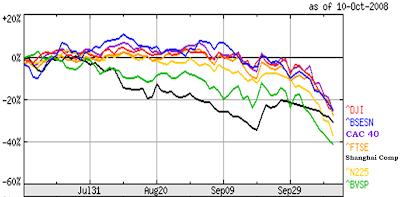
Have we hit a bottom (albeit a temporary one) for now?
And is this the dead cat bounce that everyone was waiting for?
Short these markets at your own risk!
The Nikkei 225 has really tanked!!!!

Friday, August 29, 2008

INDIAN EQUITIES: GOING NOWHERE FAST

2008 has not been a good year for Indian Equities:-Political uncertainty, moderating growth, galloping inflation, a rising Fiscal deficit and massive Foreign Institutional Investment outflows. GDP growth dipped below the 8% mark for the first time in the last 9 quarters, and Fuel and Fertilizer subsidies are going add stress to the Fiscal deficit.

2009 is an election year and the reform process is likely to take a backseat.

FIIs meanwhile have been sellers, and every rise is being sold into at the moment.

FII NET INVESTMENTS 2008 http://www.sebi.gov.in/Index.jsp?contentDisp=FIITrends

Valuations are a lot more reasonable now, and value is gradually emerging.

More on the outlook for the Indian Economy, and valuations of Indian Equities in the next post.

Sunday, August 17, 2008

GOLD – WHAT HAPPENED?

Well I’m back to posting again after a 2 week gap! There’s a lot to catch up on so its going to take a few posts.

Gold has been slam-dunked, Oil is on its way down, the USD rebounds and the rally in Commodities is over!!!
So what happened?
Lets begin with an interesting article I came across on ‘ Central bank Intervention in currency markets’
http://www.goldmoney.com/en/commentary.php#current Mystery Solved 7 Aug 2008.

The Triggers:

The slowdown in Europe will result in the ECB cutting rates.
The USA lead things on the way down, and so will be the first to recover.
The global slowdown has lead to a fall in oil consumption.


Weakening trends in the EURO and Oil and a strong USD

If there’s one thing that’s clear now, it’s that the ECB is in an equally tight spot as the FED. The FED has company!!! Does the ECB cut rates to avert a recession or does it fight inflation?

Are falling Oil prices a good sign, if they are due to contraction in demand?
Clearly speculators are bailing out too, but global demand is slowly!

The USD has pulled back sharply as the ‘Short USD/Long commodities’ trade unwound and the current uptrend is almost as severe as the breakdown in Gold. It should meet some resistance near the 78 level on the USDX.(Remember that the USDX index is EURO dominated)
So is the worst really over? (AGAIN)
While gold looks really beaten up at the moment, and Gold stocks have fared even worse, not a lot has changed in the last 2 weeks.
Central Banks are still dead scared of deflation!! And will use every means possible to get another bubble going. So that’s going to mean more intervention,bailouts and handouts to the clowns that got us into this mess in the first place.
Its also important to remember that Gold has historically never been strong in the May – August period, (usually bottoming out by August end.), so the USD rebound has added to the severity of the sell off.

I have been buying gold on declines, as it has smashed through one support after another ( $ 878.5, $ 850, $ 790), by staggering my purchases on the way down. The selloff has been so sharp that I expect a pullback especially as the Euro/USD has strong support at the 1.45 level.

So is this the return of Goldilocks? I think not!


----The US Housing market is still in a mess
----Freddie Mac and Fannie Mae need a bailout – or let’s just change the rules of the game for them!
----Are the write downs in the financials over? Or is the best yet to come? ( Like the recent settlements in the Auction rate Securities Lawsuits) More Capital raising / financial firms cutting Dividends?
----I ask again? What is the current market value of the ‘Toxic Bear Stearns securities held by the FED’ – No write downs there I hope?
----Is the strength in the USD due to any inherent fundamental change in the USD, or just due to the slowdown elsewhere?
----Can the Fed really hike rates to support the USD?—risking a meltdown in the US housing market and a collapse in US Consumer sentiment and consumption. On the other hand, how would the USD react, if the FED cut rates late into 2008?

----How long are the Central Bank Currency market interventions going to keep things afloat? Are they tackling the crux of this crisis( overleveraging and cheap credit) or just delaying an impending meltdown?
----Will the Volatile USD, (now strengthening), cause large USD holders to try to diversify out of the USD?
----Who’s going to blink first and do a bailout of a major Financial Institution- The Fed or the ECB?
----Even if the strength in the USD holds for a while yet, would you put money into stocks in an environment of inflation and slowing growth, where defaults across many sectors( not just financials) are likely to increase? I would be extremely wary of any analysts trying to call a bottom in stocks (especially the financials)!!!
----What impact is the Stronger USD going to have on the financial results of large US multinational companies whose results until recently have been ‘bolstered’ by the sliding USD. Extraordinary Forex losses in the second half maybe?

Sunday, July 13, 2008

FASTEN YOUR SEAT BELTS : TURBULENCE AHEAD

Equities the world over have had a miserable first half for 2008. Indian and Chinese Equities have sold off very sharply. As the DJIA battles it out at the 11,000 mark; markets in Europe are struggling with the ever strengthening Euro. (EUR/USD now nearing 1.60).

Meanwhile Gold ended last week at $964.60, and has outperformed equities in 2008.


Monday, June 2, 2008

FUEL CRISIS : AIRLINES

As Crude Oil prices continue to trade above the $125 mark, Airlines around the world are struggling with their Aviation Turbine Fuel (Jet Fuel) Bills.

"""" “For every dollar that the price of fuel increases, our costs go up by US$1.6 billion,” said Giovanni Bisignani, IATA Director General and CEO at the Association’s 64th Annual General Meeting and World Air Transport Summit (WATS/AGM) """"""


"""""The International Air Transport Association (IATA) called on governments, industry partners and labour to address the fuel crisis that is pushing airlines into the red. IATA forecasts a loss of US$2.3 billion for 2008 based on an average oil price of US$106.5 per barrel Brent crude."""""""

http://www.iata.org/index.htm
http://www.iata.org/pressroom/pr/2008-06-02-02.htm
http://www.iata.org/pressroom/pr/2008-06-02-01.htm

After the Bear Stearns bailout, Airlines are going to be next, unless oil prices cool off soon.

Meanwhile in India, ATF prices are among the most expensive in the world, as the government subsidises other fuels such as Petrol, Diesel, Kerosene and Cooking Gas (LPG).
http://economictimes.indiatimes.com/Economy/Govt_moves_towards_fuel_price_hike/articleshow/3090992.cms

As a result, most airlines in India are now resorting to raising the fuel surcharge on tickets
http://economictimes.indiatimes.com/News/News_By_Industry/Air_fares_head_north_as_carriers_hike_fuel_surcharge/articleshow/3094206.cms

Wednesday, April 2, 2008

THE CHINDIA MELTDOWN

CHINDIA : http://en.wikipedia.org/wiki/Chindia
Stock markets here have had a dreadful first quarter.

There seems no end to the bad news, as writedowns continue across leading Investment banks.

Local Inflation is starting to concern governments, as food and fuel prices continue to rise.

The Shanghai Composite is down almost 45% since its peak in October last year. A lot of Chinese first time investors and retail investors will learn some very hard lessons. In addition to the crash in the stock market, the chinese economy is facing rising prices at home, and the prospect of a slowing US economy.
The BSE SENSEX is down almost 25% since it Jan 2008 high. Confidence has taken a beating, and fresh buying is waiting for lower levels.
The Financial sector is down sharply, after some banks disclosed indirect exposure to 'subprime linked' assets in their US subsidiaries.
The Oil and Gas marketing companies are down, on fears of rising subsidy burdens on retail fuels.
The Exporters in the IT space, auto component and textile sector are having a difficult time dealing with a volatile but strengthening Indian Rupee
Valuations in the Capital Goods and Power sector have corrected drastically, as investor expectations are now more realistic.
Avoid the Real Estate sector and stocks of Brokerage firms. Although these stocks are down sharply from recent 52 week highs, I do not see value at current levels.
Overall, its a wait and watch approach, as the bulls have disappeared on Dalal Street in Mumbai.

Tuesday, April 1, 2008

GOLD & The Patient Investor

The recent correction in commodity markets has seen GOLD correct sharply back to the early 900's in USD terms. After its recent surge, a correction was to be expected.
Food Grains, Oil, and Precious metal prices have all pulled back sharply.

The US Treasury is now looking to expand the role of the US Fed, ensuring that it provides stability to a 'shaky US Stock Market', after the recent collapse at Bear Stearns.

The US Fed will continue to lend against 'questionable'/ 'worthless' mortgage backed paper, as its strives to avert a major collapse on Wall Street. The ECB and the BOE may have to follow the FED, if the credit markets dont ease up soon..

Coming back to the Patient Long term Gold Bullion Investor:

As was the case with the May 2006 correction, declines are pretty rapid, as leveraged speculators and short term traders who enter at peak prices get caught out.

Gold is headed for new highs for reasons listed below; the intelligent and patient gold investor, must just hang in there and enjoy the ride.

INFLATION : Gold - The Inflation Hedge

Countries around the world are struggling with rising inflation, mainly led by the surging cost of food and energy.

Central Banks are losing the fight against inflation, as they look to cut rates to combat slowing growth and continue to pump money into the markets.

India's annual inflation rate accelerated to a 13 month high of 6.68 % last friday, having doubled in just a few months.

The Chinese Consumer Price Index showed prices rising at 8.7 %yoy in February, the sharpest acceleration in almost 12 years.

Eurozone consumer price inflation rose to a new peak of 3.5 % in March.

Inflation in Saudi Arabia surged to a 27-year high of 8.7% in February.

THE CREDIT CRUNCH/ INSOLVENCY CRUNCH : No end in sight

Even as the Fed cuts rates, Mortgage rates remain high, as banks hoard cash.

The US Housing market Crisis continues....and consumer confidence is at new lows.

The ECB may have to cut rates if growth slows, even though inflation is at new highs. This action could lend support to the USD, and would as a result drag down the gold price.: This would be a good time to add to gold positions. Meanwhile the USD is headed for its biggest quarterly Loss Against Euro since 2004.

Counterparty risk is a risk no one seems to be willing to take.

Overexposed and Undercapitalized => Current state at most Investment banks with leveraged Balance Sheets.

In all the commotion, everyone seems to have forgotten about the Bond Insurers, who were the centre of attention only last month.

Bringing in more regulation now, will not make the outstanding Toxic OTC Derivative positions disappear overnight. Possibly more questions may be asked, additional paper work will add to costs and further casualties may arise.

This is a problem of Solvency, which cannot be solved by Cheap Money: The very culprit of the current crisis.

This is a time for preservation of capital rather than chasing yield.

Buy gold on declines, keeping its long term outlook in mind.