Showing posts with label INDIAN INFRASTRUCTURE. Show all posts

Monday, April 30, 2012

INDIAN ECONOMY AND INDIAN EQUITIES - STORMY WEATHER UP AHEAD

The Bullish Bear Blog has always been a long term bull as far as the Indian Economy and Equity Markets are concerned.

However, the ongoing policy paralysis over the last couple of years, further compounded by the scams and corruption issues have started to make even ardent bulls like myself a bit nervous and uncertain of India's long term outlook.

Sectors  that need a quick resolution to underlying issues include

1. Power Sector -  Coal Linkage issues have left many newly built/under construction power plants stranded. Troubles with increased royalty on imported indonesian coal has resulted in UMPP plants like the Tata Power plant at Mundra operating well below full capacity.

2. Fossil Fuels  - 

Oil and Gas - Pipeline tarrif pricing, Gas price policies, Deregulation of prices of retail fuels such as Petrol, Diesel, Kerosene, and LPG

Coal Sector - Disputes over coal block allocations, pricing of coal and arm twisting of the Coal behemoth Coal India - to sign Fuel Supply Agreements with power producers has added to the ongoing chaos in the sector.

In the long run, markets will have to move towards a market oriented pricing scheme, as the current system of subsidising fuels and end user prices is neither sustainable or viable.

3. Fertilizer Policy - Lack of proper implementation of policies has resulted in soil imbalances as farmers step up Urea usage as a substitute for more expensive DAP (Phosphate based fertilizers)

3. Telecom Sector- 2G spectrum scam and now pricey 2G auction base prices have left both investors and operators uncertain about fresh investment in the sector.

In light of the above issues, I think Akash Prakash's article in the Business Standard Newspaper Mumbai - 27-04-2012 is an excellent read, and perfectly sums up the current predicament of the every prospective and invested Indian Equity Investor.


Saturday, January 7, 2012

Monday, January 2, 2012

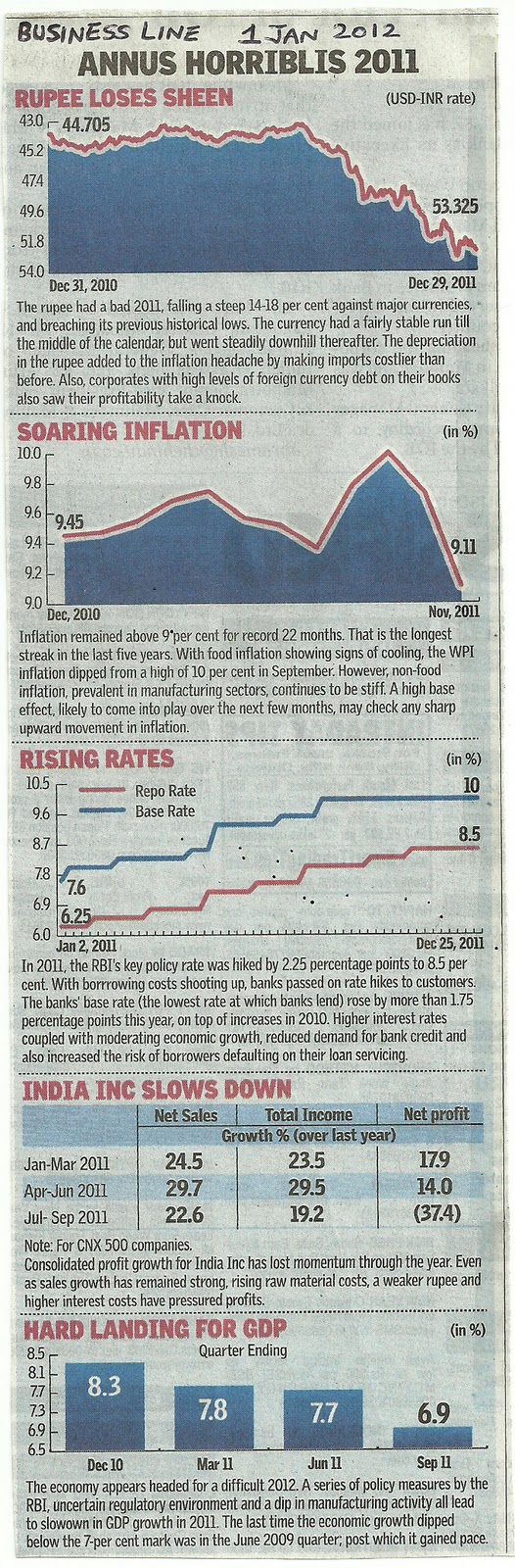
INDIAN EQUITIES - LOOKING BACK AT 2011

Here are some articles from last year that I think are worth a read.

Indian Equities have been faced with a toxic combination of Policy inaction, high interest rates, a very weak Indian Rupee and waves of instability from western markets, primarily the EU.

The articles below provide some interesting views on the Outlook for 2011. Mukul Pal's contrarian outlook, highlights the point that beaten down sectors that have been written off by Mr. Market could surprise us in 2012!

Saturday, November 26, 2011

INDIAN RUPEE : FOREX FLUCTUATION & INDIAN POLICY REFORMS

Here is a good article from today's Business Standard Newspaper in Mumbai.
Rupee fall pares India Inc's profit by a fourth in Q2

If the weakness in the INR continues, upcoming FCCB redemptions, USD denominated foreign Currency borrowings and the rising cost of imported raw materials will continue to add to the woes of Indian Corporates in the results of the third quarter.

Many blame the INR weakness on FII selling in the Indian Equity markets.
While FII selling has played its part, I feel the ongoing Government policy malaise and concerns over the Government's Fiscal Deficit continue to weigh down the INR.
Currency downgrades by the Rating Agencies will add to the downward pressure on the INR.

Also, it's about time that the Indian Government gets down to implementing many long delayed reforms.

Some sectors in dire need of reforms
POWER SECTOR - Poor financial health of State Electricity Boards (SEBs) is forcing them to resort to  load shedding of power even as Power producers are left with surplus power that they are unable to sell. These SEB's must move towards a market determined pricing of power sold by them to distribution companies.
Merchant Power sales and Power trading are also facing many unresolved policy issues.
Under construction Ultra Mega Power Projects also face uncertainities due to fuel linkages (read: Coal allocation issues and royalty issues on Coal imported from Indonesia).
.
MINING SECTOR - Confusion over a proposed Mining Tax, profit sharing with locals displaced by Mining projects, Land acquisition delays and mining scams and corruption have delayed many Mining & Smelter projects.
.
FERTILIZER SECTOR - Partial implementation of the Nutrient Based Subsidy Scheme (NBS) and the delays in decontrol of Urea pricing have compounded the problems of the sector. Heavily subsidised Urea fertilizer has resulted in farmers opting to use Urea over DAP fertilizer. Excessive use of Urea has upset the balance of soil nutrients and has thus resulted in lower crop yields.
Any further delay in decontrolling Urea fertilizer pricing will add to government subsidies as the government continues to import Urea shortfall from overseas. A weak INR will add to the cost of imported Urea fertilizer.
.
TELECOM SECTOR - The ongoing 2G scandal and corruption cases continue to dominate news in the telecom sector. What the government must take a look at is reforming regulations that will promote consolidation in the Telecom sector. Recent issues of 3G roaming should also be clarified by the TRAI and the government, to avoid any further uncertainty in this sector.
.
AVIATION SECTOR - A combination of ''below cost '' fares by Air India,  record high ATF prices, ultra competitive air ticket prices, and record high debt of the airlines themselves has resulted in some serious structural problems in the Indian Aviation sector. FDI limits in Indian Aviation will have to be liberalised and a more viable tax structure on ATF will have to be worked out, if the existing carriers are to survive as going concerns. Perhaps the government will have to look at the development of "Low cost airports'' from which the Low Cost Carriers can operate, given the expensive Landing and Parking Costs at the country's main airports.
.
OIL SECTOR - Massive delays in implementation of a clear and viable Gas Pricing policy is delaying further development of Oil and Gas Blocks in the KG Basin. Until this vital issue is resolved, Fuel Linkage issues of Power & Fertilizer Plants will not be resolved. The longer it takes for this Gas to reach the market, the more will be the delays of construction of new Power and Fertilizer Plants.
Also the" retail fuel pricing - under recovery problem" of the Oil Marketing companies (OMCs) remains unresolved. Massive subsidies on retail fuels sold by the OMCs have weakened their finances over the last decade.
A weak INR+ high Crude Oil price is adding to the under recovery burden of the OMCs.
If the government fails to move to a market determined pricing mechanism for Retail fuels soon, these OMCs will soon need to be bailed out by the government.
.
All in all, it's about time that the government takes a step forward, and gets downto resolving these 'bottle neck' issues that are plaguing the Indian Economy at the moment.

If some of the supply side issues are worked upon, then perhaps the subsequent drop in inflation and an improvement in the government's fiscal deficit targets, will help the INR to regain some lost ground.

Tuesday, November 22, 2011

THE INDIAN RUPEE - WEAKNESS CONTINUES.....

The continuing weakness of the INR vs the USD is starting to worry both investors and regulators alike. Negative FII fundflows in the Equity markets is adding to the weakness of the INR.

At a time when inflation continues to be persistantly high, a weak INR will add to India's already increasing Crude Oil import costs.

The Equity Markets in India are preparing themselves for forex loss announcements from companies that import their raw materials and those that have large Foreign Currency borrowings.

We are now surpassing levels last reached during the heights of the financial crisis in the first quarter of CY 2009, just after the Lehman Crisis!

Energy and commodity prices were far lower in March 2009 than they are right now; so the Government and especially the Central Bank (R.B.I) will have to come up with some strategy to stabilize if not support the INR at current levels.

WATCH THIS SPACE!

Friday, July 15, 2011

INDIAN EQUITIES - AN UPDATE

Here's an article titled - 'A Two - Tier Market' by Akash Prakash from the Business Standard Newspaper dated 8th of July 2011 - Mumbai edition..


He addresses the issue overvaluation of the consumer-staples sector and highlights the difficulties of buying high-quality companies at a reasonable price in the Indian Stock Market.
.


Currently, many consumer staple stock trade with PE ratios of 30-35!
.


On the other hand, investors continue to shy away from industries that are in need of capital, mainly due to concerns of poor earning visibility. Many infrastructure companies are facing great difficulty in raising capital.


The article is a fantastic read.

Tuesday, June 28, 2011

INDIAN PETROLEUM SECTOR SUBSIDY CONUNDRUM

The Government of india finally implemented a long overdue price hike in diesel, LPG & Kerosene.

Even as inflation statistics continue to remain uncomfortably high, the government had to finally bite the bullet!
The government must come up with a long term viable pricing policy for petroleum products.
The Oil Marketing companies like BPCL, HPCL & Indian Oil cannot afford to keep subsidizing retail fuel prices. Currently their profitability is dependent on Oil bonds - a government handout!
.
Upstream marketing companies like ONGC & GAIL are helping the government to bear the losses from under recoveries, and this is preventing them from investing in Oil Assets and building Oil & Gas infrastructure like gas pipelines etc
.
The government will also have to step up investment in public transport infrastructure like metro rail projects & urban bus transport networks. Perhaps such a move will help reduce traffic congestion and in the long run reduce our heavy dependence on petrol and diesel.
.
Lastly I would like to point out that a large chunk of the levied retail fuel price on fuels like petrol and diesel, consists of govenment taxes that does not go to the oil companies, but is a major source of government revenue!
.
It's time that a truly sustainable long term fuel pricing policy is formulated.
With Crude Oil prices that continue to trade around $100/barrel, the government must come up with such a policy as soon as possible.
Below is an announcement by the Govt of India in the Economic Times on the 27th of June 2011.

Sunday, December 19, 2010

INDIAN EQUITIES : FII & Domestic Institutional Fundflows

2010 has been a good year for Indian Equities. The FMCG (Consumer staples ) sector, Auto sector & Banking sector have performed well this year. Valuations are no longer cheap, and the margin of safety for investors has narrowed substantially.

Link - Domestic institutions turn cautious, go on selling spree ...
As usual, FII fundflows continue to dictate market direction, but as the above article points out, Domestic Institutional investors - Mutual Funds are booking profits.

Friday, December 17, 2010

A TALE OF TWO INDIAS !

The Economist magazine recently published an article regarding India on 25.11.2010 titled

Graft in India - Rotten to the Core? Coping with the aftermath of a massive scam !!!
And who's to say that they are off the mark as far as the story goes.


We have been on a never ending roller coaster of scams.

  • IPL - Cricket scam -issues regarding benami -ownership structures of teams
  • Commonwealth games scam.
  • Adarsh Building scam in Mumbai - Illegal Building on Army land
  • Telecom 2G scam - That's a mega one!
  • Public Sector bank officials involved in a loans for bribes scam.
  • Stock price rigging scam being investigated by SEBI.
  • Nira Radia tapes - involving journalists, industrialists etc!

So we have massive wealth disparity, income inequality, corruption, rural poverty, poor infrastructure and then we have on the other hand an ecomnomy that's doing fantastically well, while the world economy is still reeling under the strain of slowing consumer consumption and record debt levels.


.
.
.
.
.
.

.
.
.
.

..
.
.
..
.
..
.
.
.


While its going to be a never ending discussion about the politicians, industrialists and other individuals involved in these scams, there are some facts and lessons that an investor in Indian markets can take away from this mess.

  • While the Indian Economy does present a fantastic investment opportunity to both Indian and overseas investors, it can be bumpy ride at times.

  • While the Indian government continues to move slowly on / ignore vital issues like wealth disparity, rural poverty, overburdened infrastructure and the poor state of primary education and healthcare facilities across India, they must realise that this economic boom cannot continue unless they start to tackle the above mentioned critical problems and target "inclusive growth".

  • Remember to curtail investments to firms where the management has a credible track record and takes care of the interests of all stakeholders concerned - & not just themselves! You may come acoss an interesting investment opportunity, but if the management has a dodgy track record, just stay out!

  • If SEBI fails to rein in the Equity market scamsters, it will result in a massive blow to SME (Small and medium enterprises) businesses in India. The SMEs are the ones most affected by these stock rigging scams because a tightening of bank credit across the SME sector will deny working capital loans to many deserving and good quality small cap companies in India

  • The incredible progress that has been made by Corporate India has been made inspite of our politicians and not because of them!

  • While I'm not condoning the massive, almost blatant and shameless corruption here in India; we live in a world where politicians in most countries are no better than the ones we have here. It may be less blatant but sadly,corruption goes on!

  • There is incredible corruption,short termism and lack of leadership in global politics today.As someone rightly said, " The people who want to be in politics are not the people whom you want to be in politics". No politician is willing to fix a problem that he can kick further down the road, an example being the *crazy debt crisis* facing the western world today! Imagine asking consumers who have no savings to start overspending and re- leveraging again - Thats both WRONG & insane!

  • Lastly, remember that the prudent investor does not chase an over extended stock market rally. Remember to wait for pull backs and always look to invest in good quality stocks, with managements that have an established track record!

Tuesday, March 2, 2010

INDIA's PETROLEUM SUBSIDY CONUNDRUM & the Kirit Parikh Committee Report

The Kirit Parikh Committee Report on subsidies in the Petroleum Retailing sector has made quite a few headlines in local news.
Link: http://petroleum.nic.in/reportprice.pdf

Recommendations include -

  • Free market pricing of Petrol and Diesel. The Kirit Parikh report suggests an additional levy of Rs. 80,000 on a diesel vehicle, citing that the higher excise must offset benefits vis-a-vis petrol vehicles. The report submits there is no need to subsidise users of diesel cars and SUVs, vehicles which are used for personal purposes.
  • Allowing periodic price increases for cooking gas (LPG) and Kerosene, based on performance of the agricultural sector and the rate of expansion of rural electrification. This will help rural India gradually adjust to the price hikes. Kerosene is used for lighting purposes in rural areas, so expanding rural electrification will reduce dependence on kerosene for lighting purposes
  • Excluding GAIL - the gas transmission behemoth from the under recovery subsidy burden.
All in all, the ever expanding petroleum sector subsidies are proving to be a real drain on the finances of the Indian government.
Oil subsidies are currently treated as an ''off balance sheet item''.
Implementation of these recommendations will thus present a ''truer'' picture of India's fiscal deficit.
To give you an idea of just how large the oil subsidy has been: -
From 2003-04 to 2008-09 total under recoveries amounted to Rs. 2,99,222 crores.


The market capitalization of India's largest private sector Giant - Reliance Industries is Rs. 3,23,235 crores!!!

The market capitalisation of the Benchmark BSE SENSEX index is Rs. 24,81,009 crores!


Question is : Does the Government have the political will to work past all the implementation issues and carry out these recommendations in the current inflationary environment?

Everyone knows that something need to be done.
The current pricing mechanism is just not sustainable with Crude Oil prices trading at $80!

Oil subsidies are the single biggest ''stimulus'' package that the government has provided to the economy.

But there is no free lunch!!

The balance sheets of government run oil sector companies are in bad shape.
The government too is struggling with 'oil bond' issues.

So can or will the government bite the bullet or continue to avoid tackling the issue head on, just as the Finance Minister chose to avoid discussing any specifics on implementing the Kirit Parikh report in the current Union Budget.


Wednesday, January 13, 2010

L.N. Mittal of Arcelor Mittal on Investments in India, 8 January 2010

''We have not experienced this kind of growth and interest in investments in India before. neither the central government nor the states were prepared for such growth.''
- L.N. Mittal. CEO, ARCELOR MITTAL.
,

The newspaper clipping is from the Economic Times newspaper, Mumbai- 8 January 2010.
Let's take a closer look at the issue.

Land acquisition delays, loads of red tape, pending environmental clearances.........and I think Mr. Mittal is quite exhausted and frustrated.

.

.

.

.

.

.

.

.

.

.

.

.

.

At the outset, I must say that I agree with Mr Mittal. The Indian government is unprepared for the size and scale of investments that are currently being proposed and planned.

To the credit of the Indian government, a lot has been achieved since the early days of liberalisation in 1991. Sectors like IT, Telecom, Banking and Autos have come a long way since 1991! Many Indian companies have emerged as Indian Multinational corporations

The key issue that the government needs to address now is - to set a strong foundation for the next stage of development.

Many policies and regulations must be put in place before granting any permissions to business houses to set up new businesses. The rights of local communities must be protected and they must be compensated for land surrendered, before 'big business' moves in.

Here are a few of the contentious issues that need to be addressed.

  • Land Acquisition rules: This has been one of the most debated issues that has haunted 'Special Economic Zones' (SEZs) from day one. Farmers and people residing in rural India are obviously not being adequately compensated for land surrendered. Politicians are misusing the sensitive issue of 'SEZ land acquisition' for election politics. Businesses commit to a project, only to realise later that they are just unable to secure the land for it. Rules regarding taxation / tax exemption of SEZs are also unclear. Then there is also the issue of the wasteful diversion of fertile agricultural land for SEZs.

  • Telecom Sector policy: Whether its GSM vs. CDMA, the telecom companies vs. TRAI, spectrum allocation disputes or the debate and commotion over 3G auctions, there's always some confusion over the rules and policies in the Telecom sector. 2009 witnessed a bloody price war in the mobile telephony space as a number of new companies launched mobile phone services in the domestic market. With 3G auctions coming up, it's about time that the Telecom ministry clarify and set straight all regulations required for companies operating in this space.

  • Environmental Clearances: Mining projects, petro chemical complexes and offshore drilling aren't exactly environmentally friendly industries. They are industries that are responsible for a lot of environmental damage, but on the flip side, they also provide numerous employment opportunities to people across the country. The government must encourage the setting up of economic centres and industrial townships across the country, to prevent overcrowding of major cities (by people from rural India seeking employment) and thereby ensure a more equitable distribution of wealth and employment opportunities. At the same time it's important to regulate effluent treatment practices of companies and the government must ensure that its rules and regulations are in place before companies set up shop.

  • Power Sector: Despite the best efforts of public sector behemoths like NTPC, India remains a country that suffers from acute power shortages, with many states overdrawing from the national power grid. Recent initiatives like the Ultra Mega Power Projects (UMPPs) are still at the foundation stage and in many cases are grappling with land acquisition issues and fuel sourcing issues. Before these new capacities come on stream, the government will have to ensure that the transmission and distribution arms of the Power sector continue to invest in building up required infrastructure.

  • Oil & Gas Sector : Whether its the Ambani vs Ambani KG basin gas dispute or the Cairn India Rajasthan cess dispute or the gas pipleine policy, there are many grey areas in this sector. Is natural gas pricing going to be partially regulated? Will sectors like Fertilizers and Power generatioin be given predetermined gas allocations? Which regulatory authority will be the final forum for settling disputes regarding the laying of gas pipelines?

  • Railways: The Railway Container Freight sector continues to suffer from the after affects of the global meltdown of 2008-09. Private sector companies are just unable to compete with the estabilshed incumbent - The Container Corporation of India, a listed public sector enterprise. Delays and disputes over setting up inland container yards on land owned by the Indian Railways remain unresolved. Then of course comes the ambitious 'Rail Freight Corridor Project'. Here too, land acquisition issues and the ever increasing implementation cost structure and funding issues have resulted in this project being stalled at the drawing board stage for quite a while now. Recently proposed investments by the Japanese government too are at a very very early stage.

It's obvious that a number of issues and policies need to be sorted out before we invite more foreign direct investment into India

A lot needs to be done before India embarks on the next stage of her economic growth. It's not going to happen overnight.It will be gradual and quite chaotic, but we will eventually get there.

Both businessmen and stock market investors need to understand these and other issues before commiting to mega projects or long term investments in India.

Tuesday, January 12, 2010

INVESTMENT OUTLOOK 2010

At a time when many analysts and experts are advising clients and investors to increase ‘market exposure’ and take more risks I advise you to do the exact opposite.

Now is the time to step out of risky investments and look to minimize portfolio volatility.

.

Here’s how you can sum up the true state of the world economy

= Uncertain & Unstable & Volatile.

.

Here’s my 2010 check list

.

Hope springs eternal: Now that equities have staged massive rallies off their panic lows in March 2009, the performance chasing analysts continue to push more ‘buy’ recommendations to investors, even when the current risk reward ratio is clearly not in their favour.

.

Government Support: has enabled the world economy to survive a deflationary spiral that would have triggered another great depression…….or so they tell us. What we now have instead, is a global economy that is addicted to government stimulus packages, bailout packages and ever increasing government debt levels and deficits.

How costly will continuing stimulus packages be for emerging markets in 2010, as export driven Asian economies struggle with slowing consumption in the developed world?

.

Stimulus Packages: continue to strain government finances. The fragile global economic recovery is now becoming dependent on these stimulus packages that are artificially preponing demand and artificially propping up consumption. This is leading to a misallocation of resources and resulting in rising commodity prices and a buildup of excess manufacturing capacity.

.

Fed exit strategy: I do not think that the FED will be increasing rates anytime soon.

Firstly, the appetite for US Treasury Bonds remains strong. Why raise rates if the market doesn’t force you to!

Secondly, given the large amount of debt issuance lined up for 2010, why would the Fed raise rates now?

Lastly, can the Fed and the Treasury stop supporting the US mortgage market now?

As a student of the Great Depression, Bernanke knows that any further fall in home prices would deal a lethal blow to the 'nascent recovery'. So expect Freddie Mac and Fannie Mae to get unlimited amounts of support.

Stemming foreclosures and reducing the inventory of unsold homes is key to building confidence levels of the US consumer.

.

Banking: The only sector that is growing profitably again! But wait…......weren’t these guys the largest beneficiaries of the bailouts in 2008-09!

Then they rushed to reapy TARP money, so that they could start issuing bonuses again!

As for sound lending or sound accounting practices or sound banking practices, don’t expect anything to change anytime soon.

.

Employment and Capital Investment: These are two factors that have failed to recover and support this ongoing recovery and bullish sentiment. Continuing uncertainty and a total lack of confidence has resulted in businesses postponing fresh hiring and many capex plans have been shelved for now.

As for government statistics; well you must take them with a pinch of salt. Unemployment statistics, conveniently exclude individuals from the labour force, because they ‘may not be actively searching for a job’. These are people who are actually struggling to find a job in a terrible job market……..and yes they are UNEMPLOYED!

.

Expert Views:

David Rosenberg – says we are witnessing a secular shift in consumer behaviour and spending patterns in the US. According to him, ‘frugality’ is here to stay. This will ensure that the deleveraging of US consumer debt will continue unabated, despite the reflation efforts of the FED & US Treasury!

Continued inflows to fixed income investments and continued outflows by retail investors from US equity funds are also signs of a changing investor mentality.

He also labels the government’s efforts to pre pone consumption via the cash for clunkers plan and housing tax credits as ‘’bribes’’ to force consumers to start spending again.

He advises investors to take a more cautious view and favours a conservative income generation investment policy to minimize portfolio volatility and risk.

Government stimulus and inventory restocking have been key drivers of growth in the US economy and David Rosenberg believes that earnings estimates for FY 2010-11 are far too optimistic!

.

Ruchir Sharma (head of emerging markets at Morgan Stanley Investment Management) – says that ‘we are all entitled to our own opinions, but not to our own facts’, and advises investors to be wary of the herd. The world economy suffers from excess leverage in the financial system, excess manufacturing capacity and excess leverage on consumer balance sheets. ‘A growth relapse is the true contrarian view to engage in 2010.’ Risks include disappointing announcements from China or a double dip in the US! He says the most money is indeed made or saved by staying away from the herd.

.

Chris Laird: the editor of The Prudent Squirrel Newsletter is also cautious. He advises everyone to avoid being swept away by the information overload in the financial media, and avoid fresh risk taking. His track record over the past few years has been impressive!

.

US Recovery: The current rebound will go down as the weakest recovery on record going by the Recovery to loss ratio = Gain in the first year or recovery in real GDP / peak to trough loss during the recession. Q4 GDP will be boosted by inventory restocking and a low year on year base effect. How will the economy cope when government support is withdrawn…..if it can be withdrawn?

.

US domestic finances and the November 2010 elections – A number of US states continue to struggle with falling government revenues and ever increasing expenses. California is a prime example.

The world’s 8th largest economy has suffered a massive real estate collapse, record debt levels and is in need of a bailout from Washington.

Thing is, they are not the only guys queuing up! And with elections coming up later this year, can these states resort to cutting government spending?

Politicians are the same everywhere – expect election politics to kick in soon enough.

.

Government Debt: A friend of mine recently asked me if there is actually some limit on the amount of debt that a government can issue before it becomes excessive, bringing the whole system down?

Here are two quotes that answer the question:

“There is no means of avoiding the final collapse of a boom brought about by credit expansion. The alternative is only whether the crisis should come sooner as the result of voluntary abandonment of further credit expansion, or later as the final and total catastrophe of the currency system involved.”

- Ludwig von Mises, Human Action (1949).

“You have only to find a way to multiply your creditors by the cube and pay them by the square, out of their own money. The fatal weakness of the scheme is that you cannot stop. When new creditors fail to present themselves faster than the old creditors demand to be paid off, the bubble bursts.”
--Garet Garrett

Dubai, Greece, Ireland and Spain are already under severe strain as they struggle to get back on their feet. The ‘world reserve currency’ country -the U.S.A. continues to add on to its debt, as investors continue to lap up US Treasury bond issues.

No one knows what the limit is or when we will get to it – but all these governments are pushing their luck!

.

GOLD: An environment of uncertainty, instability & volatility created a perfect storm for Gold in 2009. These are bigger drivers for gold than the ‘inflation’ argument as of now.

While I think that the massive wealth destruction of the last few years will delay an eventual return of inflation, massive government intervention has created a ‘feel good…back to normal’ environment once again.

.

Question is – what normal are we talking about?

Expanding consumer leverage & consumption, permanently rising house prices and exploding mortgage derivative markets were never ‘normal’

Falling personal income, increased working hours with less pay, and continued weakness in the US real estate market are the new reality.

Gold prices have now stabilized in the $1080 - $1150 range. The year end USD rally has stalled for now. I will wait for a buying opportunity in gold, which appears likely in the event of a stock market crash, which would trigger a flight back to the USD!

.

Strategy for 2010

A genuine recovery vs. a recovery on life support – Understanding this difference is key!

Continue to book profits in equities as the current margin of safety is just not adequate.

Beware of sectors that have been the biggest beneficiaries of stimulus packages, example the auto sector.

Hold on to positions in Gold, and wait for a buying opportunity. Don’t forget that Gold was the top performing asset class of the last decade!

.

The US Dollar: I’m a long term dollar bear. In 2010, I expect to see a pullback in the USD when the equity markets correct. There are far too many USD bears out there and one can expect the usual flight to USD safety when markets correct. A rebound in the USD would also enable US Treasury Bond issues to sail through smoothly.

.

Complacency and overconfidence will be key factors that punish the unprepared investor this year. The VIX (Volatility index) is at record lows. Expect volatility to make a comeback soon, once investors realise that we aren’t out of the woods as yet!

.

The Eurozone – will face quite an eventful 2010. Weaker economies like Greece, Ireland, Spain, and yes even the UK are struggling to reduce deficits and support their local economies. Stronger economies like Germany will be forced to lead bailouts or support packages for their weaker neighbours if things take a turn for the worse.

The EURO could have a volatile time in 2010 if sparring members refuse or delay support packages for weaker members.

.

Commercial Real Estate: will continue to haunt banks that are overexposed to the sector. Office Rents continue to decline, and rising vacancies will continue to stress out balance sheets of companies in the sector.

US Home Prices: I still believe that we will see lower prices next year. The resetting of Adjustable Rate Mortgages ( more on this in subsequent posts) and more foreclosures in 2010 will delay any recovery in this sector.

.

Emerging Markets (including Indian Equities): The ‘decoupling’ theory is resurrected again, after the correlations were crushed in the crash of 2008 -09.

Export driven economies in Asia are still dependent on customers in the western world. Their stock markets are still dependent on foreign institutional investors (FIIs). These are the same guys who stormed out in panic during the crash in the first quarter of 2009.

Conclusion: It’s time to book profits or at least take some chips off the table.

.

Indian Equities have risen along with other emerging markets. Valuations leave no room for error. Capital Investment has started to increase gradually, but companies are still cautious on the sustainability of the current recovery. Sectors like FMCG and Autos are at lifetime highs. Lock in some profits now!

.

On the buy side, one sector that I’m looking into is the Telecom Industry. Valuations have been slashed after the price war of 2009. Uncertainty over the upcoming 3G rollout, continuing capital expenditure and shrinking margins has frightened investors. As a disclosure, I must say that I have recently become a shareholder of Bharti Airtel. Of the listed telecom companies, Bharti Airtel has the best balance sheet and the first mover advantage! For anyone thinking of buying in right now, I must warn you that the stock is a high risk high return proposition. We will undoubtedly see at least a year of very poor profitability until the price war stabilizes. We are heading towards a forced consolidation so it’s going to get tough.

All in all, I think Bharti Airtel is the best company if an investor must take any exposure to the Telecom space in India.

.

To conclude, I think that investors should look for sustainability over returns in 2010.

  • Gold bugs should be patient and wait for a pull back before buying in agin.
  • Don’t get caught unawares by a massive equity market selloff when it comes along!
  • Know your investment risk profile, and the volatility that you are able to cope with.
  • As David Rosenberg says, look to minimize portfolio volatility.
  • No one knows when the market will finally turn. Just like 2007-08 it will do so without any warning. The global economy faces strong headwinds in 2010, so be prepared for volatile times, even though the VIX is currently sinking to new lows.
  • It’s not a time to be buying now. It is a time to sell and book profits.

Wednesday, January 6, 2010

WELCOME TO 2010 !

Well i'm back again!
Before I begin posting new stuff for 2010, let's just take a quick look back at investment returns of the last decade!

Here's a chart from Jesse's Café Américain. Even as Gold and Silver have been star outperformers, its just amazing how little coverage they get on CNBC!

Chart of the day covers a multi decade DJIA return chart.


Clearly the 1980's and 1990'S were years of blockbuster returns in US equities.
Expert stock pickers like Warren Buffett generated market beating returns over this period.
Looking at returns over the 1960's and 1970's is almost frightening! Can the current ipod-blackberry-google search generation cope with it!
It's happened before, but can we cope with marginal returns while servicing a massive debt overhang this time round?

The Indian equity markets had a fantastic last decade.
Just a few years prior to 2000, India's manufacturing sector was in bad shape. Over the last decade, these same manufacturers have bounced back - cutting costs, improving efficiency and product quality.

Companies in the IT services space have also survived the 2000 IT/ dotcom meltdown, and have become globally recognised franchises.
The current decade will need record investments in infrastructure development if India is to emerge as a ''superpower'' by 2025!!
Reducing income disparity and improving the standard of living of people in rural India are also crucial to India's future development.

Lastly, I'd like to draw your attention to the CBOE VIX volatility Index.
Jesse's Café Américain has a good chart on the VIX.
We are not out of the woods yet! The world economy is getting ''addicted'' financial stimulus packages and ever expanding government debt and deficits.
Those looking for jobs and those trying to hang onto jobs they ''despise'' are clearly not as optimistic as equity market analysts are.
I will be putting up a post on ''what to look forward to'' and ''what to look out for'' in 2010. I'm working on it now, but it should be up in a couple of days.

Thursday, October 1, 2009

INDIAN EQUITIES : P/E RATIO ANALYSIS ! !

The Indian Stock markets have been rising steadily as the global 'stock market ' recovery continues.

Since markets hit their panic lows in March this year (yes, we can say so now, with the benefit of hindsight!!!!), the rally has been spectacular.

The world economy may not have recovered, but markets have clearly run ahead of themselves.
Below is some P/E ratio data from a recent article in the Business Standard newspaper (Thurs 29, September 2009).
Source: Current market valuations leave little scope for profit-making

It's worth remembering that markets usually overshoot both on the upside and the downside.

A quick glance at some sector P/E Ratios, and you could well think that we are back to the days of an invincible bull market.

P/E Ratios in the 25-30 x range leave no scope for disappointment.

If you exclude commodity sectors like cement and non-ferrous metals, the average P/E is even more expensive.

Risks to the economy still remain:

The monsoons this year have been rather unsatisfactory.
As stimulus packages are gradually withdrawn, sectors like autos and textiles could face head winds.

A global rally built on foundations of '''ginormous''' government money printing, stimulus packages, bailout packages and debt -----> can last longer than some bears can stay solvent.

...and when bears start to reluctantly convert to the bullish camp, it's time to take a step back and analyse your investment profile.

While you don't want to miss out on the party, it's probably more advisable to sell into the strength than buy anything now.
The risk -reward ratio is clearly not in favour of the long only investor.

Tuesday, September 1, 2009

Improving Indian Infrastructure: A long long way to go!

Here are some interesting (or shocking) statistics that I came across, while reading the Sept 6, 2009 issue of the 'Business India' Magazine.

Every successive Indian government claims to have made giant strides in India's infrastructure development. Here's some data on the Power sector and the Road Sector.

"""""""""""""""""""""""""""""""""""""""""""""""""""""""""""""
Indian Power Sector:

''Ageing thermal units that generate almost a fifth of India's power are slated for a revamp.

Old, inefficient and polluting coal fired power plants have been earmarked for the government's R&M/LE (renovation and modernisation/life extention ) programme. These mainly 210MW and some 110MW units built 20 to 30 years ago have a cumulative capacity of 27,000 MW, almost a fifth (18.21%) of India's installed power capacity.''


India's Road Sector:

''With 3.314 million km of roads, the country has the second largest such network in the world. But much of this is of abysmal and degraded quality and overburdened. This is especially true for highways - which are the lifeline of any modern economy anywhere in the world.

Highways account for some 65,000 km, or about 2%, of the total road network in the country. 90% of these highways are single - lane or two -lane affairs. Overall, roads support 80% of the passenger traffic and 65% of the freight traffic in the country. 40% of this overall traffic occurs on highways. They are overcrowded for the most part, which implies slow moving wheels of transport and of the economy, as well as poor upkeep.''

"""""""""""""""""""""""""""""""""""""""""""""""""""""""""""""
Source: September 6, 2009 Business India Magazine

Well, there's not much that I can add to the above statistics. What I can tell you, is that India is way behind schedule as far as infrastructure development goes!

Economic development and subsequent GDP growth over the past 5 years, has put further stress on an already 'stressed out' infrastructure system.
(Think of congested airports and seaports, crazy traffic jams in Mumbai, and the pending 'rail freight corridor' project)

I hope that the government realises that sustained GDP growth is impossible without improving infrastructure.

India has great potential to emerge as one of the world's largest - diversified economies.
Unlike some BRIC nations, GDP growth is well balanced, & not dependent solely on commodities. (Think Russia & Brazil)
The economy is not export dependent and domestic consumption continues to support industrial production through this economic downturn.

Before India can take its next leap forward, its infrastructure issues will have to be sorted out!

I will end with some links on the Indian Monsoon, by Business Standard columnist Shreekant Sambrani.
(While I'm not a weather/ monsoon expert, the temperatures in Mumbai this year in the months of July and August have been extremely warm, and the monsoons seem to have vanished!)

July 5, 2009 :
Follies & IMD - Siamese twins
July 16, 2009 : Shreekant Sambrani: No doubt, it's a drought
August 8, 2009 :Shreekant Sambrani: Talking down the drought
August 29, 2009 :Shreekant Sambrani: Drought of agricultural policies

Monday, August 17, 2009

INDIAN MONSOON : NO RAIN YET !!

With each passing week, the number of drought affected districts goes up.
July and August are 'crucial' months as far as the 'southwest monsoons' are concerned.
.
There's going to be a lot of drought relief work needed in the rural areas and water cuts in cities, if the monsoons fail to return.
Food crop failures will mean rising food prices and the need for 'loan waivers' in rural India.
The governments deficit is growing, and the stress of a 'failing' monsoon will add to the governments' burden.
.
As the map below shows; highly populated states like Uttar Pradesh and Bihar have been badly affected. This not only means a food shortage (as these are agricultural regions), but it also means that many many families (especially farmers) will be badly affected.
.
With many state level elections coming up, local governmnets will face an uphill struggle, as the 'opposition' seeks to highlight the governments' inadequate response to the failing monsoon!
Yes unfortunately; its election politics again!!!!!
.

EDIT: 21August 2009: Here's a great link on the monsoons so far:

Shreekant Sambrani: Talking down the drought

Source: Indian Met Dept:Monsoon-2009: Current status

Tuesday, June 16, 2009

INDIAN ECONOMY : GETTING BACK ON TRACK

The Indian economy has survived the global turmoil, and is now looking to consolidate its position as one of the few countries with a positive GDP growth rate that is driven by domestic consumption.

The Equity markets went into overdrive after a 'positive' election result, and the FIIs who were panic selling in March 2009, are now re emerging from the rubble with buy recommendations of various stocks!


While I'm not doubting India's positive long term prospects, there is clearly a lot of work to be done. As Jim Rogers recently said Indian politicians are big on promises, but execution quite often disappoints.

This brings me to a newspaper clipping from the Times of India, Mumbai, June 4, 2009. I have no idea of the accuracy of the survey undertaken, but I will say that irrespective of the political party in government, bureaucracy and red tape have always been major stumbling blocks!


India has tremendous potential - a hard working population, strong and growing household savings, and increasing levels of literacy albeit at a slow pace.
Unfortunately, if we do not clean up our act soon enough, we will continue to suffer from 'non inclusive growth', unfulfilled potential and a growing rural - urban divide.

COMING TO THE INDIAN GDP


Well the numbers look impressive (lets not forget we are battling a global slowdown!)

Here's a closer look -
Sectors like manufacturing and construction are slowing down.
Funding issues have started to stress expansion projects across sectors as companies have turned to conserving cash and paying down debt.

The figures of the recent quarters have been positively impacted by government stimulus packages ( reflected by rising government expenditure) as well as a sixth pay commission pay hike for government employees.

As the government looks to control its deficit in the upcoming budget, some subsidies and recent stimulus incentives may have to be rolled back, given that tax collections are expected to decline.

It's a wait and watch game for now, and the second half of 2009 looks as challenging as ever!

Friday, May 15, 2009

INDIAN ELECTIONS 2009

Well, its time for the election results!

Once all the campaigning and election promises are over and done with, there's a whole lot of work that is yet to be done.


This is a Financial Blog, so I'm not going to get drawn into an election debate, but I'd still like to make a few points.


  • India has survived the global financial tsunami, with its economy and banking system in far better shape than many countries.

  • While politicians from every political party are only too eager to take credit for this, there were obviously other reasons for that outcome.

  • The Indian Central Bank ( The RBI) has been very prudent through this crisis, monitoring the balance sheets of banks and avoiding frantic interest rate cuts. While Bank non - performing loans will definitely rise as the economy slows, overall most banks look to be in good shape. Leverage levels in the banking system, are far far lower than those at the largest US Banks.

  • The Indian Economy is a domestically oriented one, in comparison to some of her Asian counterparts who are export driven economies. Domestic demand has held up well so far. (although rising unemployment over the next year could hurt demand.) GDP growth isn't driven by Indian IT service exports or the financial sector alone. Agriculture and Industry (mining, manufacturing, electricity) as well as other Services (transport, communication and construction) make vital contributions

  • Although India will be unable to match the strong growth rates of recent years, current GDP growth rate estimates range from a conservative 4.5% to an optimistic 6.5%. I would think the lower end estimate to is more realistic; as I do not believe we are near the end of this down turn just yet

  • Given increasing levels of urbanisation, there is still a lot of infrastructure that needs to be set up. Transport infrastructure and Power Generation investments will have to increase, irrespective of which government comes to power.

  • Over the last few months, every political party has been campaigning aggressively and trying to secure allies incase the need of a coalition government arises ( a very likely outcome!). As the game of 'side swapping' and 'outside support' take centrestage over the next week, I hope these guys don't forget that they have a country to run.

  • India has great potential to emerge stronger from these trying times. Indians are savers and hard workers; and as a bonus: Companies operating here have a huge domestic market to cater to.

  • Lets not froget that they are many many people in this country for whom the Sensex at 21,000 and the BRIC (Brazil, Russia, India, china) nation concept means nothing!!!! Years of neglect by the political system post election time has resulted in extremely poor standards of living. Given that a social security/ welfare system is out of reach to so many, the government will have to pay close attention to the needs of this section of 'emerging India ' when times get tough.

  • Over the next 6 months many difficult decisions will have to be taken as unemployment numbers and bank non performing assets rise. This means labour disputes at factories and companies (especially the ones that over extended themselves) will need to approach the banks for debt restructuring. The government will have to work towards finding a solution to these problems rather than just resorting to populist policies at a time when tough decisions are needed.

The Equity markets here have been following global markets upward since early March, so lets wait and see how they respond to the results when they open on Monday morning.

Lastly, here is a clipping from the Business Standard newspaper( 8th May, 2009)


..